

Negotiation
10 min read
Beyond the 30% Cap: The Senior Salary Hike Percentage Guide for India
Published Date:
|
Last Modified:
For many professionals, changing jobs is the fastest way to increase compensation.
Yet one question creates more uncertainty than any interview round:
"What salary hike are you expecting?"
Some candidates ask for too little and discover later that the company had a much larger budget.
Others ask for a number that is disconnected from market reality and risk losing credibility during negotiations.
The challenge is that there is no standard answer. A reasonable salary hike percentage depends on your experience, industry, skill set, track record, and the value you can bring to the new employer.
In this guide, we'll look at the average salary hike in India, what professionals can expect when changing jobs, and how experienced candidates position themselves for stronger compensation outcomes.
Executive Summary: Salary Hike Percentage
Key Insight | What It Means |
Annual salary increases in India are projected at around 9%–9.2% | Based on Deloitte and Aon compensation surveys |
Job switches often result in larger compensation increases than annual appraisals | External hiring budgets are typically different from annual increment budgets |
Salary hikes vary significantly based on industry, skills, leadership scope, and business impact | There is no universal benchmark that applies to every professional |
Strong positioning often leads to stronger compensation outcomes | Visibility, reputation, network, and business impact can influence salary discussions |
What Is a Typical Salary Hike Percentage When Changing Jobs?
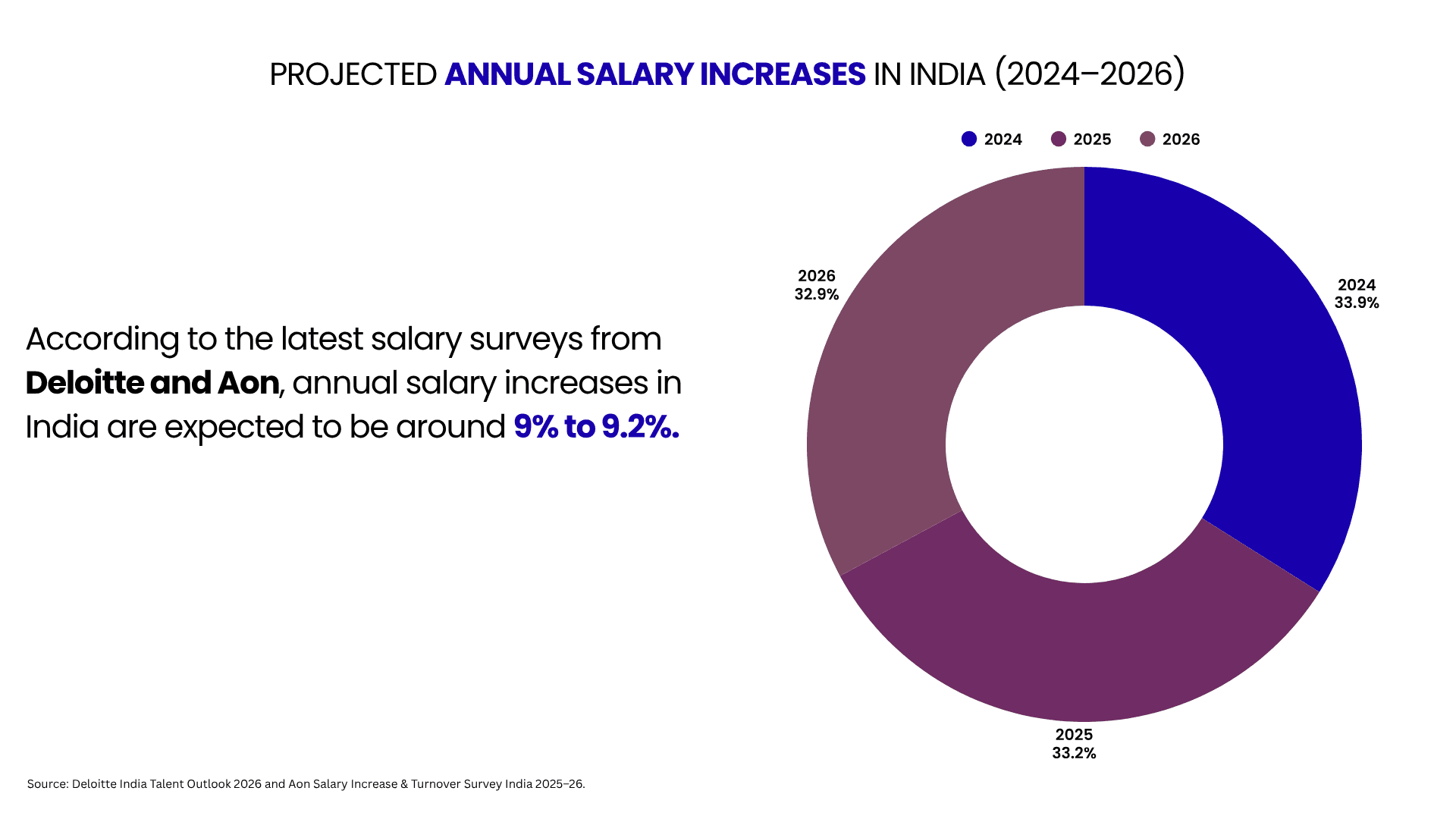
According to the latest salary surveys from Deloitte and Aon, annual salary increases in India are expected to be around 9% to 9.2%.
These numbers apply to employees who stay with their current employer.
Changing jobs is different.
When a company hires from outside, it is usually trying to fill a gap that already exists. It may need someone with specialized skills. It may need a leader for a new team. It may need someone who can solve a problem quickly.
Because of that, companies are often willing to pay more than they would during a normal appraisal cycle.
That is why many professionals see bigger salary increases when switching jobs than they do through annual increments.
How much salary hike when switching jobs is reasonable depends on the role, industry, and demand for your skills.
A professional moving into a similar role may receive a very different offer from someone being hired to build a new function, lead a team, or drive business growth.
That's why there is no single salary hike percentage that applies to everyone.
What Factors Influence Your Salary Hike Percentage?
Many professionals focus on the number they want from a new job.
In reality, employers focus on something else.
They want to know whether hiring you will create enough value to justify the investment.
This is why two candidates with similar experience can receive very different offers.
One candidate may receive a 15% increase.
Another may receive a 40% increase.
The difference often comes down to a handful of factors that influence how employers assess value.
Your Current Compensation Matters
Your current salary plays a bigger role than most people realize.
Imagine two professionals with similar experience and similar skills.
One is already being paid close to market rates.
The other is earning significantly below market.
Even if both apply for the same role, the second candidate may see a much larger increase simply because there is more room for correction.
This is one reason salary hike percentages can be misleading.
A 40% increase may sound impressive, but if a candidate was underpaid to begin with, the new offer may simply bring them closer to market value.
Industry Demand Influences Compensation
Some industries pay more because the demand for talent is higher.
According to Aon's latest Salary Increase and Turnover Survey, sectors such as automotive, engineering design services, and NBFCs are expected to see some of the strongest salary growth in India.
Industry | Salary Increase Outlook |
Automotive | Among the highest projected increases |
Engineering Design Services | Among the highest projected increases |
NBFCs | Among the highest projected increases |
India Overall Average | ~9.2% |
The same principle applies to hiring.
When companies compete for a limited pool of talent, compensation usually increases.
This is one reason professionals working in areas such as AI, cybersecurity, cloud computing, and digital transformation often receive stronger offers than market averages suggest.
Specialized Skills Create Negotiating Power
Not all experience is valued equally.
10 years of experience in a common skill set may attract less attention than five years of experience in a highly sought-after area.
Employers pay premiums for skills that are difficult to find.
The harder it is to replace someone, the more flexibility a company often has when discussing compensation.
This does not apply only to technical roles.
Sales leaders, operations heads, product leaders, and business executives can all command stronger offers when they bring expertise that is difficult to hire for.
Leadership Responsibility Increases Your Value
Salary discussions change as professionals move into leadership positions.
Employers begin looking beyond individual performance.
They want to understand the scale of responsibility.
Questions often include:
How large is the team?
What budget does the person manage?
How much revenue do they influence?
How critical is their role to business growth?
A manager responsible for a team of 5 people will be evaluated differently from a leader responsible for multiple departments, large budgets, or revenue targets.
The scope of responsibility often influences compensation as much as experience.
Business Impact Usually Matters Most
This is the factor many professionals overlook.
Employers rarely pay more because someone has spent a certain number of years in a role.
They pay more when they believe that person can create measurable results.
Can you increase revenue?
Can you reduce costs?
Can you improve productivity?
Can you build stronger teams?
Can you help the business grow faster?
The stronger your answers to those questions, the stronger your position during compensation discussions.
This is why the biggest salary hikes often go to professionals who can clearly connect their experience to business outcomes.
The most successful candidates do not spend their interviews talking about responsibilities.
They spend their interviews talking about results.
And that brings us to an important question.
If business impact matters more than experience alone, how do professionals position themselves to stand out from other candidates and secure larger salary hikes?
That's where the right strategy can make all the difference.
Why Some Professionals Receive Much Larger Salary Hikes Than Others
If two professionals have similar experience, qualifications, and job titles, why does one receive a 15% salary increase while another secures a 50% or even 100% jump?
The answer is not always experience.
And it is rarely “negotiation” alone.
The biggest salary hikes often go to professionals who create more value in the eyes of employers before compensation discussions even begin.
The Salary Hike Myth Most Professionals Believe
Many professionals believe that salary growth is determined at the negotiation table.
In reality, most of it is determined long before an offer is made.
By the time compensation discussions start, employers have already formed an opinion about a candidate's value.
They have already decided whether that person can solve important business problems, lead teams, drive growth, or deliver results.
The stronger that perception, the easier it becomes to justify a larger compensation package.
What Creates Salary Leverage?
Professionals who secure larger salary hikes often have one thing in common.
They create leverage.
That leverage can come from several sources:
A strong professional reputation
Visible expertise in their field
A network that creates referral opportunities
Clear evidence of business impact
Multiple opportunities at the same time
When employers see a candidate as difficult to replace, compensation discussions tend to look very different.
Case study: How Shravan Secured a 100% Salary Hike by Using Nxtjob.ai
Shravan, a General Manager based in Thailand, did not approach his job search like a traditional applicant.
Instead of relying solely on job applications, he focused on increasing his visibility, expanding his network, and demonstrating the business value he could bring to potential employers.
Using strategies that are now built into NxtJob.ai, he positioned himself around outcomes rather than responsibilities.
Networker showed him how to reach out to a recruiter on LinkedIn to identify decision-makers and find warm referral paths.
Influencer reinforced his professional visibility by helping him consistently share insights and establish credibility within his industry.
When opportunities emerged, Pitcher helped shift conversations away from job titles and toward business impact by demonstrating the problems he could solve and the results he could deliver.
By the time compensation discussions began, employers already had a clear understanding of his value.
This created stronger negotiating leverage than a resume alone could provide.
The result was a new opportunity that delivered a 100% increase in compensation.
While every professional's situation is different, the lesson is clear: the largest salary hikes are often created before negotiations begin through stronger visibility, better positioning, and more effective networking.
Hear from Shravan:
How NxtJob.ai Helps Professionals Build Similar Leverage
The professionals who secure the strongest salary hikes rarely rely on negotiation alone.
They become easier to find, easier to trust, and easier to hire.
That process often starts long before an offer reaches the table.
NxtJob.ai helps professionals strengthen the factors that frequently influence compensation the most: visibility, opportunity, positioning, interview performance, and negotiation.
Increase Your Visibility
Many qualified professionals remain invisible to recruiters and hiring managers.
Influencer helps professionals build authority on LinkedIn by turning their experience into consistent, professional content that showcases expertise and industry knowledge.
Networker helps users identify and connect with hiring managers, recruiters, business leaders, alumni, and referral sources who can open doors to new opportunities.
The more visible you become, the more likely opportunities find you.
Create More Opportunities
Salary growth often improves when professionals have more than one opportunity to choose from.
Hunter scans millions of jobs across company career pages, job boards, and hidden opportunities that may never appear in a traditional search.
Nova acts as a career copilot, helping professionals identify the most relevant opportunities and prioritize the actions that can move their job search forward.
More opportunities often create more leverage during compensation discussions.
Position Your Value More Effectively
Many candidates talk about responsibilities.
Top candidates talk about business outcomes.
Pitcher helps professionals create personalized WinDecks that demonstrate how they can solve business problems, create value, and contribute to company goals.
Tailor helps you make an ATS-friendly resume that is customized for each role, showing employers your most relevant achievements
Better positioning often leads to stronger employer interest and stronger offers.
Improve Interview Performance
Even highly qualified professionals can lose opportunities if they struggle to communicate their value during interviews.
Interviewer helps users prepare for interviews through mock interview practice, feedback, and role-specific preparation.
The goal is simple: help professionals communicate their experience, achievements, and leadership impact more effectively.
Strengthen Your Negotiating Position
Negotiation is most effective when it is supported by preparation and market awareness.
Negotiator helps professionals evaluate offers, prepare for compensation discussions, and approach salary conversations with greater confidence.
Instead of focusing only on salary hike percentages, it helps users understand how to communicate value and negotiate the complete compensation package.
Bring Everything Together:
The job search process is rarely one challenge.
It is a series of connected challenges.
Finding opportunities.
Building visibility.
Networking with the right people.
Positioning your value.
Preparing for interviews.
Negotiating the final offer.
Nova helps connect these activities by acting as a central career copilot, guiding professionals toward the next best action throughout their job search journey.
Because in most cases, larger salary hikes are not won in a single negotiation.
They are earned through stronger positioning across the entire process.
How to Negotiate a Higher Salary When Switching Jobs
You cannot get a good hike by following salary negotiation tactics alone.
It is usually the result of preparation, timing, and clear communication.
The goal is not to demand a higher number.
The goal is to help employers understand the value you bring and why that value justifies the compensation you are seeking.
Research Market Compensation Before Discussing Salary
Many professionals enter salary discussions without understanding what the market is willing to pay.
This creates two problems.
Some ask for too little and leave money on the table.
Others ask for unrealistic numbers and damage their credibility.
Before discussing compensation, research salary benchmarks for your role, experience level, location, and industry.
The more informed you are, the stronger your negotiating position becomes.
Focus on Business Impact, Not Just Experience
Employers rarely increase offers because someone has spent a certain number of years in a role.
They increase offers when they believe that person can deliver meaningful results.
Instead of saying:
"I have 12 years of experience."
Show the impact of that experience.
For example:
Revenue growth achieved
Costs reduced
Teams built and managed
Processes improved
New business generated
The more clearly you connect your work to business outcomes, the easier it becomes to justify higher compensation.
Avoid Revealing Your Expected Salary Too Early
One of the most common mistakes candidates make is anchoring themselves too early.
When possible, focus the conversation on the role, expectations, and business challenges before discussing compensation.
This allows employers to evaluate your value first instead of comparing your current salary with their budget.
For a detailed breakdown, read my guide on expected CTC discussions.
Create Multiple Opportunities
Negotiation becomes easier when you have options.
Candidates with multiple interviews or offers often have greater leverage because employers know they may have competing opportunities.
This does not mean creating artificial pressure.
It means building a healthy pipeline of opportunities instead of depending on a single role.
Negotiate the Complete Compensation Package
Salary is only one part of compensation.
Depending on the role, you may also be able to negotiate:
Performance bonuses
Joining bonuses
Retention bonuses
Stock options or equity
Additional leave
Flexible work arrangements
Learning and development budgets
A strong package is not always about the highest base salary. When you begin your final salary negotiation with HR, make sure to keep all of these components on the table.
Remember That Negotiation Starts Before the Offer
Many professionals treat negotiation as the final stage of the hiring process.
In reality, negotiation starts much earlier.
Your visibility.
Your professional network.
Your personal brand.
Your interview performance.
Your ability to communicate business value.
All of these influence how employers perceive your worth long before compensation discussions begin.
That is why the professionals who secure the largest salary hikes often spend more time building leverage than negotiating numbers.
Conclusion
The average salary hike in India provides a useful benchmark, but it should not define your expectations.
The salary increase you receive when changing jobs depends on far more than market averages.
Your industry, skills, leadership experience, business impact, professional visibility, and negotiating position all influence the outcome.
While some professionals may receive a good raise, others secure significantly larger compensation jumps because they create stronger leverage before negotiations begin.
The most successful job seekers do not focus only on salary discussions. They focus on becoming more valuable, more visible, and more difficult to replace.
That process starts long before an offer is made.
Sign up for free on NxtJob.ai to strengthen your positioning, build the right relationships, and clearly communicate business impact and a next high-paying job that your seniority deserves.

As a content writer and SEO strategist, I help turn complex AI job search, career-tech, and growth topics into clear, practical content. At NxtJob.ai, I write to help senior professionals make smarter career moves with clarity and confidence.
Githu Ravikkumar
Creative Strategist & Copywriter
Recent articles

Resume
5 min read
ATS Resume Format: How to Create a Resume That Gets Past Applicant Tracking Systems
Learn how to create an ATS-friendly resume that passes through applicant tracking systems and increases your chances of landing an interview.
Resume
5 min read
ATS Resume Format: How to Create a Resume That Gets Past Applicant Tracking Systems
Learn how to create an ATS-friendly resume that passes through applicant tracking systems and increases your chances of landing an interview.
Resume
5 min read
ATS Resume Format: How to Create a Resume That Gets Past Applicant Tracking Systems
Learn how to create an ATS-friendly resume that passes through applicant tracking systems and increases your chances of landing an interview.
Resume
5 min read
ATS Resume Format: How to Create a Resume That Gets Past Applicant Tracking Systems
Learn how to create an ATS-friendly resume that passes through applicant tracking systems and increases your chances of landing an interview.
Resume
5 min read
ATS Resume Format: How to Create a Resume That Gets Past Applicant Tracking Systems
Learn how to create an ATS-friendly resume that passes through applicant tracking systems and increases your chances of landing an interview.
Resume
5 min read
ATS Resume Format: How to Create a Resume That Gets Past Applicant Tracking Systems
Learn how to create an ATS-friendly resume that passes through applicant tracking systems and increases your chances of landing an interview.
Everything you need to know
Here you can find solutions to all your queries.
What is the average salary hike percentage in India?
How much salary hike should I expect when changing jobs?
Is a 30% salary hike good when switching jobs?
Can I ask for a 50% salary hike when changing jobs?
What factors influence salary hike percentages the most?
Does negotiation alone determine salary growth?
Should I reveal my expected salary early in the hiring process?
Negotiation
10 min read
Beyond the 30% Cap: The Senior Salary Hike Percentage Guide for India
Published Date:
|
Last Modified:
For many professionals, changing jobs is the fastest way to increase compensation.
Yet one question creates more uncertainty than any interview round:
"What salary hike are you expecting?"
Some candidates ask for too little and discover later that the company had a much larger budget.
Others ask for a number that is disconnected from market reality and risk losing credibility during negotiations.
The challenge is that there is no standard answer. A reasonable salary hike percentage depends on your experience, industry, skill set, track record, and the value you can bring to the new employer.
In this guide, we'll look at the average salary hike in India, what professionals can expect when changing jobs, and how experienced candidates position themselves for stronger compensation outcomes.
Executive Summary: Salary Hike Percentage
Key Insight | What It Means |
Annual salary increases in India are projected at around 9%–9.2% | Based on Deloitte and Aon compensation surveys |
Job switches often result in larger compensation increases than annual appraisals | External hiring budgets are typically different from annual increment budgets |
Salary hikes vary significantly based on industry, skills, leadership scope, and business impact | There is no universal benchmark that applies to every professional |
Strong positioning often leads to stronger compensation outcomes | Visibility, reputation, network, and business impact can influence salary discussions |
What Is a Typical Salary Hike Percentage When Changing Jobs?
According to the latest salary surveys from Deloitte and Aon, annual salary increases in India are expected to be around 9% to 9.2%.
These numbers apply to employees who stay with their current employer.
Changing jobs is different.
When a company hires from outside, it is usually trying to fill a gap that already exists. It may need someone with specialized skills. It may need a leader for a new team. It may need someone who can solve a problem quickly.
Because of that, companies are often willing to pay more than they would during a normal appraisal cycle.
That is why many professionals see bigger salary increases when switching jobs than they do through annual increments.
How much salary hike when switching jobs is reasonable depends on the role, industry, and demand for your skills.
A professional moving into a similar role may receive a very different offer from someone being hired to build a new function, lead a team, or drive business growth.
That's why there is no single salary hike percentage that applies to everyone.
What Factors Influence Your Salary Hike Percentage?
Many professionals focus on the number they want from a new job.
In reality, employers focus on something else.
They want to know whether hiring you will create enough value to justify the investment.
This is why two candidates with similar experience can receive very different offers.
One candidate may receive a 15% increase.
Another may receive a 40% increase.
The difference often comes down to a handful of factors that influence how employers assess value.
Your Current Compensation Matters
Your current salary plays a bigger role than most people realize.
Imagine two professionals with similar experience and similar skills.
One is already being paid close to market rates.
The other is earning significantly below market.
Even if both apply for the same role, the second candidate may see a much larger increase simply because there is more room for correction.
This is one reason salary hike percentages can be misleading.
A 40% increase may sound impressive, but if a candidate was underpaid to begin with, the new offer may simply bring them closer to market value.
Industry Demand Influences Compensation
Some industries pay more because the demand for talent is higher.
According to Aon's latest Salary Increase and Turnover Survey, sectors such as automotive, engineering design services, and NBFCs are expected to see some of the strongest salary growth in India.
Industry | Salary Increase Outlook |
Automotive | Among the highest projected increases |
Engineering Design Services | Among the highest projected increases |
NBFCs | Among the highest projected increases |
India Overall Average | ~9.2% |
The same principle applies to hiring.
When companies compete for a limited pool of talent, compensation usually increases.
This is one reason professionals working in areas such as AI, cybersecurity, cloud computing, and digital transformation often receive stronger offers than market averages suggest.
Specialized Skills Create Negotiating Power
Not all experience is valued equally.
10 years of experience in a common skill set may attract less attention than five years of experience in a highly sought-after area.
Employers pay premiums for skills that are difficult to find.
The harder it is to replace someone, the more flexibility a company often has when discussing compensation.
This does not apply only to technical roles.
Sales leaders, operations heads, product leaders, and business executives can all command stronger offers when they bring expertise that is difficult to hire for.
Leadership Responsibility Increases Your Value
Salary discussions change as professionals move into leadership positions.
Employers begin looking beyond individual performance.
They want to understand the scale of responsibility.
Questions often include:
How large is the team?
What budget does the person manage?
How much revenue do they influence?
How critical is their role to business growth?
A manager responsible for a team of 5 people will be evaluated differently from a leader responsible for multiple departments, large budgets, or revenue targets.
The scope of responsibility often influences compensation as much as experience.
Business Impact Usually Matters Most
This is the factor many professionals overlook.
Employers rarely pay more because someone has spent a certain number of years in a role.
They pay more when they believe that person can create measurable results.
Can you increase revenue?
Can you reduce costs?
Can you improve productivity?
Can you build stronger teams?
Can you help the business grow faster?
The stronger your answers to those questions, the stronger your position during compensation discussions.
This is why the biggest salary hikes often go to professionals who can clearly connect their experience to business outcomes.
The most successful candidates do not spend their interviews talking about responsibilities.
They spend their interviews talking about results.
And that brings us to an important question.
If business impact matters more than experience alone, how do professionals position themselves to stand out from other candidates and secure larger salary hikes?
That's where the right strategy can make all the difference.
Why Some Professionals Receive Much Larger Salary Hikes Than Others
If two professionals have similar experience, qualifications, and job titles, why does one receive a 15% salary increase while another secures a 50% or even 100% jump?
The answer is not always experience.
And it is rarely “negotiation” alone.
The biggest salary hikes often go to professionals who create more value in the eyes of employers before compensation discussions even begin.
The Salary Hike Myth Most Professionals Believe
Many professionals believe that salary growth is determined at the negotiation table.
In reality, most of it is determined long before an offer is made.
By the time compensation discussions start, employers have already formed an opinion about a candidate's value.
They have already decided whether that person can solve important business problems, lead teams, drive growth, or deliver results.
The stronger that perception, the easier it becomes to justify a larger compensation package.
What Creates Salary Leverage?
Professionals who secure larger salary hikes often have one thing in common.
They create leverage.
That leverage can come from several sources:
A strong professional reputation
Visible expertise in their field
A network that creates referral opportunities
Clear evidence of business impact
Multiple opportunities at the same time
When employers see a candidate as difficult to replace, compensation discussions tend to look very different.
Case study: How Shravan Secured a 100% Salary Hike by Using Nxtjob.ai
Shravan, a General Manager based in Thailand, did not approach his job search like a traditional applicant.
Instead of relying solely on job applications, he focused on increasing his visibility, expanding his network, and demonstrating the business value he could bring to potential employers.
Using strategies that are now built into NxtJob.ai, he positioned himself around outcomes rather than responsibilities.
Networker showed him how to reach out to a recruiter on LinkedIn to identify decision-makers and find warm referral paths.
Influencer reinforced his professional visibility by helping him consistently share insights and establish credibility within his industry.
When opportunities emerged, Pitcher helped shift conversations away from job titles and toward business impact by demonstrating the problems he could solve and the results he could deliver.
By the time compensation discussions began, employers already had a clear understanding of his value.
This created stronger negotiating leverage than a resume alone could provide.
The result was a new opportunity that delivered a 100% increase in compensation.
While every professional's situation is different, the lesson is clear: the largest salary hikes are often created before negotiations begin through stronger visibility, better positioning, and more effective networking.
Hear from Shravan:
How NxtJob.ai Helps Professionals Build Similar Leverage
The professionals who secure the strongest salary hikes rarely rely on negotiation alone.
They become easier to find, easier to trust, and easier to hire.
That process often starts long before an offer reaches the table.
NxtJob.ai helps professionals strengthen the factors that frequently influence compensation the most: visibility, opportunity, positioning, interview performance, and negotiation.
Increase Your Visibility
Many qualified professionals remain invisible to recruiters and hiring managers.
Influencer helps professionals build authority on LinkedIn by turning their experience into consistent, professional content that showcases expertise and industry knowledge.
Networker helps users identify and connect with hiring managers, recruiters, business leaders, alumni, and referral sources who can open doors to new opportunities.
The more visible you become, the more likely opportunities find you.
Create More Opportunities
Salary growth often improves when professionals have more than one opportunity to choose from.
Hunter scans millions of jobs across company career pages, job boards, and hidden opportunities that may never appear in a traditional search.
Nova acts as a career copilot, helping professionals identify the most relevant opportunities and prioritize the actions that can move their job search forward.
More opportunities often create more leverage during compensation discussions.
Position Your Value More Effectively
Many candidates talk about responsibilities.
Top candidates talk about business outcomes.
Pitcher helps professionals create personalized WinDecks that demonstrate how they can solve business problems, create value, and contribute to company goals.
Tailor helps you make an ATS-friendly resume that is customized for each role, showing employers your most relevant achievements
Better positioning often leads to stronger employer interest and stronger offers.
Improve Interview Performance
Even highly qualified professionals can lose opportunities if they struggle to communicate their value during interviews.
Interviewer helps users prepare for interviews through mock interview practice, feedback, and role-specific preparation.
The goal is simple: help professionals communicate their experience, achievements, and leadership impact more effectively.
Strengthen Your Negotiating Position
Negotiation is most effective when it is supported by preparation and market awareness.
Negotiator helps professionals evaluate offers, prepare for compensation discussions, and approach salary conversations with greater confidence.
Instead of focusing only on salary hike percentages, it helps users understand how to communicate value and negotiate the complete compensation package.
Bring Everything Together:
The job search process is rarely one challenge.
It is a series of connected challenges.
Finding opportunities.
Building visibility.
Networking with the right people.
Positioning your value.
Preparing for interviews.
Negotiating the final offer.
Nova helps connect these activities by acting as a central career copilot, guiding professionals toward the next best action throughout their job search journey.
Because in most cases, larger salary hikes are not won in a single negotiation.
They are earned through stronger positioning across the entire process.
How to Negotiate a Higher Salary When Switching Jobs
You cannot get a good hike by following salary negotiation tactics alone.
It is usually the result of preparation, timing, and clear communication.
The goal is not to demand a higher number.
The goal is to help employers understand the value you bring and why that value justifies the compensation you are seeking.
Research Market Compensation Before Discussing Salary
Many professionals enter salary discussions without understanding what the market is willing to pay.
This creates two problems.
Some ask for too little and leave money on the table.
Others ask for unrealistic numbers and damage their credibility.
Before discussing compensation, research salary benchmarks for your role, experience level, location, and industry.
The more informed you are, the stronger your negotiating position becomes.
Focus on Business Impact, Not Just Experience
Employers rarely increase offers because someone has spent a certain number of years in a role.
They increase offers when they believe that person can deliver meaningful results.
Instead of saying:
"I have 12 years of experience."
Show the impact of that experience.
For example:
Revenue growth achieved
Costs reduced
Teams built and managed
Processes improved
New business generated
The more clearly you connect your work to business outcomes, the easier it becomes to justify higher compensation.
Avoid Revealing Your Expected Salary Too Early
One of the most common mistakes candidates make is anchoring themselves too early.
When possible, focus the conversation on the role, expectations, and business challenges before discussing compensation.
This allows employers to evaluate your value first instead of comparing your current salary with their budget.
For a detailed breakdown, read my guide on expected CTC discussions.
Create Multiple Opportunities
Negotiation becomes easier when you have options.
Candidates with multiple interviews or offers often have greater leverage because employers know they may have competing opportunities.
This does not mean creating artificial pressure.
It means building a healthy pipeline of opportunities instead of depending on a single role.
Negotiate the Complete Compensation Package
Salary is only one part of compensation.
Depending on the role, you may also be able to negotiate:
Performance bonuses
Joining bonuses
Retention bonuses
Stock options or equity
Additional leave
Flexible work arrangements
Learning and development budgets
A strong package is not always about the highest base salary. When you begin your final salary negotiation with HR, make sure to keep all of these components on the table.
Remember That Negotiation Starts Before the Offer
Many professionals treat negotiation as the final stage of the hiring process.
In reality, negotiation starts much earlier.
Your visibility.
Your professional network.
Your personal brand.
Your interview performance.
Your ability to communicate business value.
All of these influence how employers perceive your worth long before compensation discussions begin.
That is why the professionals who secure the largest salary hikes often spend more time building leverage than negotiating numbers.
Conclusion
The average salary hike in India provides a useful benchmark, but it should not define your expectations.
The salary increase you receive when changing jobs depends on far more than market averages.
Your industry, skills, leadership experience, business impact, professional visibility, and negotiating position all influence the outcome.
While some professionals may receive a good raise, others secure significantly larger compensation jumps because they create stronger leverage before negotiations begin.
The most successful job seekers do not focus only on salary discussions. They focus on becoming more valuable, more visible, and more difficult to replace.
That process starts long before an offer is made.
Sign up for free on NxtJob.ai to strengthen your positioning, build the right relationships, and clearly communicate business impact and a next high-paying job that your seniority deserves.
Table of content

Negotiation
Expected CTC: How to Answer Salary Expectations As a Senior Professional
Learn how to answer the expected CTC question. Avoid early anchoring, handling HR pushback, and getting a fair salary offer.

Negotiation
Salary Negotiation Tactics: Why Senior Leaders Must Never Name a Number First
Learn advanced salary negotiation tactics to bypass HR budget caps, reframe your current CTC, and maximize your executive equity.
As a content writer and SEO strategist, I help turn complex AI job search, career-tech, and growth topics into clear, practical content. At NxtJob.ai, I write to help senior professionals make smarter career moves with clarity and confidence.
Githu Ravikkumar
Creative Strategist & Copywriter
What is the average salary hike percentage in India?
How much salary hike should I expect when changing jobs?
Is a 30% salary hike good when switching jobs?
Can I ask for a 50% salary hike when changing jobs?
What factors influence salary hike percentages the most?
Does negotiation alone determine salary growth?
Should I reveal my expected salary early in the hiring process?
Everything you need to know
Here you can find solutions to all your queries.
Negotiation
10 min read
Beyond the 30% Cap: The Senior Salary Hike Percentage Guide for India
Published Date:
|
Last Modified:
For many professionals, changing jobs is the fastest way to increase compensation.
Yet one question creates more uncertainty than any interview round:
"What salary hike are you expecting?"
Some candidates ask for too little and discover later that the company had a much larger budget.
Others ask for a number that is disconnected from market reality and risk losing credibility during negotiations.
The challenge is that there is no standard answer. A reasonable salary hike percentage depends on your experience, industry, skill set, track record, and the value you can bring to the new employer.
In this guide, we'll look at the average salary hike in India, what professionals can expect when changing jobs, and how experienced candidates position themselves for stronger compensation outcomes.
Executive Summary: Salary Hike Percentage
Key Insight | What It Means |
Annual salary increases in India are projected at around 9%–9.2% | Based on Deloitte and Aon compensation surveys |
Job switches often result in larger compensation increases than annual appraisals | External hiring budgets are typically different from annual increment budgets |
Salary hikes vary significantly based on industry, skills, leadership scope, and business impact | There is no universal benchmark that applies to every professional |
Strong positioning often leads to stronger compensation outcomes | Visibility, reputation, network, and business impact can influence salary discussions |
What Is a Typical Salary Hike Percentage When Changing Jobs?
According to the latest salary surveys from Deloitte and Aon, annual salary increases in India are expected to be around 9% to 9.2%.
These numbers apply to employees who stay with their current employer.
Changing jobs is different.
When a company hires from outside, it is usually trying to fill a gap that already exists. It may need someone with specialized skills. It may need a leader for a new team. It may need someone who can solve a problem quickly.
Because of that, companies are often willing to pay more than they would during a normal appraisal cycle.
That is why many professionals see bigger salary increases when switching jobs than they do through annual increments.
How much salary hike when switching jobs is reasonable depends on the role, industry, and demand for your skills.
A professional moving into a similar role may receive a very different offer from someone being hired to build a new function, lead a team, or drive business growth.
That's why there is no single salary hike percentage that applies to everyone.
What Factors Influence Your Salary Hike Percentage?
Many professionals focus on the number they want from a new job.
In reality, employers focus on something else.
They want to know whether hiring you will create enough value to justify the investment.
This is why two candidates with similar experience can receive very different offers.
One candidate may receive a 15% increase.
Another may receive a 40% increase.
The difference often comes down to a handful of factors that influence how employers assess value.
Your Current Compensation Matters
Your current salary plays a bigger role than most people realize.
Imagine two professionals with similar experience and similar skills.
One is already being paid close to market rates.
The other is earning significantly below market.
Even if both apply for the same role, the second candidate may see a much larger increase simply because there is more room for correction.
This is one reason salary hike percentages can be misleading.
A 40% increase may sound impressive, but if a candidate was underpaid to begin with, the new offer may simply bring them closer to market value.
Industry Demand Influences Compensation
Some industries pay more because the demand for talent is higher.
According to Aon's latest Salary Increase and Turnover Survey, sectors such as automotive, engineering design services, and NBFCs are expected to see some of the strongest salary growth in India.
Industry | Salary Increase Outlook |
Automotive | Among the highest projected increases |
Engineering Design Services | Among the highest projected increases |
NBFCs | Among the highest projected increases |
India Overall Average | ~9.2% |
The same principle applies to hiring.
When companies compete for a limited pool of talent, compensation usually increases.
This is one reason professionals working in areas such as AI, cybersecurity, cloud computing, and digital transformation often receive stronger offers than market averages suggest.
Specialized Skills Create Negotiating Power
Not all experience is valued equally.
10 years of experience in a common skill set may attract less attention than five years of experience in a highly sought-after area.
Employers pay premiums for skills that are difficult to find.
The harder it is to replace someone, the more flexibility a company often has when discussing compensation.
This does not apply only to technical roles.
Sales leaders, operations heads, product leaders, and business executives can all command stronger offers when they bring expertise that is difficult to hire for.
Leadership Responsibility Increases Your Value
Salary discussions change as professionals move into leadership positions.
Employers begin looking beyond individual performance.
They want to understand the scale of responsibility.
Questions often include:
How large is the team?
What budget does the person manage?
How much revenue do they influence?
How critical is their role to business growth?
A manager responsible for a team of 5 people will be evaluated differently from a leader responsible for multiple departments, large budgets, or revenue targets.
The scope of responsibility often influences compensation as much as experience.
Business Impact Usually Matters Most
This is the factor many professionals overlook.
Employers rarely pay more because someone has spent a certain number of years in a role.
They pay more when they believe that person can create measurable results.
Can you increase revenue?
Can you reduce costs?
Can you improve productivity?
Can you build stronger teams?
Can you help the business grow faster?
The stronger your answers to those questions, the stronger your position during compensation discussions.
This is why the biggest salary hikes often go to professionals who can clearly connect their experience to business outcomes.
The most successful candidates do not spend their interviews talking about responsibilities.
They spend their interviews talking about results.
And that brings us to an important question.
If business impact matters more than experience alone, how do professionals position themselves to stand out from other candidates and secure larger salary hikes?
That's where the right strategy can make all the difference.
Why Some Professionals Receive Much Larger Salary Hikes Than Others
If two professionals have similar experience, qualifications, and job titles, why does one receive a 15% salary increase while another secures a 50% or even 100% jump?
The answer is not always experience.
And it is rarely “negotiation” alone.
The biggest salary hikes often go to professionals who create more value in the eyes of employers before compensation discussions even begin.
The Salary Hike Myth Most Professionals Believe
Many professionals believe that salary growth is determined at the negotiation table.
In reality, most of it is determined long before an offer is made.
By the time compensation discussions start, employers have already formed an opinion about a candidate's value.
They have already decided whether that person can solve important business problems, lead teams, drive growth, or deliver results.
The stronger that perception, the easier it becomes to justify a larger compensation package.
What Creates Salary Leverage?
Professionals who secure larger salary hikes often have one thing in common.
They create leverage.
That leverage can come from several sources:
A strong professional reputation
Visible expertise in their field
A network that creates referral opportunities
Clear evidence of business impact
Multiple opportunities at the same time
When employers see a candidate as difficult to replace, compensation discussions tend to look very different.
Case study: How Shravan Secured a 100% Salary Hike by Using Nxtjob.ai
Shravan, a General Manager based in Thailand, did not approach his job search like a traditional applicant.
Instead of relying solely on job applications, he focused on increasing his visibility, expanding his network, and demonstrating the business value he could bring to potential employers.
Using strategies that are now built into NxtJob.ai, he positioned himself around outcomes rather than responsibilities.
Networker showed him how to reach out to a recruiter on LinkedIn to identify decision-makers and find warm referral paths.
Influencer reinforced his professional visibility by helping him consistently share insights and establish credibility within his industry.
When opportunities emerged, Pitcher helped shift conversations away from job titles and toward business impact by demonstrating the problems he could solve and the results he could deliver.
By the time compensation discussions began, employers already had a clear understanding of his value.
This created stronger negotiating leverage than a resume alone could provide.
The result was a new opportunity that delivered a 100% increase in compensation.
While every professional's situation is different, the lesson is clear: the largest salary hikes are often created before negotiations begin through stronger visibility, better positioning, and more effective networking.
Hear from Shravan:
How NxtJob.ai Helps Professionals Build Similar Leverage
The professionals who secure the strongest salary hikes rarely rely on negotiation alone.
They become easier to find, easier to trust, and easier to hire.
That process often starts long before an offer reaches the table.
NxtJob.ai helps professionals strengthen the factors that frequently influence compensation the most: visibility, opportunity, positioning, interview performance, and negotiation.
Increase Your Visibility
Many qualified professionals remain invisible to recruiters and hiring managers.
Influencer helps professionals build authority on LinkedIn by turning their experience into consistent, professional content that showcases expertise and industry knowledge.
Networker helps users identify and connect with hiring managers, recruiters, business leaders, alumni, and referral sources who can open doors to new opportunities.
The more visible you become, the more likely opportunities find you.
Create More Opportunities
Salary growth often improves when professionals have more than one opportunity to choose from.
Hunter scans millions of jobs across company career pages, job boards, and hidden opportunities that may never appear in a traditional search.
Nova acts as a career copilot, helping professionals identify the most relevant opportunities and prioritize the actions that can move their job search forward.
More opportunities often create more leverage during compensation discussions.
Position Your Value More Effectively
Many candidates talk about responsibilities.
Top candidates talk about business outcomes.
Pitcher helps professionals create personalized WinDecks that demonstrate how they can solve business problems, create value, and contribute to company goals.
Tailor helps you make an ATS-friendly resume that is customized for each role, showing employers your most relevant achievements
Better positioning often leads to stronger employer interest and stronger offers.
Improve Interview Performance
Even highly qualified professionals can lose opportunities if they struggle to communicate their value during interviews.
Interviewer helps users prepare for interviews through mock interview practice, feedback, and role-specific preparation.
The goal is simple: help professionals communicate their experience, achievements, and leadership impact more effectively.
Strengthen Your Negotiating Position
Negotiation is most effective when it is supported by preparation and market awareness.
Negotiator helps professionals evaluate offers, prepare for compensation discussions, and approach salary conversations with greater confidence.
Instead of focusing only on salary hike percentages, it helps users understand how to communicate value and negotiate the complete compensation package.
Bring Everything Together:
The job search process is rarely one challenge.
It is a series of connected challenges.
Finding opportunities.
Building visibility.
Networking with the right people.
Positioning your value.
Preparing for interviews.
Negotiating the final offer.
Nova helps connect these activities by acting as a central career copilot, guiding professionals toward the next best action throughout their job search journey.
Because in most cases, larger salary hikes are not won in a single negotiation.
They are earned through stronger positioning across the entire process.
How to Negotiate a Higher Salary When Switching Jobs
You cannot get a good hike by following salary negotiation tactics alone.
It is usually the result of preparation, timing, and clear communication.
The goal is not to demand a higher number.
The goal is to help employers understand the value you bring and why that value justifies the compensation you are seeking.
Research Market Compensation Before Discussing Salary
Many professionals enter salary discussions without understanding what the market is willing to pay.
This creates two problems.
Some ask for too little and leave money on the table.
Others ask for unrealistic numbers and damage their credibility.
Before discussing compensation, research salary benchmarks for your role, experience level, location, and industry.
The more informed you are, the stronger your negotiating position becomes.
Focus on Business Impact, Not Just Experience
Employers rarely increase offers because someone has spent a certain number of years in a role.
They increase offers when they believe that person can deliver meaningful results.
Instead of saying:
"I have 12 years of experience."
Show the impact of that experience.
For example:
Revenue growth achieved
Costs reduced
Teams built and managed
Processes improved
New business generated
The more clearly you connect your work to business outcomes, the easier it becomes to justify higher compensation.
Avoid Revealing Your Expected Salary Too Early
One of the most common mistakes candidates make is anchoring themselves too early.
When possible, focus the conversation on the role, expectations, and business challenges before discussing compensation.
This allows employers to evaluate your value first instead of comparing your current salary with their budget.
For a detailed breakdown, read my guide on expected CTC discussions.
Create Multiple Opportunities
Negotiation becomes easier when you have options.
Candidates with multiple interviews or offers often have greater leverage because employers know they may have competing opportunities.
This does not mean creating artificial pressure.
It means building a healthy pipeline of opportunities instead of depending on a single role.
Negotiate the Complete Compensation Package
Salary is only one part of compensation.
Depending on the role, you may also be able to negotiate:
Performance bonuses
Joining bonuses
Retention bonuses
Stock options or equity
Additional leave
Flexible work arrangements
Learning and development budgets
A strong package is not always about the highest base salary. When you begin your final salary negotiation with HR, make sure to keep all of these components on the table.
Remember That Negotiation Starts Before the Offer
Many professionals treat negotiation as the final stage of the hiring process.
In reality, negotiation starts much earlier.
Your visibility.
Your professional network.
Your personal brand.
Your interview performance.
Your ability to communicate business value.
All of these influence how employers perceive your worth long before compensation discussions begin.
That is why the professionals who secure the largest salary hikes often spend more time building leverage than negotiating numbers.
Conclusion
The average salary hike in India provides a useful benchmark, but it should not define your expectations.
The salary increase you receive when changing jobs depends on far more than market averages.
Your industry, skills, leadership experience, business impact, professional visibility, and negotiating position all influence the outcome.
While some professionals may receive a good raise, others secure significantly larger compensation jumps because they create stronger leverage before negotiations begin.
The most successful job seekers do not focus only on salary discussions. They focus on becoming more valuable, more visible, and more difficult to replace.
That process starts long before an offer is made.
Sign up for free on NxtJob.ai to strengthen your positioning, build the right relationships, and clearly communicate business impact and a next high-paying job that your seniority deserves.
Table of content
Negotiation
Expected CTC: How to Answer Salary Expectations As a Senior Professional
Learn how to answer the expected CTC question. Avoid early anchoring, handling HR pushback, and getting a fair salary offer.
Negotiation
Salary Negotiation Tactics: Why Senior Leaders Must Never Name a Number First
Learn advanced salary negotiation tactics to bypass HR budget caps, reframe your current CTC, and maximize your executive equity.
As a content writer and SEO strategist, I help turn complex AI job search, career-tech, and growth topics into clear, practical content. At NxtJob.ai, I write to help senior professionals make smarter career moves with clarity and confidence.
Githu Ravikkumar
Creative Strategist & Copywriter
Recent articles

Resume
5 min read
How to Reach Out to a Recruiter on LinkedIn: A Senior Professional’s Guide
Discover how senior professionals can use recruiter outreach, referrals, and networking to unlock better career opportunities on LinkedIn.
Resume
5 min read
Salary Negotiation With HR: How Senior Professionals Should Handle the Conversation
Learn how senior professionals can handle salary negotiation with HR, respond to pushback, protect their value, and avoid underselling themselves.
Resume
5 min read
How to Make an ATS-Friendly Resume: Format, Tips, and Examples for Experienced Professionals
Learn how to make an ATS-friendly resume with the right format, keywords, structure, and role-specific details for experienced professionals.
Resume
5 min read
How to Reach Out to a Recruiter on LinkedIn: A Senior Professional’s Guide
Discover how senior professionals can use recruiter outreach, referrals, and networking to unlock better career opportunities on LinkedIn.
Resume
5 min read
Salary Negotiation With HR: How Senior Professionals Should Handle the Conversation
Learn how senior professionals can handle salary negotiation with HR, respond to pushback, protect their value, and avoid underselling themselves.
Everything you need to know
Here you can find solutions to all your queries.
What is the average salary hike percentage in India?
How much salary hike should I expect when changing jobs?
Is a 30% salary hike good when switching jobs?
Can I ask for a 50% salary hike when changing jobs?
What factors influence salary hike percentages the most?
Does negotiation alone determine salary growth?
Should I reveal my expected salary early in the hiring process?
Join the Revolution
Your AI career copilot to land you top jobs in under 90 days.
A Pinnacle Shift Company
by Richik Sinha Roy
Join the Revolution
Your AI career copilot to land you top jobs in under 90 days.
Join the Revolution
Your AI career copilot to land you top jobs in under 90 days.