
Interview
15 min read
Salary Negotiation With HR: How Senior Professionals Should Handle the Conversation
Published Date:
|
Last Modified:
You don’t lose salary negotiation with HR only because the company has a lower budget.
You often lose it because you enter the conversation without a clear number, weak proof, or a calm response to pushback.
For senior professionals, salary negotiation is not just about asking for more money. It is about proving business value, showing market fit, and making sure your next offer reflects the level of ownership you bring.
When you have 15+ years of experience, your current CTC should not become the ceiling for your next move.
This guide will show you how to handle salary negotiation with HR, what to say, what to avoid, how to respond when HR pushes back, and how to prepare before the conversation so you don’t undersell yourself.
Salary Negotiation With HR for Senior Professionals
Salary negotiation with HR is not a fight. It is a business conversation about role scope, market value, and the impact you are expected to deliver.
According to Aon India’s Annual Salary Increase and Turnover Survey 2025 to 2026, salaries in India are projected to rise by 9.1% in 2026, up from 8.9% in 2025. The survey covered more than 1,400 organizations across 45 industries.
Prepare your expected salary range before the HR call.
Tie your ask to business impact, not only years of experience.
Ask for the full compensation structure before reacting.
Treat HR pushback as part of the process, not rejection.
Don’t let current CTC become the only benchmark for your next offer.
A senior professional should not walk into a salary discussion hoping the company “does the right thing.” You need your number, your proof, and your response to the most common objections.
What Salary Negotiation With HR Really Means at Senior Levels
At junior levels, salary negotiation often revolves around one question: “How much hike can I get?” At senior levels, that question is too small.
When HR discusses compensation for a senior role, they’re not only thinking about your current CTC. They’re also looking at internal salary bands, market benchmarks, role scope, leadership expectations, budget limits, team structure, and how badly the business needs your skill set.
HR is not only checking your expected salary
HR wants to know whether your expectations fit the company’s budget. That part is obvious.
But HR is also checking how you think about your own value. If you give a number without context, HR may treat it like a demand. If you explain the number through role scope, business outcomes, and market range, it becomes a professional case.
Imagine you’re interviewing for a VP Sales role. If you say, “I’m expecting a 40% hike,” that gives HR very little to work with.
But if you say, “Given the revenue ownership, team size, regional coverage, and my experience scaling similar sales teams, I’m looking at a range closer to X,” you move the conversation from personal expectation to business value.
They are testing clarity, confidence, and role fit
Senior hiring has more risk than junior hiring. A wrong senior hire can affect teams, budgets,
clients, strategy, and delivery.
That is why salary negotiation with HR is also a signal. It shows how clearly you understand the role, how calmly you handle pressure, and whether you can make a business case without sounding defensive.
This does not mean you need to be aggressive. It means you need to be prepared.
Why senior professionals cannot negotiate like freshers
Freshers often negotiate from potential. Senior professionals negotiate from proof.
Your strongest position is not “I have 15 years of experience.” Many people have 15 years of experience. Your stronger position is what those 15 years have produced.
Did you grow revenue? Reduce cost? Build teams? Fix broken processes? Open new markets? Improve delivery? Lead cross-functional work? Handle large clients? Own budgets?
That proof matters more than tenure. Once you understand that, the next question becomes clear: why do experienced professionals still undersell themselves?
Why Senior Professionals Undersell Themselves During Salary Discussions
Many senior professionals lose money before HR even shares the offer.
They enter the call with weak anchors, unclear proof, or too much dependence on current CTC. That gives HR room to frame the conversation around percentage hike instead of role value.
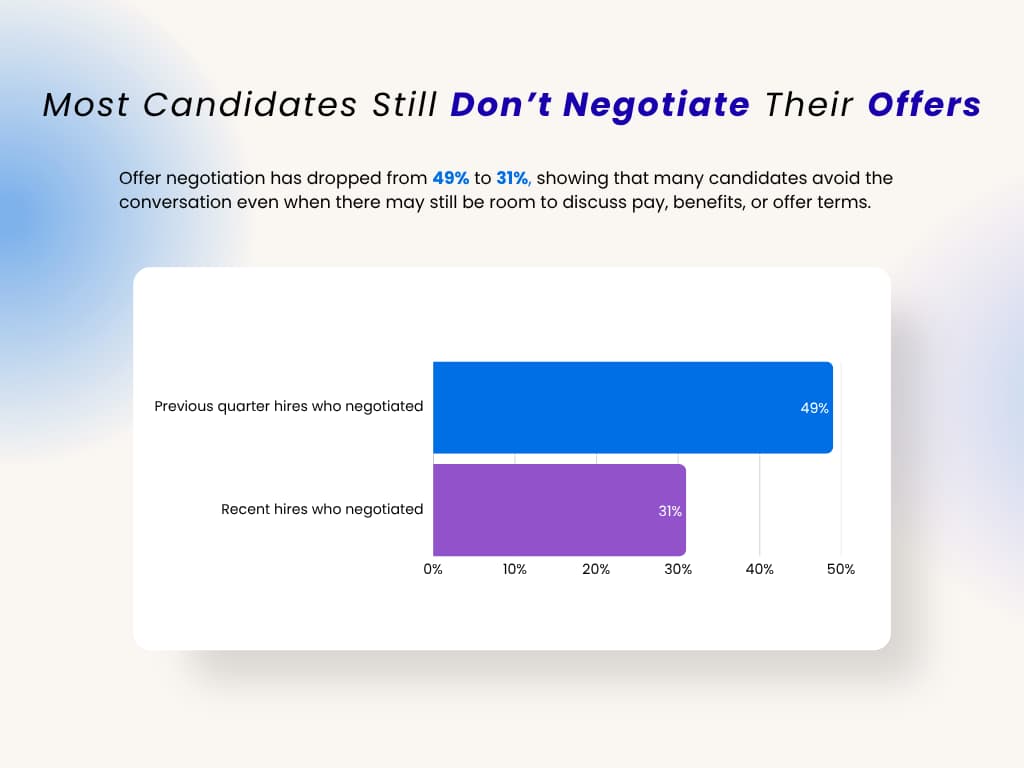
A 2025 Wall Street Journal report citing ZipRecruiter survey data said only 31% of recent hires negotiated their offers, down from 49% in the previous quarter. The report also noted that many candidates avoid negotiation because they feel tired after long hiring processes or fear losing the offer.
They anchor too closely to current CTC
Current CTC is a reference point. It should not become your ceiling.
If you are moving into a larger role, handling a bigger team, taking on revenue ownership, or shifting into a high-demand function, your past pay may not reflect your future value.
This is where negotiating with HR on salary gets tricky. HR may ask for your current CTC because it helps them place you inside a budget range. But if the role is larger than your current role, you should not let the discussion stop there.
A better frame is:
“My current CTC is one reference point, but I’d like to align this discussion with the role scope, market range, and the level of responsibility expected.”
That sentence does not avoid the topic. It expands the frame.
They talk about years of experience instead of business value
Years of experience can open the door, but outcomes strengthen your ask.
Saying “I have 18 years of experience” is weaker than saying, “I’ve led a 40-member team, handled ₹X crore in revenue responsibility, and improved operating margins by X% in my last role.”
The second version gives HR something concrete to discuss with the hiring manager.
They enter the call without a walk-away number
A senior professional should enter the conversation with three numbers:
Ideal number
Acceptable number
Walk-away number
Without these, you may react emotionally to the first offer. You may accept too fast, ask too vaguely, or reject too sharply.
Your walk-away number is not about ego. It protects you from accepting a role that creates regret six months later.
They treat HR pushback as rejection
HR saying “this is our budget” does not always mean the conversation is over.
Sometimes fixed pay is tight, but joining bonus, variable pay, title, review timeline, relocation support, or flexibility may still be open. The problem is many candidates panic after the first no.
Negotiation works better when you stay calm enough to ask the next useful question.
How NxtJob.ai Negotiator Helps You Negotiate Salary with HR
The hard part about salary negotiation is not only what you say. It is what you prepare before you say it.
By the time HR shares an offer, the company has already formed a view of your value. That view comes from your resume, your interview answers, your role fit, your seniority, your proof of impact, and how clearly you have positioned yourself through the hiring process.
This is why salary negotiation cannot be treated as one isolated call at the end. For senior professionals, it has to be part of the full job search system.
Reuters reported that TeamLease is currently able to fill only about 30% of client openings because of mismatches in salary expectations, location preferences, and required skills.
It helps you define your salary range before pressure hits
Many senior professionals know they want a better offer, but they do not know how to set the right range.
Negotiator helps you think through:
your current CTC
your target role
your expected salary range
your walk-away number
your business impact
the kind of pushback HR may use
This matters because salary pressure often appears suddenly. HR may ask for your expected CTC during screening, before you have fully understood the role. If you are not prepared, you may anchor too low.
It helps you connect your ask to business impact
A weak salary ask sounds like this:
“I want this much because I have 15 years of experience.”
A stronger ask sounds like this:
“Given the role scope, expected ownership, and my experience leading similar business outcomes, I believe this range is fair.”
Negotiator helps you move from a personal number to a business-backed number.
That shift matters. HR can push back on a random hike. It is harder to dismiss a clear case tied to role scope, market range, and proof of impact.
It helps you prepare for HR pushback
Most salary conversations have predictable pushback.
HR may say:
“This is our fixed budget.”
“Your current CTC is lower.”
“We cannot offer that hike.”
“Let us revisit this after six months.”
“Other candidates are available in this range.”
The problem is not that HR says these things. The problem is that many candidates hear them for the first time during the call.
Negotiator helps you prepare calm, clear responses before the pressure starts.
It supports your wider senior job search strategy
Your negotiation power improves when your entire job search is stronger.
If you know how to make an ATS-friendly resume that shows business impact, your interviews prove senior judgment, your outreach creates better access, and your target roles match your value, the salary conversation becomes easier to defend.
That is the real point. Salary negotiation with HR should not depend on one clever line. It should be supported by your positioning across the full hiring journey.
How to Practice Salary Negotiation With NxtJob.ai
Here’s how a senior professional can use NxtJob.ai to practice salary negotiation before speaking to HR.
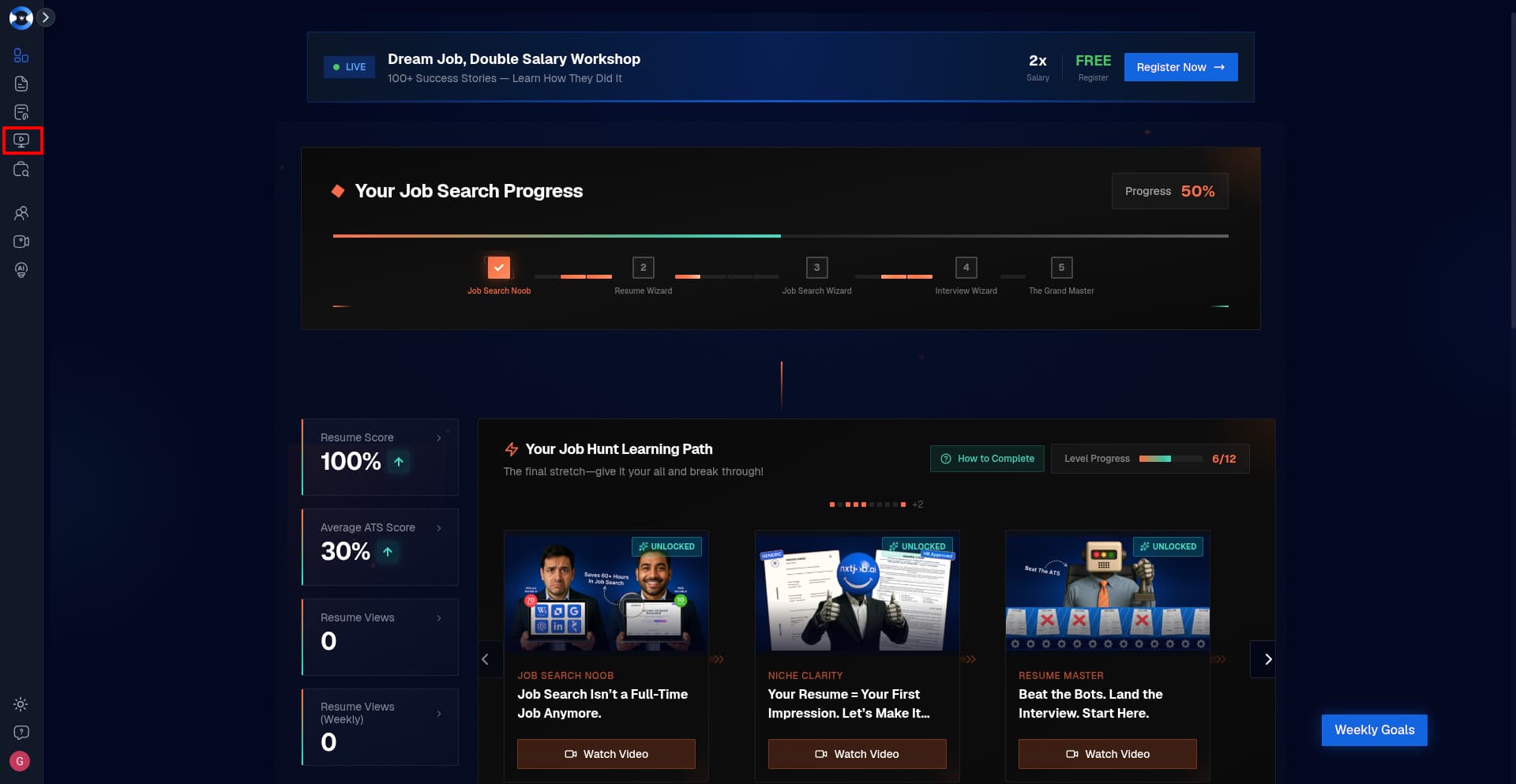
Open the Interviewer sectionFrom your NxtJob.ai dashboard, click the interview icon on the left sidebar. This opens the interview practice area.
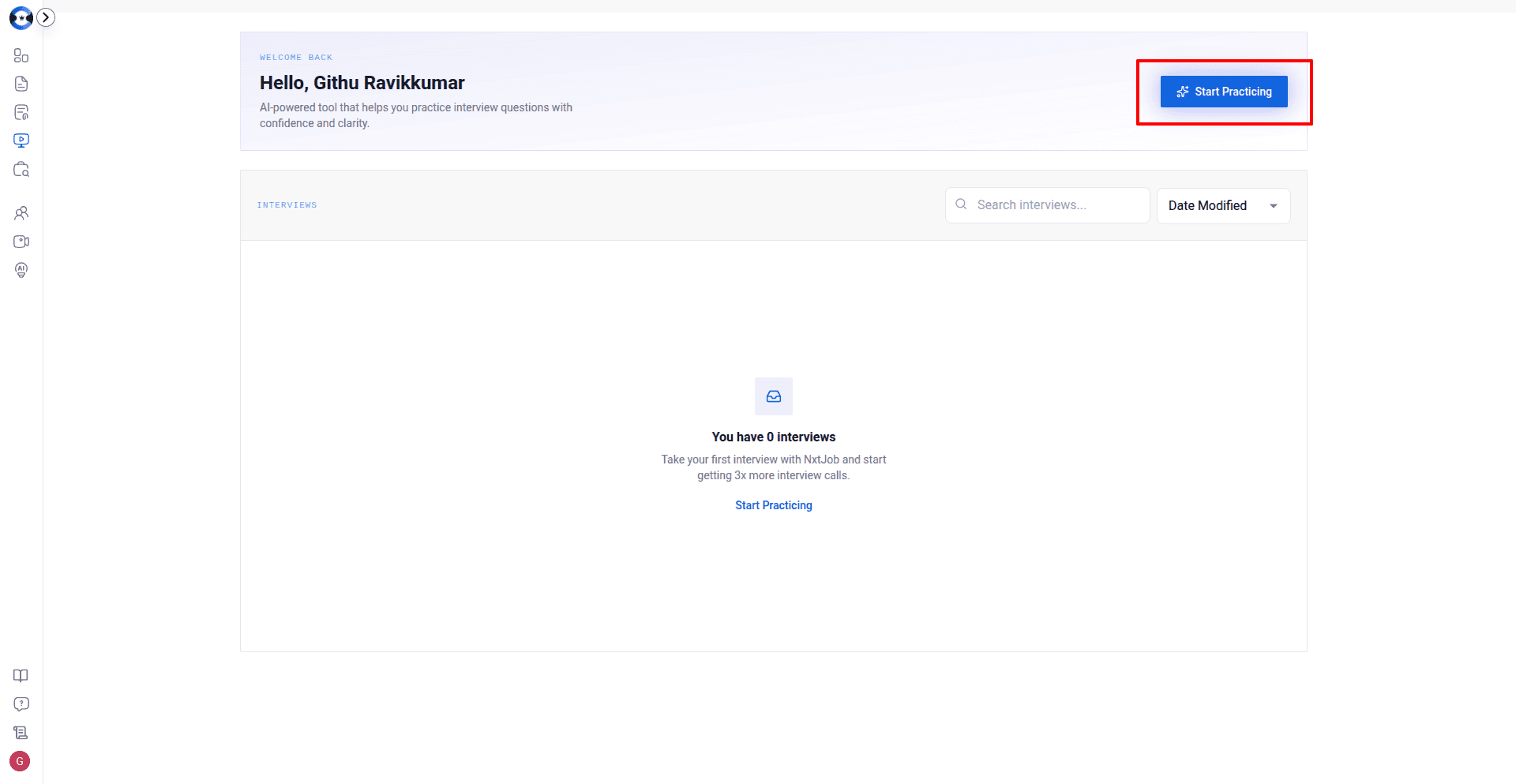
Click “Start Practicing”
Select the Start Practicing button to begin a new practice session.
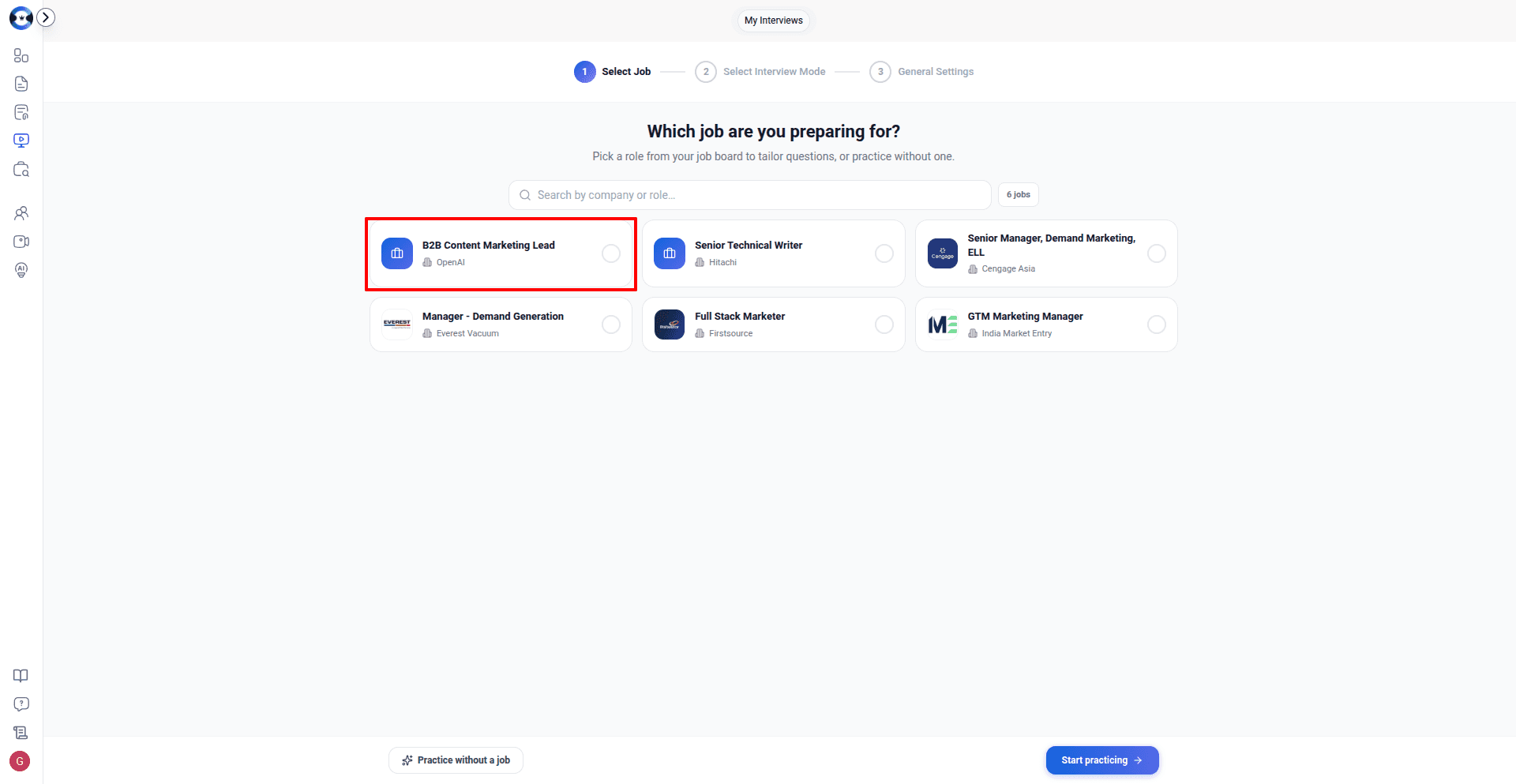
Choose the job you are preparing for
Pick the role from your saved job list. This helps NxtJob.ai tailor the questions to the role, company, and job context. You can also choose to practice without a job.
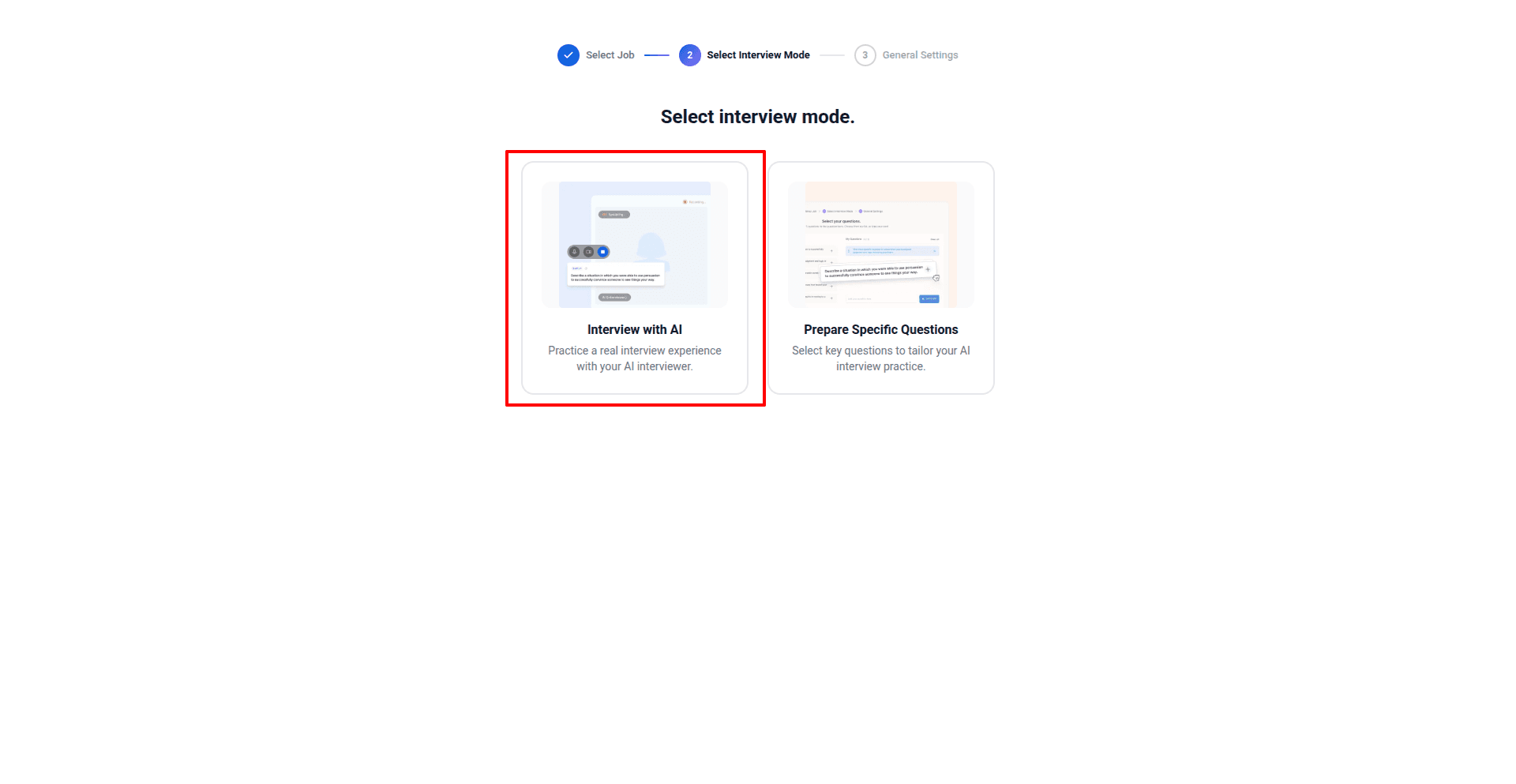
Select the interview mode
Choose the type of interview you want to practice. For salary conversations, select Negotiation. This mode focuses on salary and offer negotiation practice.
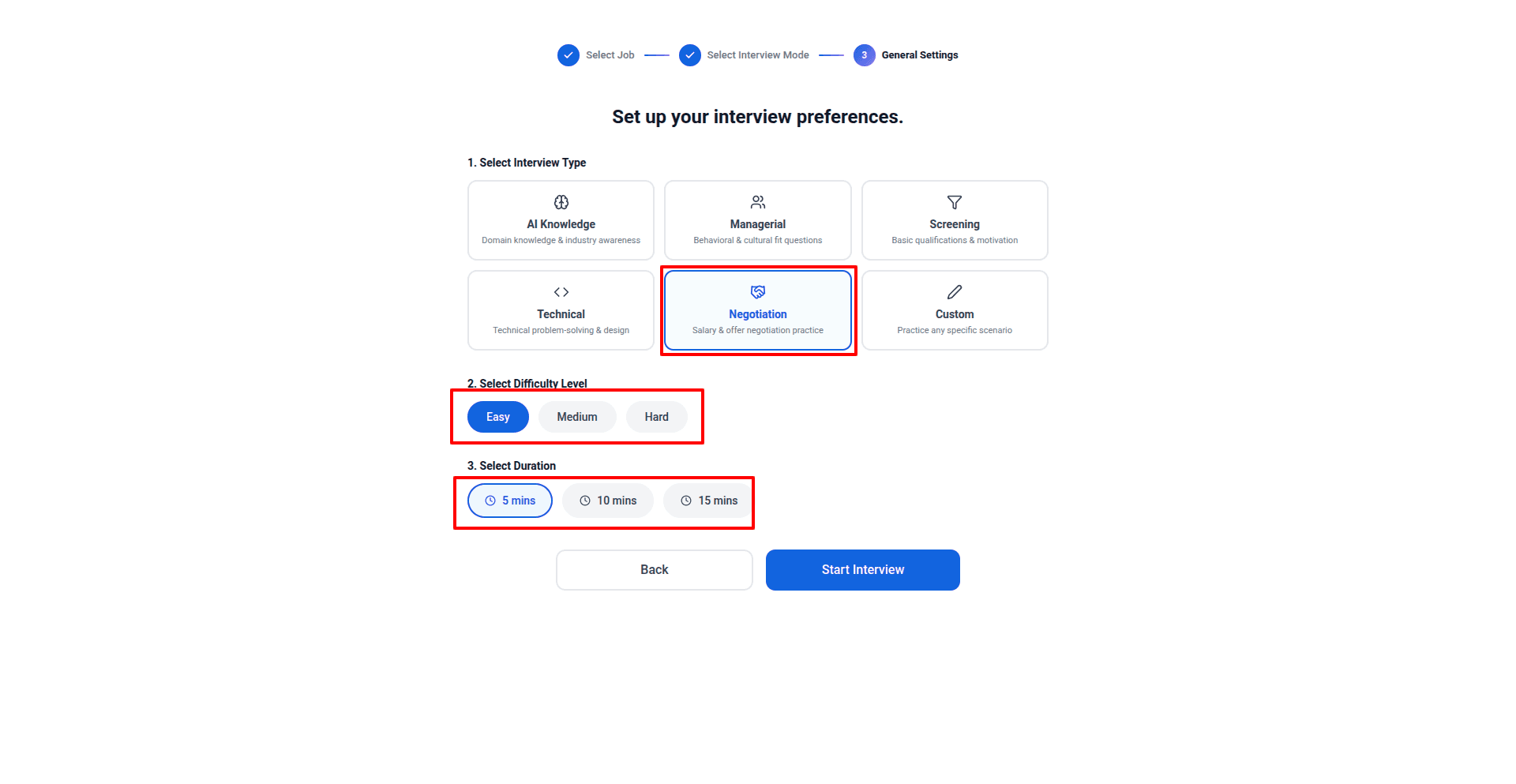
Choose your difficulty level
Select Easy, Medium, or Hard based on how much pressure you want in the practice session. If you are new to salary negotiation, start with Easy and move up later. Choose a 5-minute, 10-minute, or 15-minute session. A shorter session helps you warm up. A longer session gives you more room to practice detailed answers.
Start the interview
Click Start Interview. NxtJob.ai will ask salary negotiation questions based on the selected role and interview mode.
Answer like you would in a real HR call
Practice your response out loud. Focus on your expected salary range, current CTC, role scope, business impact, and how you handle pushback.
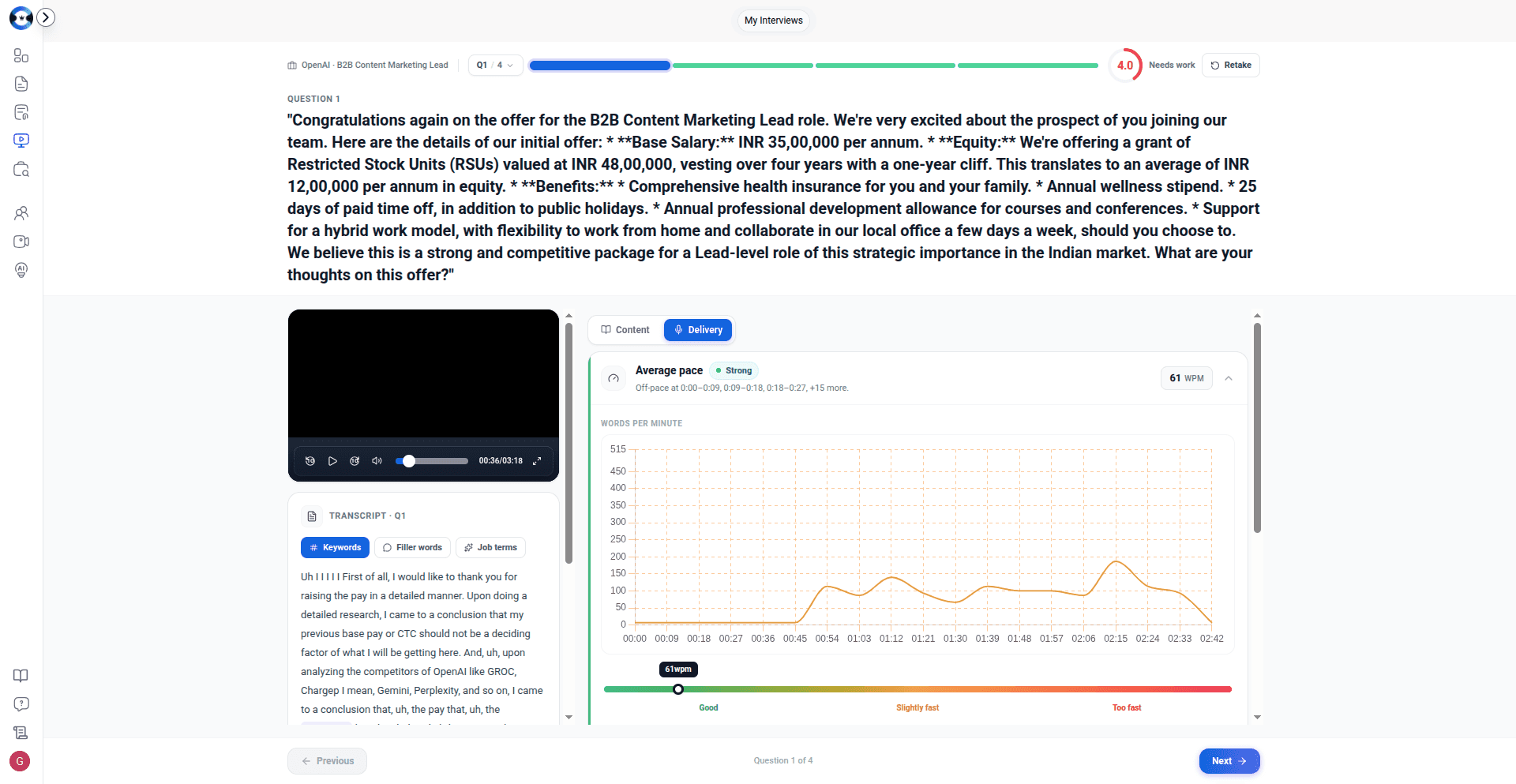
Review your performance
After the session, check your score, transcript, delivery feedback, and content feedback. This helps you understand where your answer was strong and where it needs work.
How to Prepare Before You Negotiate Salary With HR
The worst time to prepare for salary negotiation is after HR has already asked for your expected CTC.
At that point, you may feel pressured to answer fast. Senior professionals need a clearer prep process before the call, especially when the role involves larger scope, higher pay, or a major career move.
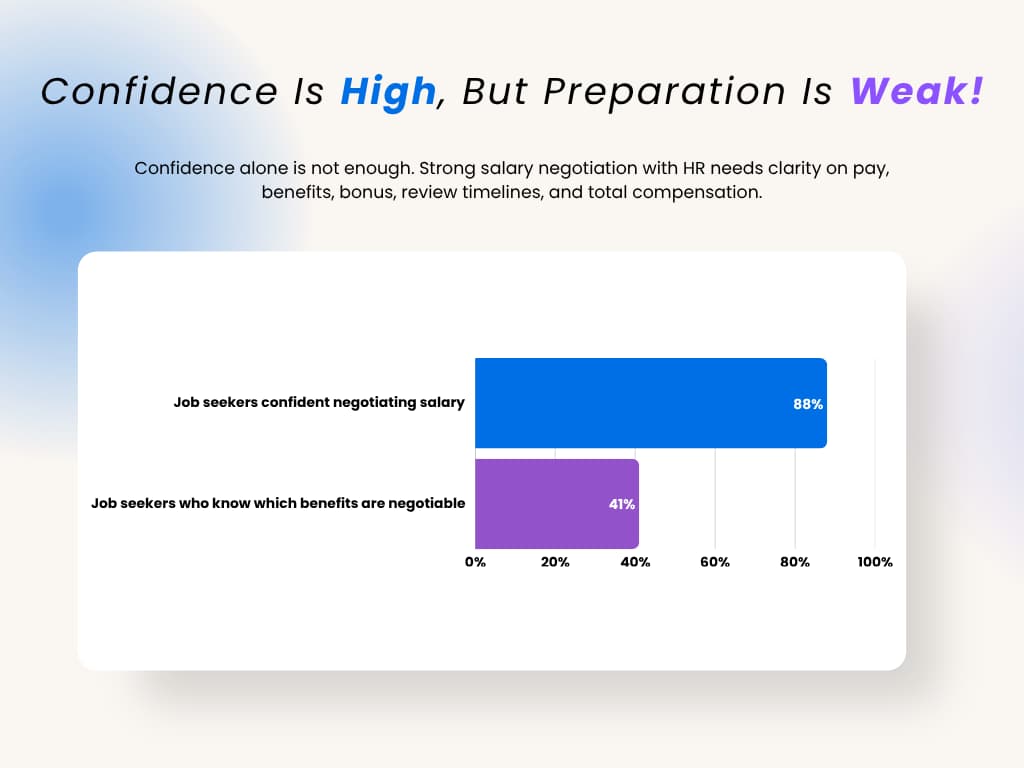
According to Robert Half’s 2026 Salary Guide, nearly three-quarters of employers worry they cannot meet candidate salary expectations. The same report found that 88% of job seekers feel confident negotiating salary, but only 41% know which benefits are negotiable.
Know your market range before the call
Before salary negotiation with HR, check the market range for your function, level, location, and industry.
Don’t rely on one source. Salary ranges can vary by company size, funding stage, industry, profitability, location, and role complexity.
Use a mix of:
salary reports
recruiter input
peer conversations
job descriptions with salary bands
platforms such as AmbitionBox, Glassdoor, or LinkedIn salary insights, where relevant
The goal is not to find one perfect number. The goal is to avoid walking into the call blind.
Define your ideal, acceptable, and walk-away number
Your ideal number is what you want if the role scope and company context justify it.
Your acceptable number is what you can say yes to without regret.
Your walk-away number is the point below which the role no longer makes sense.
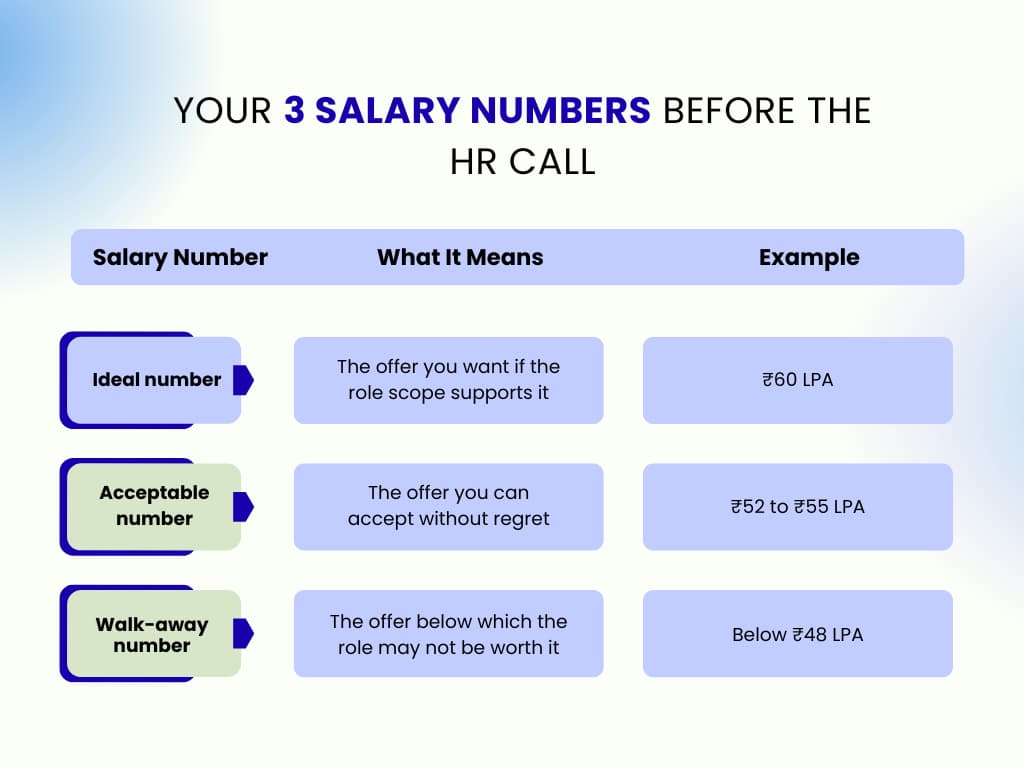
These numbers are only examples. The real range should come from your role, industry, market, and risk level.
Map your achievements to business outcomes
HR cannot always judge your impact alone. They often need inputs they can take back to the hiring manager.
Prepare 3 to 5 proof points before the call.
For example:
“Led a 60-member operations team across three regions.”
“Reduced vendor cost by 18% through renegotiation and process control.”
“Improved sales conversion by 22% within two quarters.”
“Built a new customer success process that reduced churn.”
“Managed enterprise accounts worth ₹X crore.”
These proof points help you justify the number without sounding personal.
Understand the full compensation package
Don’t negotiate only fixed pay.
Look at:
fixed CTC
variable pay
joining bonus
retention bonus
ESOPs or equity
insurance
leave policy
remote or hybrid flexibility
relocation support
notice-period buyout
annual review cycle
title and reporting structure
Randstad’s 2025 Workmonitor found that 83% of workers globally ranked work-life balance as important, the same share as job security. Pay ranked close behind at 82%. This matters because a senior offer is not only a salary number. It is a full work-life and career decision.
Once you know the full structure, you can negotiate with more control.
How to Deal With HR for Salary Negotiation Without Sounding Aggressive
Many candidates confuse firmness with aggression.
You can ask for better compensation without sounding entitled. The tone matters, but the structure matters more. If your request is vague, even a polite tone may not help. If your request is clear, evidence-based, and calm, HR has something useful to respond to.
Business Insider reported advice from Korn Ferry’s Ron Seifert that candidates should ask how the organization makes compensation decisions, including market data, internal equity, performance, scope of responsibility, and timing. That kind of question moves the discussion from emotion to decision criteria.
Start with appreciation, then move to value
A good negotiation response begins by showing interest. Then it moves to the gap.
Weak response:
“Can you increase this? It is too low.”
Stronger response:
“Thank you for the offer. I’m excited about the role and the kind of impact expected here. Based on the role scope, market range, and my experience leading similar outcomes, I was expecting a package closer to X.”
This works because it does three things:
confirms interest
avoids sounding dismissive
gives a reason for the ask
Ask for the compensation structure before reacting
Don’t react to the headline CTC too fast.
Ask HR to break down:
fixed pay
variable pay
bonus terms
benefits
joining bonus
review timeline
deferred components
A package that looks high may have weak fixed pay. A package that looks lower may have strong benefits or faster review cycles.
You can’t judge the offer well unless you know the structure.
Use a range only when it protects your floor
Salary ranges can help or hurt you.
If you say, “I’m looking at ₹45 to ₹60 LPA,” many companies will hear ₹45 LPA. Your lower number becomes the anchor.
A better range has a tight floor:
“Given the role scope, I’m looking at a range between ₹55 and ₹60 LPA.”
That range gives HR room to work, but it does not pull you too low.
Keep your tone calm, but do not weaken your ask
Many senior professionals soften their ask too much.
They say:
“I know this may not be possible.”
“Sorry to ask, but...”
“I’m okay if not.”
These phrases make your request weaker before HR has responded.
Use calm language instead:
“I’d like to discuss whether there is room to align the offer closer to the role scope.”
That sounds professional, not aggressive.
Weak salary negotiation response | Strong senior-level response |
“Can you increase it a little?” | “Based on the role scope and my experience leading similar outcomes, I was expecting a range closer to X.” |
“My current CTC is X, so anything above that works.” | “My current CTC is one reference point, but I’d like to align this discussion with the role’s scope and market range.” |
“I have 15 years of experience.” | “I’ve led teams, managed business outcomes, and delivered measurable impact in similar roles.” |
“I need this much because of personal commitments.” | “Given the responsibilities, expected ownership, and market benchmarks, this is the range I believe is fair.” |
Once your tone is clear, the next step is knowing what to say in specific HR situations.
What to Say During Salary Negotiation With HR
Salary negotiation becomes easier when you prepare for the exact moments that usually create pressure.
HR may ask for expected salary early. They may share a number below your expectation. They may say the budget is fixed. They may compare the offer with your current CTC. None of these situations should surprise you.
If HR asks, “What is your expected salary?”
Avoid giving a random number too early.
Say:
“I’d like to understand the full role scope, team size, business goals, and compensation structure before giving a final number. Based on what I know so far, I’m expecting a range around X to Y.”
This helps you answer without losing control.
If HR insists on a number, give a researched range with a strong floor.
If HR says, “This is our fixed budget”
Don’t argue. Ask a better question.
Say:
“I understand there may be budget limits. Can you help me understand whether the fixed component is firm, or if there is flexibility through joining bonus, variable pay, review timeline, or title alignment?”
This keeps the conversation open.
If HR asks, “Why are you expecting this hike?”
Don’t say, “Because I deserve it.”
Say:
“The expectation is based on the role scope, the level of ownership required, market range for similar roles, and the impact I’ve delivered in similar contexts.”
Then give 2 or 3 proof points.
For example:
“In my current role, I led X, improved Y, and managed Z. This role appears to need similar or larger ownership, so I believe this range is fair.”
If HR compares the offer with your current CTC
This is common in India.
Say:
“My current CTC reflects my current role and company structure. For this move, I’d like to evaluate compensation based on the new role’s responsibilities, expected business impact, and market range.”
That is a clean way to avoid being trapped by your previous salary.
If HR says, “We’ll get back to you”
End the call with clarity.
Say:
“Thank you. I appreciate you considering it. May I know when I can expect an update, and if there is any additional information I can share to support the discussion?”
This shows interest and keeps the conversation moving.
Now let’s turn those situations into scripts you can adapt.
Salary Negotiation With HR Script for Senior Professionals
Scripts are not meant to be memorized word for word.
Use them as a base. Your goal is to sound prepared, not rehearsed. If you copy a script without matching it to your role, it will sound flat.
Script 1: When HR asks for your expected salary early
“Before I share a final number, I’d like to understand the full scope of the role, the team size, business goals, and compensation structure. From what I understand so far, this role requires senior ownership, so I’m looking at a range closer to X to Y. I’m open to discussing the full package once I understand the structure better.”
Use this when the process is still early and you do not want to lock yourself into a low number.
Script 2: When HR shares an offer below your expectation
“Thank you for sharing the offer. I’m excited about the role and the problems the team is trying to solve. Based on the role scope, expected ownership, and my experience handling similar responsibilities, I was expecting something closer to X. Is there room to review the offer?”
This is useful when you want to negotiate salary with HR without sounding disappointed or defensive.
Script 3: When HR says the budget is fixed
“I understand there are internal budget limits. If the fixed component cannot move, can we discuss other parts of the package, such as joining bonus, performance bonus, review timeline, flexibility, or title alignment?”
This shows flexibility without giving up your value.
Script 4: When you want time to think before accepting
“Thank you for the offer. I’m interested in the role, and I’d like to review the full compensation structure before confirming. Can I take some time to go through the details and get back with a clear response?”
This is better than accepting on the call because you felt pressured.
Script 5: When HR asks about current CTC
“My current CTC is X. For this move, I’d like to discuss compensation based on the new role’s scope, responsibility, and market range. From what I understand, the role involves broader ownership, so I’d be looking at a range closer to Y.”
This keeps the current CTC visible but not dominant.
A script can help, but it won’t save you if your strategy is weak. That is why you also need to avoid common mistakes.
Common Salary Negotiation Mistakes Senior Professionals Should Avoid
Most salary negotiation mistakes are not dramatic. They are small moments of weakness that change the final number.
You speak too soon. You explain too much. You accept vague terms. You make your case personal instead of professional. By the time you realize it, HR has already anchored the conversation.
Giving a number too early
If you give a number before you understand the role, you may underquote.
This happens often when HR asks for expectations during the first screening call. You feel pressure. You name a number. Later, you learn the role is larger than expected.
Instead, ask for role and range clarity first.
Using personal expenses as the reason
Your EMI, family plans, rent, or financial goals may be real. But they are not strong negotiation points.
Companies pay for role value, not personal need.
Say less about your costs. Say more about your contribution.
Accepting verbal offers without clarity
A verbal offer is not enough.
Before you accept, ask for the full offer in writing. Check the fixed pay, variable terms, joining bonus, probation terms, notice-period rules, clawback clauses, and review cycle.
A senior role often has more moving parts. Don’t rely on memory after a phone call.
Negotiating only fixed pay
Fixed pay matters. But if the company cannot move it much, other parts may still be open.
You can ask about:
joining bonus
early appraisal
performance bonus
title
work flexibility
relocation support
notice buyout
learning budget
The key is to know what matters to you before the call.
Sounding apologetic while asking for fair value
You don’t need to apologize for negotiating.
A fair negotiation is part of a senior hiring process. If your tone is respectful and your ask is backed by role value, you are not doing anything wrong.
Making threats or comparing offers poorly
Don’t say:
“Another company is giving more, so match it.”
Say:
“I do have another process moving in a higher range, but I’m very interested in this role. I’d like to explore whether we can get closer to X.”
That keeps the door open.
The 5-Step HR Salary Negotiation Checklist
A good negotiation is not just what you say on the call. It is what you prepare before the call.
This framework gives you a simple way to prepare before salary negotiation with HR. It works best when you use it before the offer stage, not after HR has already framed the number.
Korn Ferry’s Ron Seifert advises candidates to ground salary discussions in data, the situation, and the value they deliver to the organization. That is a useful way to think about senior compensation: it should connect numbers to role context and business impact.
Step 1: Confirm the role scope
Before discussing salary, understand what the role truly includes.
Ask:
What team size will I manage?
What business goals will I own?
What revenue, cost, product, or delivery outcomes matter most?
Who will I report to?
What does success look like in the first 6 to 12 months?
You cannot price the role well if you don’t understand the role.
Step 2: Benchmark the market range
Check salary data from more than one place.
Look at industry reports, job posts with salary ranges, recruiter conversations, and peer inputs.
Don’t copy the highest number you find. Use the data to understand a realistic range.
Step 3: Prepare 3 proof points from your career
Pick proof points that match the role.
If the role needs revenue growth, prepare revenue examples. If the role needs operational control, prepare cost, process, and delivery examples. If the role needs people leadership, prepare team and change-management examples.
Your proof should match the job.
Step 4: Set your salary range before the call
Write down your range before HR asks.
Use three levels:
Ideal number
Acceptable number
Walk-away number
This prevents panic decisions.
Step 5: Respond to HR pushback with value, not emotion
HR may say:
“This is beyond our budget.”
“Your current CTC is much lower.”
“We have internal parity.”
“We can revisit later.”
“This is the best we can do.”
Prepare your response before the call. Don’t improvise under pressure.
Screenshot-worthy checklist
Role scope is clear
Market range is checked
Expected salary range is ready
Walk-away number is decided
Business impact proof is prepared
Total compensation is reviewed
HR pushback responses are ready
Final offer is checked in writing
When this checklist is ready, the conversation feels less like a risk and more like a planned discussion.
Conclusion
Before your next salary conversation, remember this:
Prepare your number before HR asks for it.
Tie your salary expectation to role scope, market range, and business impact.
Don’t let current CTC become the only benchmark for your next offer.
Respond to HR pushback with clarity, not panic.
Salary negotiation with HR should not feel like a guessing game. At senior levels, your compensation should reflect the role you’re taking on, the problems you can solve, and the value you’re expected to create.
Get a free demo to see how NxtJob.ai can make a difference in your senior job search.
FAQs on Salary Negotiation With HR
1. How do I negotiate salary with HR?
Start by thanking HR for the offer. Then explain your expected range using role scope, market value, and your business impact. Keep the tone calm, clear, and professional.
2. How do I ask HR for a higher salary?
Say that you’re interested in the role, but expected a package closer to your range based on the responsibilities, market benchmarks, and your experience handling similar outcomes.
3. What should I say if HR says the salary is fixed?
Ask if the fixed pay is final or if there is room in joining bonus, variable pay, review timeline, flexibility, title, or other benefits. Do not stop at the first no.
4. Should I reveal my current CTC to HR?
Share it if required, but do not let it define your next salary. Explain that the new offer should reflect the role scope, market range, and expected ownership.
5. Can HR reject me for negotiating salary?
A respectful negotiation should not hurt your chances. Problems start when candidates sound rude, threatening, or unrealistic. A calm, evidence-backed ask is part of senior hiring.
6. How much salary hike should I ask from HR?
There is no fixed percentage. Your ask should depend on your current pay, role scope, market value, company budget, skills, and the level of business impact expected from you.
7. How do I deal with HR for salary negotiation?
Prepare before the call. Know your expected range, walk-away number, proof points, and possible HR pushback. Then respond with value, not emotion.

As a content writer and SEO strategist, I help turn complex AI job search, career-tech, and growth topics into clear, practical content. At NxtJob.ai, I write to help senior professionals make smarter career moves with clarity and confidence.
Githu Ravikkumar
Creative Strategist & Copyriter
Recent articles

Resume
5 min read
ATS Resume Format: How to Create a Resume That Gets Past Applicant Tracking Systems
Learn how to create an ATS-friendly resume that passes through applicant tracking systems and increases your chances of landing an interview.
Resume
5 min read
ATS Resume Format: How to Create a Resume That Gets Past Applicant Tracking Systems
Learn how to create an ATS-friendly resume that passes through applicant tracking systems and increases your chances of landing an interview.
Resume
5 min read
ATS Resume Format: How to Create a Resume That Gets Past Applicant Tracking Systems
Learn how to create an ATS-friendly resume that passes through applicant tracking systems and increases your chances of landing an interview.
Resume
5 min read
ATS Resume Format: How to Create a Resume That Gets Past Applicant Tracking Systems
Learn how to create an ATS-friendly resume that passes through applicant tracking systems and increases your chances of landing an interview.
Resume
5 min read
ATS Resume Format: How to Create a Resume That Gets Past Applicant Tracking Systems
Learn how to create an ATS-friendly resume that passes through applicant tracking systems and increases your chances of landing an interview.
Resume
5 min read
ATS Resume Format: How to Create a Resume That Gets Past Applicant Tracking Systems
Learn how to create an ATS-friendly resume that passes through applicant tracking systems and increases your chances of landing an interview.
Everything you need to know
Here you can find solutions to all your queries.
Interview
15 min read
Salary Negotiation With HR: How Senior Professionals Should Handle the Conversation
Published Date:
|
Last Modified:
You don’t lose salary negotiation with HR only because the company has a lower budget.
You often lose it because you enter the conversation without a clear number, weak proof, or a calm response to pushback.
For senior professionals, salary negotiation is not just about asking for more money. It is about proving business value, showing market fit, and making sure your next offer reflects the level of ownership you bring.
When you have 15+ years of experience, your current CTC should not become the ceiling for your next move.
This guide will show you how to handle salary negotiation with HR, what to say, what to avoid, how to respond when HR pushes back, and how to prepare before the conversation so you don’t undersell yourself.
Salary Negotiation With HR for Senior Professionals
Salary negotiation with HR is not a fight. It is a business conversation about role scope, market value, and the impact you are expected to deliver.
According to Aon India’s Annual Salary Increase and Turnover Survey 2025 to 2026, salaries in India are projected to rise by 9.1% in 2026, up from 8.9% in 2025. The survey covered more than 1,400 organizations across 45 industries.
Prepare your expected salary range before the HR call.
Tie your ask to business impact, not only years of experience.
Ask for the full compensation structure before reacting.
Treat HR pushback as part of the process, not rejection.
Don’t let current CTC become the only benchmark for your next offer.
A senior professional should not walk into a salary discussion hoping the company “does the right thing.” You need your number, your proof, and your response to the most common objections.
What Salary Negotiation With HR Really Means at Senior Levels
At junior levels, salary negotiation often revolves around one question: “How much hike can I get?” At senior levels, that question is too small.
When HR discusses compensation for a senior role, they’re not only thinking about your current CTC. They’re also looking at internal salary bands, market benchmarks, role scope, leadership expectations, budget limits, team structure, and how badly the business needs your skill set.
HR is not only checking your expected salary
HR wants to know whether your expectations fit the company’s budget. That part is obvious.
But HR is also checking how you think about your own value. If you give a number without context, HR may treat it like a demand. If you explain the number through role scope, business outcomes, and market range, it becomes a professional case.
Imagine you’re interviewing for a VP Sales role. If you say, “I’m expecting a 40% hike,” that gives HR very little to work with.
But if you say, “Given the revenue ownership, team size, regional coverage, and my experience scaling similar sales teams, I’m looking at a range closer to X,” you move the conversation from personal expectation to business value.
They are testing clarity, confidence, and role fit
Senior hiring has more risk than junior hiring. A wrong senior hire can affect teams, budgets,
clients, strategy, and delivery.
That is why salary negotiation with HR is also a signal. It shows how clearly you understand the role, how calmly you handle pressure, and whether you can make a business case without sounding defensive.
This does not mean you need to be aggressive. It means you need to be prepared.
Why senior professionals cannot negotiate like freshers
Freshers often negotiate from potential. Senior professionals negotiate from proof.
Your strongest position is not “I have 15 years of experience.” Many people have 15 years of experience. Your stronger position is what those 15 years have produced.
Did you grow revenue? Reduce cost? Build teams? Fix broken processes? Open new markets? Improve delivery? Lead cross-functional work? Handle large clients? Own budgets?
That proof matters more than tenure. Once you understand that, the next question becomes clear: why do experienced professionals still undersell themselves?
Why Senior Professionals Undersell Themselves During Salary Discussions
Many senior professionals lose money before HR even shares the offer.
They enter the call with weak anchors, unclear proof, or too much dependence on current CTC. That gives HR room to frame the conversation around percentage hike instead of role value.
A 2025 Wall Street Journal report citing ZipRecruiter survey data said only 31% of recent hires negotiated their offers, down from 49% in the previous quarter. The report also noted that many candidates avoid negotiation because they feel tired after long hiring processes or fear losing the offer.
They anchor too closely to current CTC
Current CTC is a reference point. It should not become your ceiling.
If you are moving into a larger role, handling a bigger team, taking on revenue ownership, or shifting into a high-demand function, your past pay may not reflect your future value.
This is where negotiating with HR on salary gets tricky. HR may ask for your current CTC because it helps them place you inside a budget range. But if the role is larger than your current role, you should not let the discussion stop there.
A better frame is:
“My current CTC is one reference point, but I’d like to align this discussion with the role scope, market range, and the level of responsibility expected.”
That sentence does not avoid the topic. It expands the frame.
They talk about years of experience instead of business value
Years of experience can open the door, but outcomes strengthen your ask.
Saying “I have 18 years of experience” is weaker than saying, “I’ve led a 40-member team, handled ₹X crore in revenue responsibility, and improved operating margins by X% in my last role.”
The second version gives HR something concrete to discuss with the hiring manager.
They enter the call without a walk-away number
A senior professional should enter the conversation with three numbers:
Ideal number
Acceptable number
Walk-away number
Without these, you may react emotionally to the first offer. You may accept too fast, ask too vaguely, or reject too sharply.
Your walk-away number is not about ego. It protects you from accepting a role that creates regret six months later.
They treat HR pushback as rejection
HR saying “this is our budget” does not always mean the conversation is over.
Sometimes fixed pay is tight, but joining bonus, variable pay, title, review timeline, relocation support, or flexibility may still be open. The problem is many candidates panic after the first no.
Negotiation works better when you stay calm enough to ask the next useful question.
How NxtJob.ai Negotiator Helps You Negotiate Salary with HR
The hard part about salary negotiation is not only what you say. It is what you prepare before you say it.
By the time HR shares an offer, the company has already formed a view of your value. That view comes from your resume, your interview answers, your role fit, your seniority, your proof of impact, and how clearly you have positioned yourself through the hiring process.
This is why salary negotiation cannot be treated as one isolated call at the end. For senior professionals, it has to be part of the full job search system.
Reuters reported that TeamLease is currently able to fill only about 30% of client openings because of mismatches in salary expectations, location preferences, and required skills.
It helps you define your salary range before pressure hits
Many senior professionals know they want a better offer, but they do not know how to set the right range.
Negotiator helps you think through:
your current CTC
your target role
your expected salary range
your walk-away number
your business impact
the kind of pushback HR may use
This matters because salary pressure often appears suddenly. HR may ask for your expected CTC during screening, before you have fully understood the role. If you are not prepared, you may anchor too low.
It helps you connect your ask to business impact
A weak salary ask sounds like this:
“I want this much because I have 15 years of experience.”
A stronger ask sounds like this:
“Given the role scope, expected ownership, and my experience leading similar business outcomes, I believe this range is fair.”
Negotiator helps you move from a personal number to a business-backed number.
That shift matters. HR can push back on a random hike. It is harder to dismiss a clear case tied to role scope, market range, and proof of impact.
It helps you prepare for HR pushback
Most salary conversations have predictable pushback.
HR may say:
“This is our fixed budget.”
“Your current CTC is lower.”
“We cannot offer that hike.”
“Let us revisit this after six months.”
“Other candidates are available in this range.”
The problem is not that HR says these things. The problem is that many candidates hear them for the first time during the call.
Negotiator helps you prepare calm, clear responses before the pressure starts.
It supports your wider senior job search strategy
Your negotiation power improves when your entire job search is stronger.
If you know how to make an ATS-friendly resume that shows business impact, your interviews prove senior judgment, your outreach creates better access, and your target roles match your value, the salary conversation becomes easier to defend.
That is the real point. Salary negotiation with HR should not depend on one clever line. It should be supported by your positioning across the full hiring journey.
How to Practice Salary Negotiation With NxtJob.ai
Here’s how a senior professional can use NxtJob.ai to practice salary negotiation before speaking to HR.
Open the Interviewer sectionFrom your NxtJob.ai dashboard, click the interview icon on the left sidebar. This opens the interview practice area.
Click “Start Practicing”
Select the Start Practicing button to begin a new practice session.
Choose the job you are preparing for
Pick the role from your saved job list. This helps NxtJob.ai tailor the questions to the role, company, and job context. You can also choose to practice without a job.
Select the interview mode
Choose the type of interview you want to practice. For salary conversations, select Negotiation. This mode focuses on salary and offer negotiation practice.
Choose your difficulty level
Select Easy, Medium, or Hard based on how much pressure you want in the practice session. If you are new to salary negotiation, start with Easy and move up later. Choose a 5-minute, 10-minute, or 15-minute session. A shorter session helps you warm up. A longer session gives you more room to practice detailed answers.
Start the interview
Click Start Interview. NxtJob.ai will ask salary negotiation questions based on the selected role and interview mode.
Answer like you would in a real HR call
Practice your response out loud. Focus on your expected salary range, current CTC, role scope, business impact, and how you handle pushback.
Review your performance
After the session, check your score, transcript, delivery feedback, and content feedback. This helps you understand where your answer was strong and where it needs work.
How to Prepare Before You Negotiate Salary With HR
The worst time to prepare for salary negotiation is after HR has already asked for your expected CTC.
At that point, you may feel pressured to answer fast. Senior professionals need a clearer prep process before the call, especially when the role involves larger scope, higher pay, or a major career move.
According to Robert Half’s 2026 Salary Guide, nearly three-quarters of employers worry they cannot meet candidate salary expectations. The same report found that 88% of job seekers feel confident negotiating salary, but only 41% know which benefits are negotiable.
Know your market range before the call
Before salary negotiation with HR, check the market range for your function, level, location, and industry.
Don’t rely on one source. Salary ranges can vary by company size, funding stage, industry, profitability, location, and role complexity.
Use a mix of:
salary reports
recruiter input
peer conversations
job descriptions with salary bands
platforms such as AmbitionBox, Glassdoor, or LinkedIn salary insights, where relevant
The goal is not to find one perfect number. The goal is to avoid walking into the call blind.
Define your ideal, acceptable, and walk-away number
Your ideal number is what you want if the role scope and company context justify it.
Your acceptable number is what you can say yes to without regret.
Your walk-away number is the point below which the role no longer makes sense.
These numbers are only examples. The real range should come from your role, industry, market, and risk level.
Map your achievements to business outcomes
HR cannot always judge your impact alone. They often need inputs they can take back to the hiring manager.
Prepare 3 to 5 proof points before the call.
For example:
“Led a 60-member operations team across three regions.”
“Reduced vendor cost by 18% through renegotiation and process control.”
“Improved sales conversion by 22% within two quarters.”
“Built a new customer success process that reduced churn.”
“Managed enterprise accounts worth ₹X crore.”
These proof points help you justify the number without sounding personal.
Understand the full compensation package
Don’t negotiate only fixed pay.
Look at:
fixed CTC
variable pay
joining bonus
retention bonus
ESOPs or equity
insurance
leave policy
remote or hybrid flexibility
relocation support
notice-period buyout
annual review cycle
title and reporting structure
Randstad’s 2025 Workmonitor found that 83% of workers globally ranked work-life balance as important, the same share as job security. Pay ranked close behind at 82%. This matters because a senior offer is not only a salary number. It is a full work-life and career decision.
Once you know the full structure, you can negotiate with more control.
How to Deal With HR for Salary Negotiation Without Sounding Aggressive
Many candidates confuse firmness with aggression.
You can ask for better compensation without sounding entitled. The tone matters, but the structure matters more. If your request is vague, even a polite tone may not help. If your request is clear, evidence-based, and calm, HR has something useful to respond to.
Business Insider reported advice from Korn Ferry’s Ron Seifert that candidates should ask how the organization makes compensation decisions, including market data, internal equity, performance, scope of responsibility, and timing. That kind of question moves the discussion from emotion to decision criteria.
Start with appreciation, then move to value
A good negotiation response begins by showing interest. Then it moves to the gap.
Weak response:
“Can you increase this? It is too low.”
Stronger response:
“Thank you for the offer. I’m excited about the role and the kind of impact expected here. Based on the role scope, market range, and my experience leading similar outcomes, I was expecting a package closer to X.”
This works because it does three things:
confirms interest
avoids sounding dismissive
gives a reason for the ask
Ask for the compensation structure before reacting
Don’t react to the headline CTC too fast.
Ask HR to break down:
fixed pay
variable pay
bonus terms
benefits
joining bonus
review timeline
deferred components
A package that looks high may have weak fixed pay. A package that looks lower may have strong benefits or faster review cycles.
You can’t judge the offer well unless you know the structure.
Use a range only when it protects your floor
Salary ranges can help or hurt you.
If you say, “I’m looking at ₹45 to ₹60 LPA,” many companies will hear ₹45 LPA. Your lower number becomes the anchor.
A better range has a tight floor:
“Given the role scope, I’m looking at a range between ₹55 and ₹60 LPA.”
That range gives HR room to work, but it does not pull you too low.
Keep your tone calm, but do not weaken your ask
Many senior professionals soften their ask too much.
They say:
“I know this may not be possible.”
“Sorry to ask, but...”
“I’m okay if not.”
These phrases make your request weaker before HR has responded.
Use calm language instead:
“I’d like to discuss whether there is room to align the offer closer to the role scope.”
That sounds professional, not aggressive.
Weak salary negotiation response | Strong senior-level response |
“Can you increase it a little?” | “Based on the role scope and my experience leading similar outcomes, I was expecting a range closer to X.” |
“My current CTC is X, so anything above that works.” | “My current CTC is one reference point, but I’d like to align this discussion with the role’s scope and market range.” |
“I have 15 years of experience.” | “I’ve led teams, managed business outcomes, and delivered measurable impact in similar roles.” |
“I need this much because of personal commitments.” | “Given the responsibilities, expected ownership, and market benchmarks, this is the range I believe is fair.” |
Once your tone is clear, the next step is knowing what to say in specific HR situations.
What to Say During Salary Negotiation With HR
Salary negotiation becomes easier when you prepare for the exact moments that usually create pressure.
HR may ask for expected salary early. They may share a number below your expectation. They may say the budget is fixed. They may compare the offer with your current CTC. None of these situations should surprise you.
If HR asks, “What is your expected salary?”
Avoid giving a random number too early.
Say:
“I’d like to understand the full role scope, team size, business goals, and compensation structure before giving a final number. Based on what I know so far, I’m expecting a range around X to Y.”
This helps you answer without losing control.
If HR insists on a number, give a researched range with a strong floor.
If HR says, “This is our fixed budget”
Don’t argue. Ask a better question.
Say:
“I understand there may be budget limits. Can you help me understand whether the fixed component is firm, or if there is flexibility through joining bonus, variable pay, review timeline, or title alignment?”
This keeps the conversation open.
If HR asks, “Why are you expecting this hike?”
Don’t say, “Because I deserve it.”
Say:
“The expectation is based on the role scope, the level of ownership required, market range for similar roles, and the impact I’ve delivered in similar contexts.”
Then give 2 or 3 proof points.
For example:
“In my current role, I led X, improved Y, and managed Z. This role appears to need similar or larger ownership, so I believe this range is fair.”
If HR compares the offer with your current CTC
This is common in India.
Say:
“My current CTC reflects my current role and company structure. For this move, I’d like to evaluate compensation based on the new role’s responsibilities, expected business impact, and market range.”
That is a clean way to avoid being trapped by your previous salary.
If HR says, “We’ll get back to you”
End the call with clarity.
Say:
“Thank you. I appreciate you considering it. May I know when I can expect an update, and if there is any additional information I can share to support the discussion?”
This shows interest and keeps the conversation moving.
Now let’s turn those situations into scripts you can adapt.
Salary Negotiation With HR Script for Senior Professionals
Scripts are not meant to be memorized word for word.
Use them as a base. Your goal is to sound prepared, not rehearsed. If you copy a script without matching it to your role, it will sound flat.
Script 1: When HR asks for your expected salary early
“Before I share a final number, I’d like to understand the full scope of the role, the team size, business goals, and compensation structure. From what I understand so far, this role requires senior ownership, so I’m looking at a range closer to X to Y. I’m open to discussing the full package once I understand the structure better.”
Use this when the process is still early and you do not want to lock yourself into a low number.
Script 2: When HR shares an offer below your expectation
“Thank you for sharing the offer. I’m excited about the role and the problems the team is trying to solve. Based on the role scope, expected ownership, and my experience handling similar responsibilities, I was expecting something closer to X. Is there room to review the offer?”
This is useful when you want to negotiate salary with HR without sounding disappointed or defensive.
Script 3: When HR says the budget is fixed
“I understand there are internal budget limits. If the fixed component cannot move, can we discuss other parts of the package, such as joining bonus, performance bonus, review timeline, flexibility, or title alignment?”
This shows flexibility without giving up your value.
Script 4: When you want time to think before accepting
“Thank you for the offer. I’m interested in the role, and I’d like to review the full compensation structure before confirming. Can I take some time to go through the details and get back with a clear response?”
This is better than accepting on the call because you felt pressured.
Script 5: When HR asks about current CTC
“My current CTC is X. For this move, I’d like to discuss compensation based on the new role’s scope, responsibility, and market range. From what I understand, the role involves broader ownership, so I’d be looking at a range closer to Y.”
This keeps the current CTC visible but not dominant.
A script can help, but it won’t save you if your strategy is weak. That is why you also need to avoid common mistakes.
Common Salary Negotiation Mistakes Senior Professionals Should Avoid
Most salary negotiation mistakes are not dramatic. They are small moments of weakness that change the final number.
You speak too soon. You explain too much. You accept vague terms. You make your case personal instead of professional. By the time you realize it, HR has already anchored the conversation.
Giving a number too early
If you give a number before you understand the role, you may underquote.
This happens often when HR asks for expectations during the first screening call. You feel pressure. You name a number. Later, you learn the role is larger than expected.
Instead, ask for role and range clarity first.
Using personal expenses as the reason
Your EMI, family plans, rent, or financial goals may be real. But they are not strong negotiation points.
Companies pay for role value, not personal need.
Say less about your costs. Say more about your contribution.
Accepting verbal offers without clarity
A verbal offer is not enough.
Before you accept, ask for the full offer in writing. Check the fixed pay, variable terms, joining bonus, probation terms, notice-period rules, clawback clauses, and review cycle.
A senior role often has more moving parts. Don’t rely on memory after a phone call.
Negotiating only fixed pay
Fixed pay matters. But if the company cannot move it much, other parts may still be open.
You can ask about:
joining bonus
early appraisal
performance bonus
title
work flexibility
relocation support
notice buyout
learning budget
The key is to know what matters to you before the call.
Sounding apologetic while asking for fair value
You don’t need to apologize for negotiating.
A fair negotiation is part of a senior hiring process. If your tone is respectful and your ask is backed by role value, you are not doing anything wrong.
Making threats or comparing offers poorly
Don’t say:
“Another company is giving more, so match it.”
Say:
“I do have another process moving in a higher range, but I’m very interested in this role. I’d like to explore whether we can get closer to X.”
That keeps the door open.
The 5-Step HR Salary Negotiation Checklist
A good negotiation is not just what you say on the call. It is what you prepare before the call.
This framework gives you a simple way to prepare before salary negotiation with HR. It works best when you use it before the offer stage, not after HR has already framed the number.
Korn Ferry’s Ron Seifert advises candidates to ground salary discussions in data, the situation, and the value they deliver to the organization. That is a useful way to think about senior compensation: it should connect numbers to role context and business impact.
Step 1: Confirm the role scope
Before discussing salary, understand what the role truly includes.
Ask:
What team size will I manage?
What business goals will I own?
What revenue, cost, product, or delivery outcomes matter most?
Who will I report to?
What does success look like in the first 6 to 12 months?
You cannot price the role well if you don’t understand the role.
Step 2: Benchmark the market range
Check salary data from more than one place.
Look at industry reports, job posts with salary ranges, recruiter conversations, and peer inputs.
Don’t copy the highest number you find. Use the data to understand a realistic range.
Step 3: Prepare 3 proof points from your career
Pick proof points that match the role.
If the role needs revenue growth, prepare revenue examples. If the role needs operational control, prepare cost, process, and delivery examples. If the role needs people leadership, prepare team and change-management examples.
Your proof should match the job.
Step 4: Set your salary range before the call
Write down your range before HR asks.
Use three levels:
Ideal number
Acceptable number
Walk-away number
This prevents panic decisions.
Step 5: Respond to HR pushback with value, not emotion
HR may say:
“This is beyond our budget.”
“Your current CTC is much lower.”
“We have internal parity.”
“We can revisit later.”
“This is the best we can do.”
Prepare your response before the call. Don’t improvise under pressure.
Screenshot-worthy checklist
Role scope is clear
Market range is checked
Expected salary range is ready
Walk-away number is decided
Business impact proof is prepared
Total compensation is reviewed
HR pushback responses are ready
Final offer is checked in writing
When this checklist is ready, the conversation feels less like a risk and more like a planned discussion.
Conclusion
Before your next salary conversation, remember this:
Prepare your number before HR asks for it.
Tie your salary expectation to role scope, market range, and business impact.
Don’t let current CTC become the only benchmark for your next offer.
Respond to HR pushback with clarity, not panic.
Salary negotiation with HR should not feel like a guessing game. At senior levels, your compensation should reflect the role you’re taking on, the problems you can solve, and the value you’re expected to create.
Get a free demo to see how NxtJob.ai can make a difference in your senior job search.
FAQs on Salary Negotiation With HR
1. How do I negotiate salary with HR?
Start by thanking HR for the offer. Then explain your expected range using role scope, market value, and your business impact. Keep the tone calm, clear, and professional.
2. How do I ask HR for a higher salary?
Say that you’re interested in the role, but expected a package closer to your range based on the responsibilities, market benchmarks, and your experience handling similar outcomes.
3. What should I say if HR says the salary is fixed?
Ask if the fixed pay is final or if there is room in joining bonus, variable pay, review timeline, flexibility, title, or other benefits. Do not stop at the first no.
4. Should I reveal my current CTC to HR?
Share it if required, but do not let it define your next salary. Explain that the new offer should reflect the role scope, market range, and expected ownership.
5. Can HR reject me for negotiating salary?
A respectful negotiation should not hurt your chances. Problems start when candidates sound rude, threatening, or unrealistic. A calm, evidence-backed ask is part of senior hiring.
6. How much salary hike should I ask from HR?
There is no fixed percentage. Your ask should depend on your current pay, role scope, market value, company budget, skills, and the level of business impact expected from you.
7. How do I deal with HR for salary negotiation?
Prepare before the call. Know your expected range, walk-away number, proof points, and possible HR pushback. Then respond with value, not emotion.
Table of content
Resume
How to Make an ATS-Friendly Resume: Format, Tips, and Examples for Experienced Professionals
Learn how to make an ATS-friendly resume with the right format, keywords, structure, and role-specific details for experienced professionals.
Resume
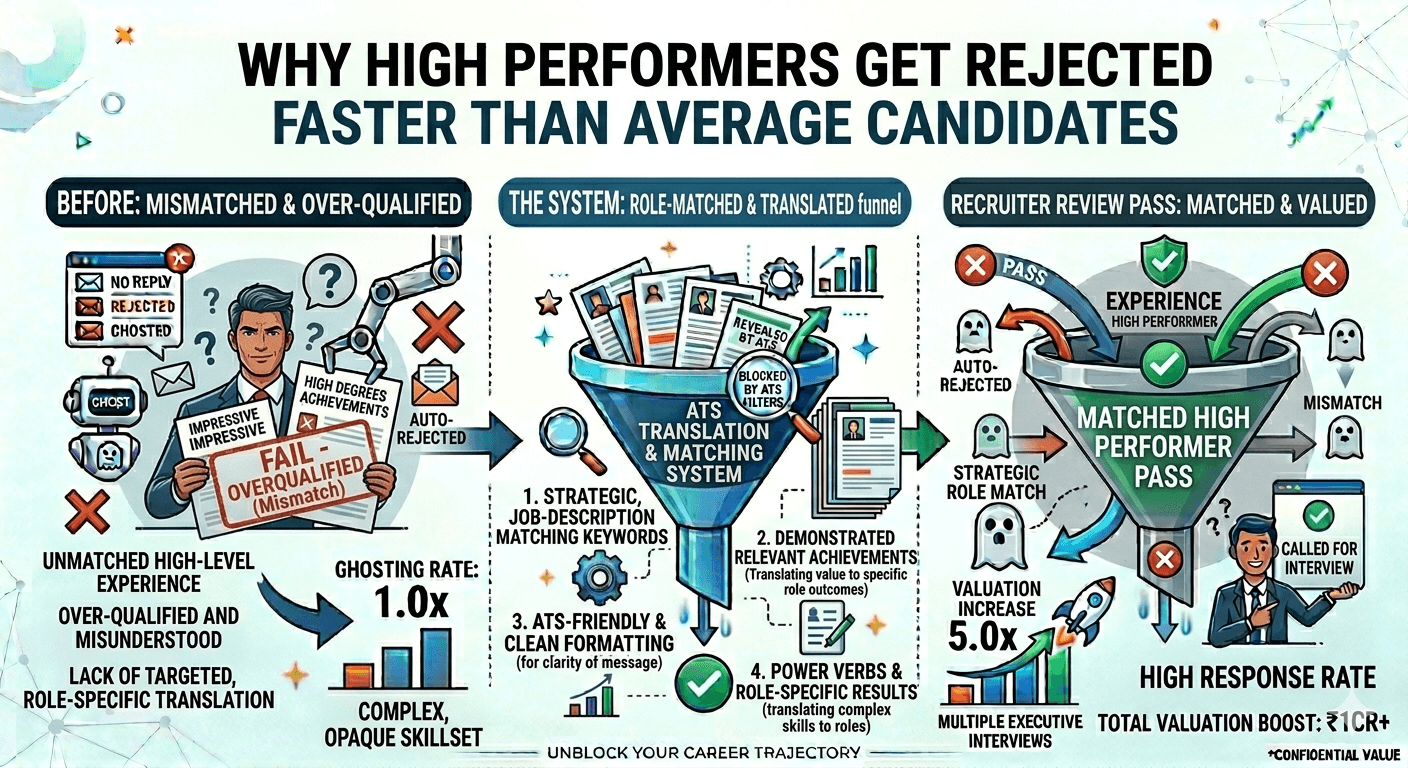
Why High Performers Get Rejected Faster Than Average Candidates
Why High Performers Get Rejected Faster Than Average Candidates
As a content writer and SEO strategist, I help turn complex AI job search, career-tech, and growth topics into clear, practical content. At NxtJob.ai, I write to help senior professionals make smarter career moves with clarity and confidence.
Githu Ravikkumar
Creative Strategist & Copyriter
Everything you need to know
Here you can find solutions to all your queries.
Interview
15 min read
Salary Negotiation With HR: How Senior Professionals Should Handle the Conversation
Published Date:
|
Last Modified:
You don’t lose salary negotiation with HR only because the company has a lower budget.
You often lose it because you enter the conversation without a clear number, weak proof, or a calm response to pushback.
For senior professionals, salary negotiation is not just about asking for more money. It is about proving business value, showing market fit, and making sure your next offer reflects the level of ownership you bring.
When you have 15+ years of experience, your current CTC should not become the ceiling for your next move.
This guide will show you how to handle salary negotiation with HR, what to say, what to avoid, how to respond when HR pushes back, and how to prepare before the conversation so you don’t undersell yourself.
Salary Negotiation With HR for Senior Professionals
Salary negotiation with HR is not a fight. It is a business conversation about role scope, market value, and the impact you are expected to deliver.
According to Aon India’s Annual Salary Increase and Turnover Survey 2025 to 2026, salaries in India are projected to rise by 9.1% in 2026, up from 8.9% in 2025. The survey covered more than 1,400 organizations across 45 industries.
Prepare your expected salary range before the HR call.
Tie your ask to business impact, not only years of experience.
Ask for the full compensation structure before reacting.
Treat HR pushback as part of the process, not rejection.
Don’t let current CTC become the only benchmark for your next offer.
A senior professional should not walk into a salary discussion hoping the company “does the right thing.” You need your number, your proof, and your response to the most common objections.
What Salary Negotiation With HR Really Means at Senior Levels
At junior levels, salary negotiation often revolves around one question: “How much hike can I get?” At senior levels, that question is too small.
When HR discusses compensation for a senior role, they’re not only thinking about your current CTC. They’re also looking at internal salary bands, market benchmarks, role scope, leadership expectations, budget limits, team structure, and how badly the business needs your skill set.
HR is not only checking your expected salary
HR wants to know whether your expectations fit the company’s budget. That part is obvious.
But HR is also checking how you think about your own value. If you give a number without context, HR may treat it like a demand. If you explain the number through role scope, business outcomes, and market range, it becomes a professional case.
Imagine you’re interviewing for a VP Sales role. If you say, “I’m expecting a 40% hike,” that gives HR very little to work with.
But if you say, “Given the revenue ownership, team size, regional coverage, and my experience scaling similar sales teams, I’m looking at a range closer to X,” you move the conversation from personal expectation to business value.
They are testing clarity, confidence, and role fit
Senior hiring has more risk than junior hiring. A wrong senior hire can affect teams, budgets,
clients, strategy, and delivery.
That is why salary negotiation with HR is also a signal. It shows how clearly you understand the role, how calmly you handle pressure, and whether you can make a business case without sounding defensive.
This does not mean you need to be aggressive. It means you need to be prepared.
Why senior professionals cannot negotiate like freshers
Freshers often negotiate from potential. Senior professionals negotiate from proof.
Your strongest position is not “I have 15 years of experience.” Many people have 15 years of experience. Your stronger position is what those 15 years have produced.
Did you grow revenue? Reduce cost? Build teams? Fix broken processes? Open new markets? Improve delivery? Lead cross-functional work? Handle large clients? Own budgets?
That proof matters more than tenure. Once you understand that, the next question becomes clear: why do experienced professionals still undersell themselves?
Why Senior Professionals Undersell Themselves During Salary Discussions
Many senior professionals lose money before HR even shares the offer.
They enter the call with weak anchors, unclear proof, or too much dependence on current CTC. That gives HR room to frame the conversation around percentage hike instead of role value.
A 2025 Wall Street Journal report citing ZipRecruiter survey data said only 31% of recent hires negotiated their offers, down from 49% in the previous quarter. The report also noted that many candidates avoid negotiation because they feel tired after long hiring processes or fear losing the offer.
They anchor too closely to current CTC
Current CTC is a reference point. It should not become your ceiling.
If you are moving into a larger role, handling a bigger team, taking on revenue ownership, or shifting into a high-demand function, your past pay may not reflect your future value.
This is where negotiating with HR on salary gets tricky. HR may ask for your current CTC because it helps them place you inside a budget range. But if the role is larger than your current role, you should not let the discussion stop there.
A better frame is:
“My current CTC is one reference point, but I’d like to align this discussion with the role scope, market range, and the level of responsibility expected.”
That sentence does not avoid the topic. It expands the frame.
They talk about years of experience instead of business value
Years of experience can open the door, but outcomes strengthen your ask.
Saying “I have 18 years of experience” is weaker than saying, “I’ve led a 40-member team, handled ₹X crore in revenue responsibility, and improved operating margins by X% in my last role.”
The second version gives HR something concrete to discuss with the hiring manager.
They enter the call without a walk-away number
A senior professional should enter the conversation with three numbers:
Ideal number
Acceptable number
Walk-away number
Without these, you may react emotionally to the first offer. You may accept too fast, ask too vaguely, or reject too sharply.
Your walk-away number is not about ego. It protects you from accepting a role that creates regret six months later.
They treat HR pushback as rejection
HR saying “this is our budget” does not always mean the conversation is over.
Sometimes fixed pay is tight, but joining bonus, variable pay, title, review timeline, relocation support, or flexibility may still be open. The problem is many candidates panic after the first no.
Negotiation works better when you stay calm enough to ask the next useful question.
How NxtJob.ai Negotiator Helps You Negotiate Salary with HR
The hard part about salary negotiation is not only what you say. It is what you prepare before you say it.
By the time HR shares an offer, the company has already formed a view of your value. That view comes from your resume, your interview answers, your role fit, your seniority, your proof of impact, and how clearly you have positioned yourself through the hiring process.
This is why salary negotiation cannot be treated as one isolated call at the end. For senior professionals, it has to be part of the full job search system.
Reuters reported that TeamLease is currently able to fill only about 30% of client openings because of mismatches in salary expectations, location preferences, and required skills.
It helps you define your salary range before pressure hits
Many senior professionals know they want a better offer, but they do not know how to set the right range.
Negotiator helps you think through:
your current CTC
your target role
your expected salary range
your walk-away number
your business impact
the kind of pushback HR may use
This matters because salary pressure often appears suddenly. HR may ask for your expected CTC during screening, before you have fully understood the role. If you are not prepared, you may anchor too low.
It helps you connect your ask to business impact
A weak salary ask sounds like this:
“I want this much because I have 15 years of experience.”
A stronger ask sounds like this:
“Given the role scope, expected ownership, and my experience leading similar business outcomes, I believe this range is fair.”
Negotiator helps you move from a personal number to a business-backed number.
That shift matters. HR can push back on a random hike. It is harder to dismiss a clear case tied to role scope, market range, and proof of impact.
It helps you prepare for HR pushback
Most salary conversations have predictable pushback.
HR may say:
“This is our fixed budget.”
“Your current CTC is lower.”
“We cannot offer that hike.”
“Let us revisit this after six months.”
“Other candidates are available in this range.”
The problem is not that HR says these things. The problem is that many candidates hear them for the first time during the call.
Negotiator helps you prepare calm, clear responses before the pressure starts.
It supports your wider senior job search strategy
Your negotiation power improves when your entire job search is stronger.
If you know how to make an ATS-friendly resume that shows business impact, your interviews prove senior judgment, your outreach creates better access, and your target roles match your value, the salary conversation becomes easier to defend.
That is the real point. Salary negotiation with HR should not depend on one clever line. It should be supported by your positioning across the full hiring journey.
How to Practice Salary Negotiation With NxtJob.ai
Here’s how a senior professional can use NxtJob.ai to practice salary negotiation before speaking to HR.
Open the Interviewer sectionFrom your NxtJob.ai dashboard, click the interview icon on the left sidebar. This opens the interview practice area.
Click “Start Practicing”
Select the Start Practicing button to begin a new practice session.
Choose the job you are preparing for
Pick the role from your saved job list. This helps NxtJob.ai tailor the questions to the role, company, and job context. You can also choose to practice without a job.
Select the interview mode
Choose the type of interview you want to practice. For salary conversations, select Negotiation. This mode focuses on salary and offer negotiation practice.
Choose your difficulty level
Select Easy, Medium, or Hard based on how much pressure you want in the practice session. If you are new to salary negotiation, start with Easy and move up later. Choose a 5-minute, 10-minute, or 15-minute session. A shorter session helps you warm up. A longer session gives you more room to practice detailed answers.
Start the interview
Click Start Interview. NxtJob.ai will ask salary negotiation questions based on the selected role and interview mode.
Answer like you would in a real HR call
Practice your response out loud. Focus on your expected salary range, current CTC, role scope, business impact, and how you handle pushback.
Review your performance
After the session, check your score, transcript, delivery feedback, and content feedback. This helps you understand where your answer was strong and where it needs work.
How to Prepare Before You Negotiate Salary With HR
The worst time to prepare for salary negotiation is after HR has already asked for your expected CTC.
At that point, you may feel pressured to answer fast. Senior professionals need a clearer prep process before the call, especially when the role involves larger scope, higher pay, or a major career move.
According to Robert Half’s 2026 Salary Guide, nearly three-quarters of employers worry they cannot meet candidate salary expectations. The same report found that 88% of job seekers feel confident negotiating salary, but only 41% know which benefits are negotiable.
Know your market range before the call
Before salary negotiation with HR, check the market range for your function, level, location, and industry.
Don’t rely on one source. Salary ranges can vary by company size, funding stage, industry, profitability, location, and role complexity.
Use a mix of:
salary reports
recruiter input
peer conversations
job descriptions with salary bands
platforms such as AmbitionBox, Glassdoor, or LinkedIn salary insights, where relevant
The goal is not to find one perfect number. The goal is to avoid walking into the call blind.
Define your ideal, acceptable, and walk-away number
Your ideal number is what you want if the role scope and company context justify it.
Your acceptable number is what you can say yes to without regret.
Your walk-away number is the point below which the role no longer makes sense.
These numbers are only examples. The real range should come from your role, industry, market, and risk level.
Map your achievements to business outcomes
HR cannot always judge your impact alone. They often need inputs they can take back to the hiring manager.
Prepare 3 to 5 proof points before the call.
For example:
“Led a 60-member operations team across three regions.”
“Reduced vendor cost by 18% through renegotiation and process control.”
“Improved sales conversion by 22% within two quarters.”
“Built a new customer success process that reduced churn.”
“Managed enterprise accounts worth ₹X crore.”
These proof points help you justify the number without sounding personal.
Understand the full compensation package
Don’t negotiate only fixed pay.
Look at:
fixed CTC
variable pay
joining bonus
retention bonus
ESOPs or equity
insurance
leave policy
remote or hybrid flexibility
relocation support
notice-period buyout
annual review cycle
title and reporting structure
Randstad’s 2025 Workmonitor found that 83% of workers globally ranked work-life balance as important, the same share as job security. Pay ranked close behind at 82%. This matters because a senior offer is not only a salary number. It is a full work-life and career decision.
Once you know the full structure, you can negotiate with more control.
How to Deal With HR for Salary Negotiation Without Sounding Aggressive
Many candidates confuse firmness with aggression.
You can ask for better compensation without sounding entitled. The tone matters, but the structure matters more. If your request is vague, even a polite tone may not help. If your request is clear, evidence-based, and calm, HR has something useful to respond to.
Business Insider reported advice from Korn Ferry’s Ron Seifert that candidates should ask how the organization makes compensation decisions, including market data, internal equity, performance, scope of responsibility, and timing. That kind of question moves the discussion from emotion to decision criteria.
Start with appreciation, then move to value
A good negotiation response begins by showing interest. Then it moves to the gap.
Weak response:
“Can you increase this? It is too low.”
Stronger response:
“Thank you for the offer. I’m excited about the role and the kind of impact expected here. Based on the role scope, market range, and my experience leading similar outcomes, I was expecting a package closer to X.”
This works because it does three things:
confirms interest
avoids sounding dismissive
gives a reason for the ask
Ask for the compensation structure before reacting
Don’t react to the headline CTC too fast.
Ask HR to break down:
fixed pay
variable pay
bonus terms
benefits
joining bonus
review timeline
deferred components
A package that looks high may have weak fixed pay. A package that looks lower may have strong benefits or faster review cycles.
You can’t judge the offer well unless you know the structure.
Use a range only when it protects your floor
Salary ranges can help or hurt you.
If you say, “I’m looking at ₹45 to ₹60 LPA,” many companies will hear ₹45 LPA. Your lower number becomes the anchor.
A better range has a tight floor:
“Given the role scope, I’m looking at a range between ₹55 and ₹60 LPA.”
That range gives HR room to work, but it does not pull you too low.
Keep your tone calm, but do not weaken your ask
Many senior professionals soften their ask too much.
They say:
“I know this may not be possible.”
“Sorry to ask, but...”
“I’m okay if not.”
These phrases make your request weaker before HR has responded.
Use calm language instead:
“I’d like to discuss whether there is room to align the offer closer to the role scope.”
That sounds professional, not aggressive.
Weak salary negotiation response | Strong senior-level response |
“Can you increase it a little?” | “Based on the role scope and my experience leading similar outcomes, I was expecting a range closer to X.” |
“My current CTC is X, so anything above that works.” | “My current CTC is one reference point, but I’d like to align this discussion with the role’s scope and market range.” |
“I have 15 years of experience.” | “I’ve led teams, managed business outcomes, and delivered measurable impact in similar roles.” |
“I need this much because of personal commitments.” | “Given the responsibilities, expected ownership, and market benchmarks, this is the range I believe is fair.” |
Once your tone is clear, the next step is knowing what to say in specific HR situations.
What to Say During Salary Negotiation With HR
Salary negotiation becomes easier when you prepare for the exact moments that usually create pressure.
HR may ask for expected salary early. They may share a number below your expectation. They may say the budget is fixed. They may compare the offer with your current CTC. None of these situations should surprise you.
If HR asks, “What is your expected salary?”
Avoid giving a random number too early.
Say:
“I’d like to understand the full role scope, team size, business goals, and compensation structure before giving a final number. Based on what I know so far, I’m expecting a range around X to Y.”
This helps you answer without losing control.
If HR insists on a number, give a researched range with a strong floor.
If HR says, “This is our fixed budget”
Don’t argue. Ask a better question.
Say:
“I understand there may be budget limits. Can you help me understand whether the fixed component is firm, or if there is flexibility through joining bonus, variable pay, review timeline, or title alignment?”
This keeps the conversation open.
If HR asks, “Why are you expecting this hike?”
Don’t say, “Because I deserve it.”
Say:
“The expectation is based on the role scope, the level of ownership required, market range for similar roles, and the impact I’ve delivered in similar contexts.”
Then give 2 or 3 proof points.
For example:
“In my current role, I led X, improved Y, and managed Z. This role appears to need similar or larger ownership, so I believe this range is fair.”
If HR compares the offer with your current CTC
This is common in India.
Say:
“My current CTC reflects my current role and company structure. For this move, I’d like to evaluate compensation based on the new role’s responsibilities, expected business impact, and market range.”
That is a clean way to avoid being trapped by your previous salary.
If HR says, “We’ll get back to you”
End the call with clarity.
Say:
“Thank you. I appreciate you considering it. May I know when I can expect an update, and if there is any additional information I can share to support the discussion?”
This shows interest and keeps the conversation moving.
Now let’s turn those situations into scripts you can adapt.
Salary Negotiation With HR Script for Senior Professionals
Scripts are not meant to be memorized word for word.
Use them as a base. Your goal is to sound prepared, not rehearsed. If you copy a script without matching it to your role, it will sound flat.
Script 1: When HR asks for your expected salary early
“Before I share a final number, I’d like to understand the full scope of the role, the team size, business goals, and compensation structure. From what I understand so far, this role requires senior ownership, so I’m looking at a range closer to X to Y. I’m open to discussing the full package once I understand the structure better.”
Use this when the process is still early and you do not want to lock yourself into a low number.
Script 2: When HR shares an offer below your expectation
“Thank you for sharing the offer. I’m excited about the role and the problems the team is trying to solve. Based on the role scope, expected ownership, and my experience handling similar responsibilities, I was expecting something closer to X. Is there room to review the offer?”
This is useful when you want to negotiate salary with HR without sounding disappointed or defensive.
Script 3: When HR says the budget is fixed
“I understand there are internal budget limits. If the fixed component cannot move, can we discuss other parts of the package, such as joining bonus, performance bonus, review timeline, flexibility, or title alignment?”
This shows flexibility without giving up your value.
Script 4: When you want time to think before accepting
“Thank you for the offer. I’m interested in the role, and I’d like to review the full compensation structure before confirming. Can I take some time to go through the details and get back with a clear response?”
This is better than accepting on the call because you felt pressured.
Script 5: When HR asks about current CTC
“My current CTC is X. For this move, I’d like to discuss compensation based on the new role’s scope, responsibility, and market range. From what I understand, the role involves broader ownership, so I’d be looking at a range closer to Y.”
This keeps the current CTC visible but not dominant.
A script can help, but it won’t save you if your strategy is weak. That is why you also need to avoid common mistakes.
Common Salary Negotiation Mistakes Senior Professionals Should Avoid
Most salary negotiation mistakes are not dramatic. They are small moments of weakness that change the final number.
You speak too soon. You explain too much. You accept vague terms. You make your case personal instead of professional. By the time you realize it, HR has already anchored the conversation.
Giving a number too early
If you give a number before you understand the role, you may underquote.
This happens often when HR asks for expectations during the first screening call. You feel pressure. You name a number. Later, you learn the role is larger than expected.
Instead, ask for role and range clarity first.
Using personal expenses as the reason
Your EMI, family plans, rent, or financial goals may be real. But they are not strong negotiation points.
Companies pay for role value, not personal need.
Say less about your costs. Say more about your contribution.
Accepting verbal offers without clarity
A verbal offer is not enough.
Before you accept, ask for the full offer in writing. Check the fixed pay, variable terms, joining bonus, probation terms, notice-period rules, clawback clauses, and review cycle.
A senior role often has more moving parts. Don’t rely on memory after a phone call.
Negotiating only fixed pay
Fixed pay matters. But if the company cannot move it much, other parts may still be open.
You can ask about:
joining bonus
early appraisal
performance bonus
title
work flexibility
relocation support
notice buyout
learning budget
The key is to know what matters to you before the call.
Sounding apologetic while asking for fair value
You don’t need to apologize for negotiating.
A fair negotiation is part of a senior hiring process. If your tone is respectful and your ask is backed by role value, you are not doing anything wrong.
Making threats or comparing offers poorly
Don’t say:
“Another company is giving more, so match it.”
Say:
“I do have another process moving in a higher range, but I’m very interested in this role. I’d like to explore whether we can get closer to X.”
That keeps the door open.
The 5-Step HR Salary Negotiation Checklist
A good negotiation is not just what you say on the call. It is what you prepare before the call.
This framework gives you a simple way to prepare before salary negotiation with HR. It works best when you use it before the offer stage, not after HR has already framed the number.
Korn Ferry’s Ron Seifert advises candidates to ground salary discussions in data, the situation, and the value they deliver to the organization. That is a useful way to think about senior compensation: it should connect numbers to role context and business impact.
Step 1: Confirm the role scope
Before discussing salary, understand what the role truly includes.
Ask:
What team size will I manage?
What business goals will I own?
What revenue, cost, product, or delivery outcomes matter most?
Who will I report to?
What does success look like in the first 6 to 12 months?
You cannot price the role well if you don’t understand the role.
Step 2: Benchmark the market range
Check salary data from more than one place.
Look at industry reports, job posts with salary ranges, recruiter conversations, and peer inputs.
Don’t copy the highest number you find. Use the data to understand a realistic range.
Step 3: Prepare 3 proof points from your career
Pick proof points that match the role.
If the role needs revenue growth, prepare revenue examples. If the role needs operational control, prepare cost, process, and delivery examples. If the role needs people leadership, prepare team and change-management examples.
Your proof should match the job.
Step 4: Set your salary range before the call
Write down your range before HR asks.
Use three levels:
Ideal number
Acceptable number
Walk-away number
This prevents panic decisions.
Step 5: Respond to HR pushback with value, not emotion
HR may say:
“This is beyond our budget.”
“Your current CTC is much lower.”
“We have internal parity.”
“We can revisit later.”
“This is the best we can do.”
Prepare your response before the call. Don’t improvise under pressure.
Screenshot-worthy checklist
Role scope is clear
Market range is checked
Expected salary range is ready
Walk-away number is decided
Business impact proof is prepared
Total compensation is reviewed
HR pushback responses are ready
Final offer is checked in writing
When this checklist is ready, the conversation feels less like a risk and more like a planned discussion.
Conclusion
Before your next salary conversation, remember this:
Prepare your number before HR asks for it.
Tie your salary expectation to role scope, market range, and business impact.
Don’t let current CTC become the only benchmark for your next offer.
Respond to HR pushback with clarity, not panic.
Salary negotiation with HR should not feel like a guessing game. At senior levels, your compensation should reflect the role you’re taking on, the problems you can solve, and the value you’re expected to create.
Get a free demo to see how NxtJob.ai can make a difference in your senior job search.
FAQs on Salary Negotiation With HR
1. How do I negotiate salary with HR?
Start by thanking HR for the offer. Then explain your expected range using role scope, market value, and your business impact. Keep the tone calm, clear, and professional.
2. How do I ask HR for a higher salary?
Say that you’re interested in the role, but expected a package closer to your range based on the responsibilities, market benchmarks, and your experience handling similar outcomes.
3. What should I say if HR says the salary is fixed?
Ask if the fixed pay is final or if there is room in joining bonus, variable pay, review timeline, flexibility, title, or other benefits. Do not stop at the first no.
4. Should I reveal my current CTC to HR?
Share it if required, but do not let it define your next salary. Explain that the new offer should reflect the role scope, market range, and expected ownership.
5. Can HR reject me for negotiating salary?
A respectful negotiation should not hurt your chances. Problems start when candidates sound rude, threatening, or unrealistic. A calm, evidence-backed ask is part of senior hiring.
6. How much salary hike should I ask from HR?
There is no fixed percentage. Your ask should depend on your current pay, role scope, market value, company budget, skills, and the level of business impact expected from you.
7. How do I deal with HR for salary negotiation?
Prepare before the call. Know your expected range, walk-away number, proof points, and possible HR pushback. Then respond with value, not emotion.
Table of content
Resume
How to Make an ATS-Friendly Resume: Format, Tips, and Examples for Experienced Professionals
Learn how to make an ATS-friendly resume with the right format, keywords, structure, and role-specific details for experienced professionals.
Resume
Why High Performers Get Rejected Faster Than Average Candidates
Why High Performers Get Rejected Faster Than Average Candidates
As a content writer and SEO strategist, I help turn complex AI job search, career-tech, and growth topics into clear, practical content. At NxtJob.ai, I write to help senior professionals make smarter career moves with clarity and confidence.
Githu Ravikkumar
Creative Strategist & Copyriter
Recent articles
Resume
5 min read
Why High Performers Get Rejected Faster Than Average Candidates
Why High Performers Get Rejected Faster Than Average Candidates
Resume
5 min read
Your Experience Isn’t the Problem, Your Resume Translation Is
Struggling to get interviews despite strong experience? Discover how an ATS Resume Checker reveals hidden resume gaps and helps you translate your experience into results that recruiters actually notice.
Resume
5 min read
The Resume Mistake That’s Costing You ₹20L+ Every Year
The Resume Mistake That’s Costing You ₹20L+ Every Year
Resume
5 min read
Why High Performers Get Rejected Faster Than Average Candidates
Why High Performers Get Rejected Faster Than Average Candidates
Resume
5 min read
Your Experience Isn’t the Problem, Your Resume Translation Is
Struggling to get interviews despite strong experience? Discover how an ATS Resume Checker reveals hidden resume gaps and helps you translate your experience into results that recruiters actually notice.
Everything you need to know
Here you can find solutions to all your queries.
Join the Revolution
Your AI career copilot to land you top jobs in under 90 days.
Join the Revolution
Your AI career copilot to land you top jobs in under 90 days.
Join the Revolution
Your AI career copilot to land you top jobs in under 90 days.