
Job search
15 min read
How to Reach Out to a Recruiter on LinkedIn: A Senior Professional’s Guide
Published Date:
|
Last Modified:
Most executive job seekers believe their career transition hinges on finding a "magic" message template. They spend hours adjusting introductions, hoping the perfect arrangement of words will unlock a hidden opportunity.
But senior professionals with over 20 years of experience know the challenge runs much deeper. At the leadership level (where compensation packages exceed ₹50 LPA to ₹1 Cr), opportunities are rarely won through bulk applications.
Relying on public portals can actually erode your professional authority, as automated screening algorithms strip away your strategic value.
The reality is that elite senior opportunities are secured long before positions are publicly advertised. They are built through quiet, structured, and deliberate conversations with trusted industry partners. Learning how to reach out to a recruiter on LinkedIn is not an isolated tactical task; it is one part of a systematic access strategy designed to protect your professional dignity.
Why Senior Leaders Need an Outreach Operating System
The manual friction of managing an executive transition can quickly exhaust even the most disciplined leader.
When you are balancing a highly demanding current role, attempting to source prospects, customize introductions, follow up on silent threads, and track status across multiple companies leads to execution fatigue.
Traditional networking often looks like a chaotic mess of browser tabs, bookmarked LinkedIn profiles, and outdated spreadsheets. This ad-hoc approach is not only time-consuming but also risky.
When you are managing communications manually, you are highly likely to miss critical follow-up opportunities, allow warm conversations to go cold, or send rushed messages that compromise your seniority.
To maintain your executive authority and transition systematically, you must move away from manual tracking and adopt an outreach operating system.
Inside NxtJob.ai, this infrastructure is managed by Networker, your specialized executive networking agent
Traditional Networking | NxtJob's Networker System |
Searching profiles on LinkedIn ad-hoc | Sourcing highly targeted corporate partners and search partners |
Copy-pasting raw templates and modifying variables manually | Automating peer-level contextual drafting |
Forgetting follow-up windows and timelines | Triggering structured, respectful follow-up sequences |
Sifting through scattered spreadsheets and browser tabs | Tracking active campaigns across a unified workspace pipeline |
The Networker system acts as your structural coordinator. Rather than relying on spam automation, Networker organizes your outreach into a highly visible, five-column pipeline: Sent, Accepted, Engagement, Converted, and Rejected.
This visual system ensures that your pipeline remains consistent without turning your transition into a stressful, second full-time job. It preserves your highly personalized standards while eliminating the administrative friction of follow-up management.
Case Study 1: Srinivasan Shankar (20+ Years - Enterprise-scale Solution Architect)
Background and Executive Context
Srinivasan Shankar is an enterprise-scale Solution Architect with over 20 years of experience designing complex technology infrastructures.
Following a sudden departure from a major technology firm, he felt deeply motivated to prove both to his previous employer and to himself that he possessed the capability to bounce back rapidly without taking months to find his next leadership landing.
The Pain Point: "Nervous Energy" and the ChatGPT Resume Trap
Before joining NxtJob, Srinivasan described his transition process as highly nervous, fragmented, and directionless. He felt as if he was driving a car in "sixth gear," hitting every obstacle on the road with no clear path.
To find a way out, he spent ₹17,000 to ₹18,000 on generic subscriptions (such as Naukri and Founded) and worked with a third-party consulting firm (MyPM) that promised to apply to jobs on his behalf. These services yielded no results.
Srinivasan was manually applying to five jobs a day, using ChatGPT to customize his resume for every single job description. The AI simply stuffed JD keywords into his resume, creating an inflated, artificial profile.
While this automated optimization did get him interviews, he found himself completely unable to meet the expectations of the interviewers because he did not even know what achievements ChatGPT had fabricated on his resume.
He was trapped in a demoralizing cycle, taking multiple interviews but losing out on final offers from premium organizations (including PwC, TCS, Callaway Golf, and Coforge), leading him to describe himself as a "duki atma" (sad soul) in his weekly progress feedback.
The Strategic Pivot: Reverse-Engineering and Systemic LinkedIn Networking
Onboarding with NxtJob required Srinivasan to go through a complete unlearning process. Instead of attempting to force his background to fit every single job description, he implemented NxtJob's core reverse-engineering model (Richic's brainchild), putting only what he had actually accomplished into his resume.
He adopted the 70% match rule, only targeting roles where his natural, multi-decade career history was already a 70% baseline match to the job description, achieving minimum customization effort for maximum conversion probability.
He then transitioned his networking approach on LinkedIn. Rather than using cold, transactional job-seeking messages, he focused his energy on building high-trust professional relationships with enterprise leaders and executive search consultants.
While these connections did not always lead to immediate hires, they created an indirect referral network, where industry leaders actively introduced him to other C-suite decision-makers.
The Quantitative Transition Outcome
By focusing his operational energy, Srinivasan's efforts became concentrated like a magnifying glass burning paper. He ran his transition pipeline like an active call center, taking technical interviews every single morning, afternoon, and evening.
During his final evaluation loop for a senior Solution Architect mandate (Syntax), he navigated a rigorous, continuous 1.5-hour process. In this loop, four different stakeholders (including the regional Managing Director and Senior Vice President) interviewed him back-to-back on a single call, resulting in a direct, high-value offer.
Finally, to secure his target package, Srinivasan used NxtJob's negotiation simulator on "hard mode" to practice his compensation discussions 10 to 15 times, breaking past his previous assumptions and successfully graduating with four premium offers.
Before You Connect: Fix These Four Positioning Pillars First
A well-crafted outreach message cannot compensate for weak or confusing positioning on your profile. Before you begin to use Networker to connect with recruiters on LinkedIn, you must audit your digital presence.
If an executive search consultant clicks on your profile and sees an outdated resume, a generic headline, or a passive tone, they will archive your message. Your profile must match your seniority.
Positioning Pillar | Core Executive Focus | Common Pitfalls to Avoid |
1. Role Focus | Specializing in a clear, high-relevance domain (e.g., Enterprise Cloud Architecture). | Sounding "flexible" or open to general management, which dilutes authority. |
2. Headline Audit | Stating your executive title, domain, and the specific scale of your past impact. | Using passive, looking-for-work phrases such as "Seeking Next Opportunity." |
3. About Narrative | Crafting a strategic business story outlining P&L, team headcount, and turnarounds. | Listing tactical, chronological task lists instead of strategic leadership outcomes. |
4. Quantified Metrics | Proving your multi-decade value through clear revenue, efficiency, and cost metrics. | Making general, qualitative claims like "highly collaborative leader." |
1. Clarify your target role
At the 20+ year level, sounding "flexible" is a positioning risk. If your profile suggests you are open to being a VP of Operations, a Head of Customer Success, or a General Manager of Sales, you appear unfocused.
Executive search consultants look for specialists who possess deep, authoritative solutions to specific problems. Define your target niche clearly (such as SaaS Scale-Up Operations or Enterprise Cloud Architecture) and align your entire profile with that single direction.
2. Optimize your LinkedIn headline
Your headline is your billboard. It is the first thing a recruiter sees when your profile appears in search results or message previews.
What to avoid: Generic, passive phrases like "Experienced Leader Looking for Next Opportunity" or "VP of Operations, Open to New Roles." This signals that you are out of options.
What to use: A clear statement of your title, your specialized domain, and the scale of your past impact.
Example: "VP of Operations | Scaling SaaS Infrastructure from ₹50Cr to ₹200Cr ARR | Restructuring Cross-Functional Teams"
3. Strengthen your About section
Your LinkedIn "About" section should read like a strategic executive summary, not a chronological list of tasks.
The Hook: Start with a strong, definitive statement of your business philosophy or core specialization.
The Scale: Outline the parameters of your leadership: budget size (P&L), team size, geographic footprint, and major business turnarounds.
The Narrative: Connect your multi-decade journey into a coherent story of compounding value, demonstrating why you are a low-risk, high-return hire for your target firms.
4. Demonstrate measurable business impact
At the senior level, qualitative claims like "results-driven leader" or "excellent communication skills" carry very little weight. Your profile must prove your value through quantified metrics.
Wherever possible, illustrate your career achievements with clear numbers:
Before: "Managed regional sales operations and grew market share."
After: "Directed regional sales operations across South Asia, expanding market share by 24% and growing annual revenue from ₹40Cr to ₹110Cr within 36 months."
Note: The way you position yourself on LinkedIn must align with your physical resume. To ensure your offline assets match your digital authority, review our guide on How to Make an ATS-Friendly Resume.
The 6-Stage LinkedIn Access Pipeline (Networker Workflow)
To prevent your transition from feeling like a series of disconnected, stressful activities, NxtJob.ai organizes your linkedin networking strategy into a highly structured, 6-stage operational pipeline.
This workflow integrates our browser utility directly with your LinkedIn profile, turning manual networking into an organized access campaign.
Access Stage | Sourcing Step | Operational Value |
Stage 1 | Download Browser Extension | Creates the essential bridge to manage pipeline data from your active tab. |
Stage 2 | Connect LinkedIn Profile | Securely integrates and syncs LinkedIn communication records into your dashboard. |
Stage 3 | Sourcing Target Roles (Hunter) | Identifies stable, high-growth target companies using off-portal intelligence. |
Stage 4 | Mapping Key Contacts | Filters and isolates high-value hiring managers, alumni, and search partners. |
Stage 5 | Triggering Outreach Sequences | Despatches personalized sequences using targeted variable configurations. |
Stage 6 | Kanban Pipeline Management | Tracks and converts candidate contacts systematically toward formal interviews. |
Stage 1: Download the NxtJob.ai extension
Your journey begins by installing the NxtJob.ai browser utility. This lightweight application serves as your primary bridge, allowing you to extract profiles, save contacts, and manage sequences directly from your active LinkedIn browser tab.
Stage 2: Connect your LinkedIn profile
Once the utility is installed, authenticate and connect your LinkedIn profile to your NxtJob.ai workspace. This secure integration allows the Networker system to sync your connections, visualize your message histories, and prepare customized outreach drafts directly in your dashboard.
Stage 3: Discover target companies via Hunter
Before reaching out to individuals, you must define where you want to work. Use NxtJob.ai’s Hunter system to scan corporate records, funding databases, and hidden growth signals to locate companies that match your career roadmap.
Save these companies and their active, unadvertised roles directly to your workspace.
Stage 4: Map relevant recruiters and hiring managers
With your target companies locked, use the extension on LinkedIn to identify the exact decision-makers inside those firms.
Networker filters for the high-value contacts you need: the senior internal talent partners, the retained search consultants, and the functional managers (such as VPs or CXOs) who would serve as your direct manager.
Stage 5: Trigger your targeted message sequences
Rather than sending isolated, manually typed introductions, select a contact and launch your targeted messaging sequence. You can choose the highly vetted default sequence or customize your own multi-step cadence.
The initial connection invite utilizes NxtJob’s custom variables, automatically auto-filling fields like {firstName}, {jobTitle}, and {companyName} within LinkedIn’s strict 300-character limit, ensuring perfect personalization without manual copy-paste errors.
Sequence Step | Message Type | Automation Scope |
Step 1 | Connection Request (Limit: 300 characters) | Auto-fills {firstName} and {companyName} dynamically based on profile extraction. |
Step 2 | Pitch Message (Wait 1 day if no reply) | Networker pauses for 24 hours, monitors approval status, and drafts follow-up with zero manual copy-paste. |
Stage 6: Manage your pipeline column by column
As your outreach campaigns progress, manage your contacts across your visual Kanban workspace. Move cards from Sent to Accepted as connections are established.
Once a peer-level dialogue begins, transition the card to Engagement. The ultimate operational goal of this systematic pipeline is to move your target contacts into the Converted column, signaling that you have secured an interview call or received a direct confirmation that your leadership interview has been scheduled.
Executive Discovery: How to Find the Right Recruiters on LinkedIn
One of the most common reasons senior professionals experience low response rates is that they target the wrong individuals. When executing a linkedin networking strategy, you must understand the distinct tiers of recruiters and focus your limited energy on those who actually manage high-level mandates.
Recruiter Type | Operational Scope | Strategic Value to Senior Candidates |
Retained Search Firms | Exclusively hired by boards to quietly place VP and CXO talent. | High. Builds long-term relationships and maps hidden market portfolios. |
Internal Talent Teams | Full-time corporate recruiters managing company-wide hiring portfolios. | Medium. Direct access to internal stakeholders but focused on volume metrics. |
Contingency Agencies | Sourcing general mid-to-low level candidates paid upon placement. | Low. Volume-driven matches with very few executive mandates. |
Internal recruiters
These are full-time employees of your target companies, typically carrying titles like Director of Leadership Recruiting or Head of Executive Talent Acquisition.
Why they matter: They have direct, unmediated access to the hiring business heads and understand the confidential strategic changes happening inside the firm.
How to approach: Focus your outreach on their long-term talent-mapping initiatives.
Agency recruiters
These are external, third-party recruiters who work across multiple client portfolios.
The Caveat: Many agency recruiters operate on a contingency basis, meaning they are only paid if their candidate is hired. Because of this, they tend to focus on high-volume, mid-level roles and may not manage senior executive positions.
The Rule: Only invest time in agency recruiters who have a visible, proven track record of placing senior leadership talent in your specific domain.
Executive search recruiters
These are highly specialized partners at global search firms (such as Korn Ferry, Spencer Stuart, or boutique leadership consultancies).
Why they are critical: They are paid retained fees upfront to discreetly map the market for VP, CXO, and Board-level roles. They value relationships over transaction volume.
How to approach: Introduce your profile as a strategic asset for their upcoming, highly confidential briefs.
Recruiters inside target companies
When searching for internal recruiters on LinkedIn, use highly specific search queries to filter out junior coordinators:
Target Search Query: "Director of Executive Search" AND [Your Target Company Name] or "Head of Leadership Hiring" AND [Target Sector].
Signs you're contacting the wrong recruiter
To save your operational energy, learn to recognize when a recruiter is unlikely to be helpful:
Their active LinkedIn posts and shared roles target junior or mid-level competencies.
They work across highly unrelated domains, such as a recruiter handling both retail sales roles and enterprise cybersecurity mandates.
Their profile shows a high volume of transactional, bulk postings without any focus on executive leadership or corporate strategy.
Case Study 2: Runali (Expert in SAP Record-to-Report (R2R) financial systems)
Executive Context and Background
Runali is an experienced operations executive specializing in SAP Record-to-Report (R2R) financial systems. For several years, she worked demanding US corporate shifts, a lifestyle that eventually led to severe health issues and physical burnout.
Following a medical warning where her doctor ordered immediate recovery steps, Runali realized she needed a strategic transition to a premium, day-shift SAP R2R role to protect her health and reclaim her career momentum.
The Pain Point: Shift Burnout and the Failure of Cold Portals
Prior to NxtJob, Runali spent over six months actively searching the market. She spent money across multiple paid portals, including Naukri, Facebook ads, Indeed, and LinkedIn Premium, but received only a single interview call during that entire half-year period. She felt as though she was dumping her professional energy into a black hole.
Her search was unstructured, relying on a single general resume that listed her operational tasks rather than her business impact. Working continuous overnight shifts while managing an unsuccessful, manual job hunt left her physically exhausted and professionally discouraged.
The Systemic Implementation: Customization and Corporate Culture Mapping
Runali decided to treat her career transition as a rigorous professional project, committing at least two hours of focused effort daily to the process. Her strategic pivot included:
Networking over Applications: Runali stopped applying blindly to open portals. She used NxtJob's referral-led networking frameworks to identify senior managers and executive search partners on LinkedIn, bypassing HR gatekeepers.
ATS Optimization with Quantified Metrics: Using the Tailor agent, she audited her resume. Instead of fabricating achievements, she polished her phrasing to focus on how her SAP R2R process optimizations historically reduced corporate overhead and streamlined financial reporting, which elevated her ATS score.
Deconstruction of Corporate Culture: She systematically studied her target organizations, mapping her past achievements to match their visible culture, mission, and strategic goals.
The Quantitative Transition Outcome
Runali practiced her interview loops using NxtJob's AI-powered Interviewer platform to prepare for real-world scenarios. During her technical rounds, she introduced a company-specific WIN Deck (a strategic presentation analyzing her target firm's financial bottleneck challenges), which deeply impressed European stakeholders and immediately accelerated her to the final board rounds.
Finally, using the Negotiation GPT database, Runali mapped standard market rates for senior SAP R2R roles. By keeping her salary discussions open-ended and refusing to disclose her specific expectations too early in the process, she successfully navigated HR salary boundaries to secure a 28% salary hike and transition into a premium, day-shift SAP R2R role.
Peer-Level Message Construction on LinkedIn
Once you have identified your strategic targets, your outreach message must be designed to stand out from the noise in an executive search consultant’s inbox. To message recruiters on LinkedIn successfully, you must match your copy to the specific psychology of senior hiring.
What recruiters actually want to see
Executive recruiters are not looking for generalists; they are looking for specific solutions to clear problems. When they read your message, they want to see three things immediately:
Immediate Context: Why are you reaching out to them specifically?
Quantified Authority: What scale of business operations have you directed?
Low-friction Call to Action: What is the specific, low-commitment next step you are proposing?
What to include in your first message
Your initial message should be highly structured and strictly under 150 words:
The Hook: Reference a mutual connection, a shared sector insight, or a confidential transition occurring at their target client firm.
The Scale Statement: State your primary executive title, your domain specialization, and a quantified metric proving your past outcome-delivery.
The Low-Friction Request: Propose a brief, 10-minute exchange of market insights regarding upcoming trends in your domain.
What to avoid
To preserve your premium positioning, eliminate these common mistakes from your messaging:
Do not ask for a job: Asking "Do you have any open roles for me?" immediately casts you as a transactional supplicant.
Do not attach your resume immediately: Sending a cold resume suggests you are desperate for an immediate opening. Propose a conversation first; share your resume once professional interest is established.
Do not send essays: Long paragraphs detailing your entire 20-year career history are overwhelming. Keep your outreach concise, direct, and outcome-led.
When to follow up
In executive search, silence does not necessarily mean rejection. Executive recruiters are incredibly busy, often balancing multiple active mandates, client alignment meetings, and board briefings.
If they do not respond to your initial message, wait 5 to 7 business days before sending a polite, value-led follow-up.
How often to follow up
Limit your follow-up sequence to two respectful touches after your initial message.
The Rule: If you do not receive a response after three total messages, spaced across 2 to 3 weeks, pause your outreach to that specific contact.
Why: Continuing to message a silent inbox erodes your professional status and can lead to your profile being flagged as spam. Maintain your professional dignity by moving on to other high-value targets in your pipeline.
The Anatomy of NxtJob’s Executive Messaging Blueprints
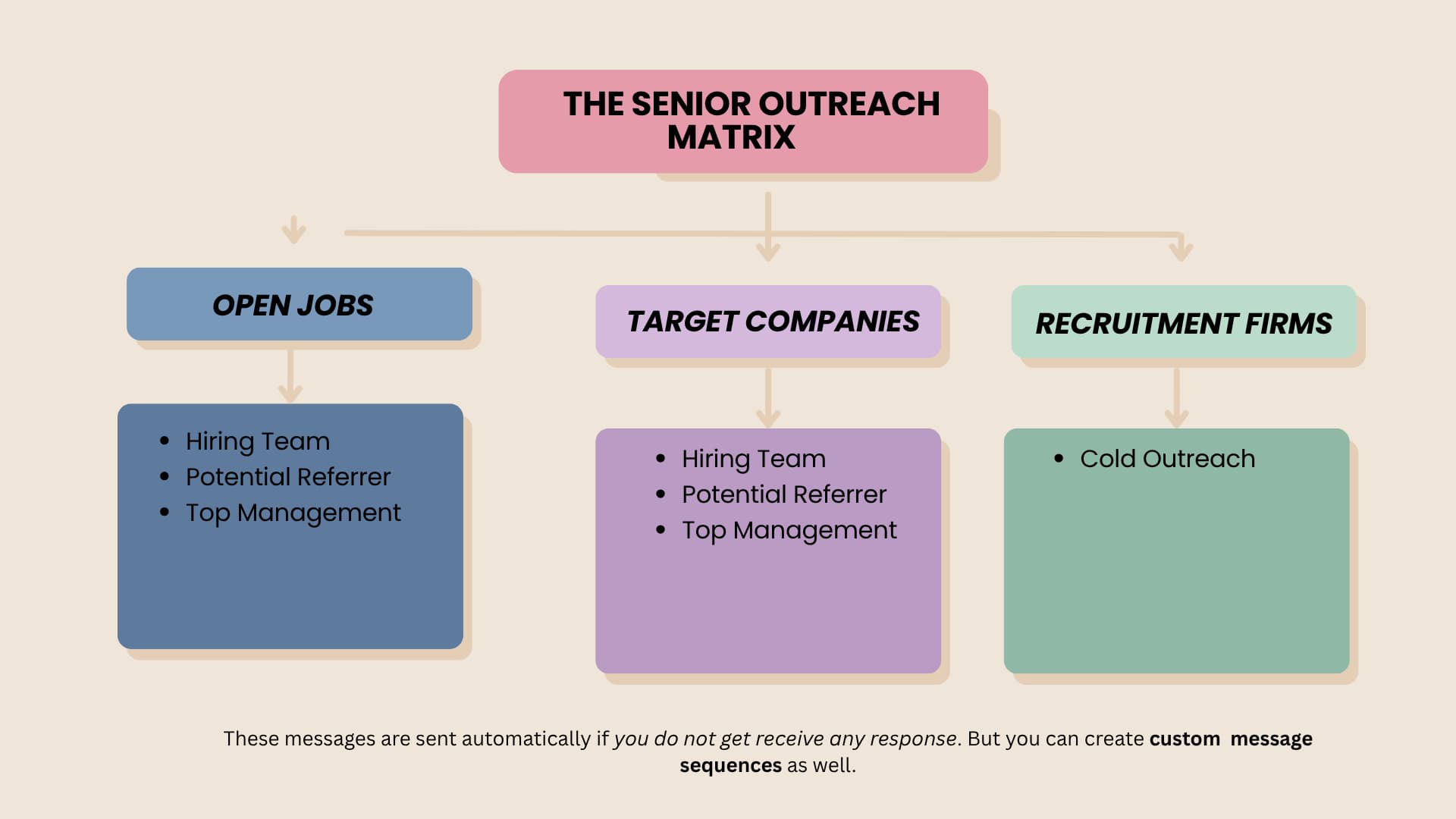
At the 20+ year level, outreach cannot rely on static text. It must be dynamically personalized to match the recipient's specific business context, utilizing clear parameters like {firstName}, {jobTitle}, and {companyName} within structured, multi-step sequences.
Below is the strategic anatomy of the primary sequences managed by the system:
Recruiters vs Hiring Managers vs Referrers: Who Should You Contact?
Executing a high-yield linkedin networking strategy requires understanding that different stakeholders serve completely different functions in your transition pipeline.
To optimize your operational energy, you must build multiple access pathways into your target companies.
Access Pathway | Target Stakeholder | Core Operational Value |
Recruiter Channel | Executive search partners & internal talent heads | Best for active, confidential mandates or corporate mapping. |
Hiring Manager Channel | Functional business heads (VPs, CXOs, CCOs). | Best for co-creating unadvertised roles based on immediate business pain |
Referrer Channel | Executive board members, alumni, and former colleagues. | Bypasses automated gateways and gatekeepers via peer-to-peer trust. |
When recruiters are the right choice
Recruiters are your primary entry point when a company has an active, publicly visible, or retained executive mandate.
The Strategy: Use recruiters to understand the structural boundaries of the role: reporting lines, salary bands, and the board’s immediate expectations. Treat them as valuable resource partners who can help you prepare your strategic win decks before you present to the hiring committee.
When hiring managers are better
Hiring managers, meaning the functional VPs, CXOs, or Managing Directors who own the business unit, are your best target when no active role is advertised, but the company is experiencing visible transition challenges.
The Strategy: Approach them directly with peer-level solutions. By starting a business conversation regarding their active pain points, you can often inspire the creation of a bespoke role designed specifically for your capabilities, bypassing competitive hiring channels entirely.
When referrals create stronger access
A warm introduction from a trusted referrer, such as an advisory board member, a mutual client, or a former business partner, is the highest-yielding access point in executive search.
The Strategy: A referral bypasses both automated screening algorithms and human resource gatekeepers. When a senior decision-maker receives a recommendation from a peer they trust, your profile is immediately reviewed with high authority.
Why alumni networks matter
Do not overlook your executive alumni directories, whether from past organizations or business schools.
The Strategy: Alumni networks operate on an immediate foundation of shared history and trust. Reaching out to a Managing Director at a target firm with a brief, alumni-centric context (such as "As a fellow [University Name] alumnus...") has an exceptionally high conversion rate, transforming cold outreach into a warm, supportive conversation in seconds.
Building multiple paths into target companies
To maximize your transition success, combine these strategies.
The Ideal Scenario: If you want to transition into a target firm, you should connect with the retained executive search recruiter, initiate a peer-level dialogue with the functional hiring head, and seek out mutual alumni to provide internal support. This multi-layered access plan ensures your authority is felt at every level of the decision-making process.
Case Study 3: Gireesha (International Director)
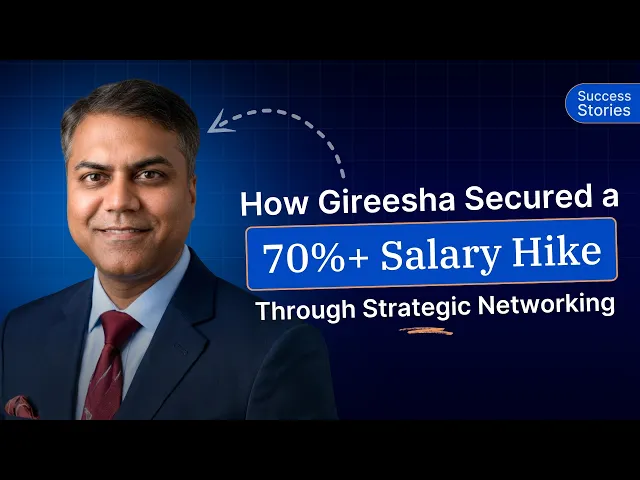
How an executive with 21 years of single-company tenure overcame the portal "black box" to secure a high-paying international leadership role.
Executive Context and Background
Gireesha is a seasoned senior leader who spent 21 dedicated years building, managing, and scaling operations within a single, prominent organization. When he decided to make a transition, he found himself navigating a recruitment market that had changed dramatically since he was last active.
His goal was to secure a high-paying, international director-level leadership role, but his long-term loyalty to one firm made his transition positioning complex.
The Pain Point: The "Black Box" of Automated Portals
Attempting to use traditional channels, Gireesha found that applying through standard job boards felt like throwing his multi-decade history into a silent, unresponsive "black box." Despite being perfectly qualified for the leadership roles he targeted, he received almost zero feedback.
This algorithmic gating created a massive barrier, demonstrating that traditional, volume-focused applications degrade executive status and fail to convey the value of deep, single-company tenure.
The Systemic Implementation: Structured Foundations and CAR Mapping
Recognizing that he needed a strategic approach, Gireesha abandoned cold applications and focused on NxtJob’s structured foundation framework:
CV Reverse Engineering: He restructured his resume, mapping his multi-decade accomplishments to align with his specific executive niche.
SWOT Self-Introspection: He conducted a detailed SWOT analysis to systematically map his strengths, market opportunities, and potential transition risks.
CAR Documentation: He drafted highly polished CAR (Challenge, Action, Result) statements to document the massive business value he had generated over his 21-year career.
Strategic Relationship Building: Using the Networker system, he shifted his focus from passive applications to active relationship design, initiating direct LinkedIn dialogues with senior Vice Presidents to bypass automated HR gateways.
The Quantitative Transition Outcome
To secure his international mandate, Gireesha implemented a highly disciplined, two-stage WIN Strategy:
The Precursor WIN Document: He drafted an initial value-add proposal based on early corporate research to show he understood the target firm's general operational challenges.
The Refined WIN Proposal: After securing a call and discussing specific pain points directly with the hiring manager, he delivered a second, highly tailored proposal mapping his exact solutions.
This unique, relationship-first methodology proved to be the ultimate differentiator.
By focusing on NxtJob's playbooks and strategic access models rather than simple resume-builder features, Gireesha bypassed traditional corporate barriers and successfully transitioned into a high-paying, international senior director-level role
Common LinkedIn Outreach Mistakes Senior Professionals Make
Even with decades of executive experience, many leadership candidates fall into operational traps that quietly derail their job search networking efforts. By recognizing and correcting these common mistakes, you can instantly improve your outreach conversion rate.
Sending generic messages
Recruiters and business heads receive dozens of generic, automated outreach messages every week. If your message reads like a template that could have been sent to any industry or any company, it will be ignored. Always customize your hook, your proof metrics, and your business context to the specific individual you are targeting.
Asking for jobs immediately
The fastest way to shut down a potential transition conversation is to ask for a job in your very first message. This immediately shifts the dynamic from a peer-level professional exchange of ideas to a transactional negotiation. Always focus your initial outreach on building a relationship, sharing insights, or exploring mutual alignments.
Contacting the wrong recruiter
As detailed previously, targeting agency recruiters who focus on high-volume, mid-level roles is a major waste of executive energy. Always audit a recruiter’s profile, post history, and placement record before reaching out. Ensure they actively operate in your salary and seniority bracket.
Ignoring follow-ups
Many senior professionals send a single, well-crafted message, receive no response, and assume there is no interest. But in executive hiring, timelines are long and corporate calendars are demanding. Failing to execute a polite, value-led follow-up sequence means leaving half of your potential transition pipeline completely untapped.
Treating networking as a one-time activity
If you only initiate job search networking when you are actively looking for a new role, you are operating reactively. This approach can sometimes lead to rushed transitions and compromised positioning. Build and maintain your professional network consistently, cultivating relationships with key executive search consultants even when you are fully satisfied with your current role.
Focusing only on recruiters
While executive search consultants are vital partners, they are only one part of the opportunity network. Over-indexing on recruiters while ignoring direct functional heads, industry referrers, and alumni networks means ignoring your highest-yielding access channels. Build multiple access pathways into every target organization.
Why Recruiter Outreach Alone Is Not Enough
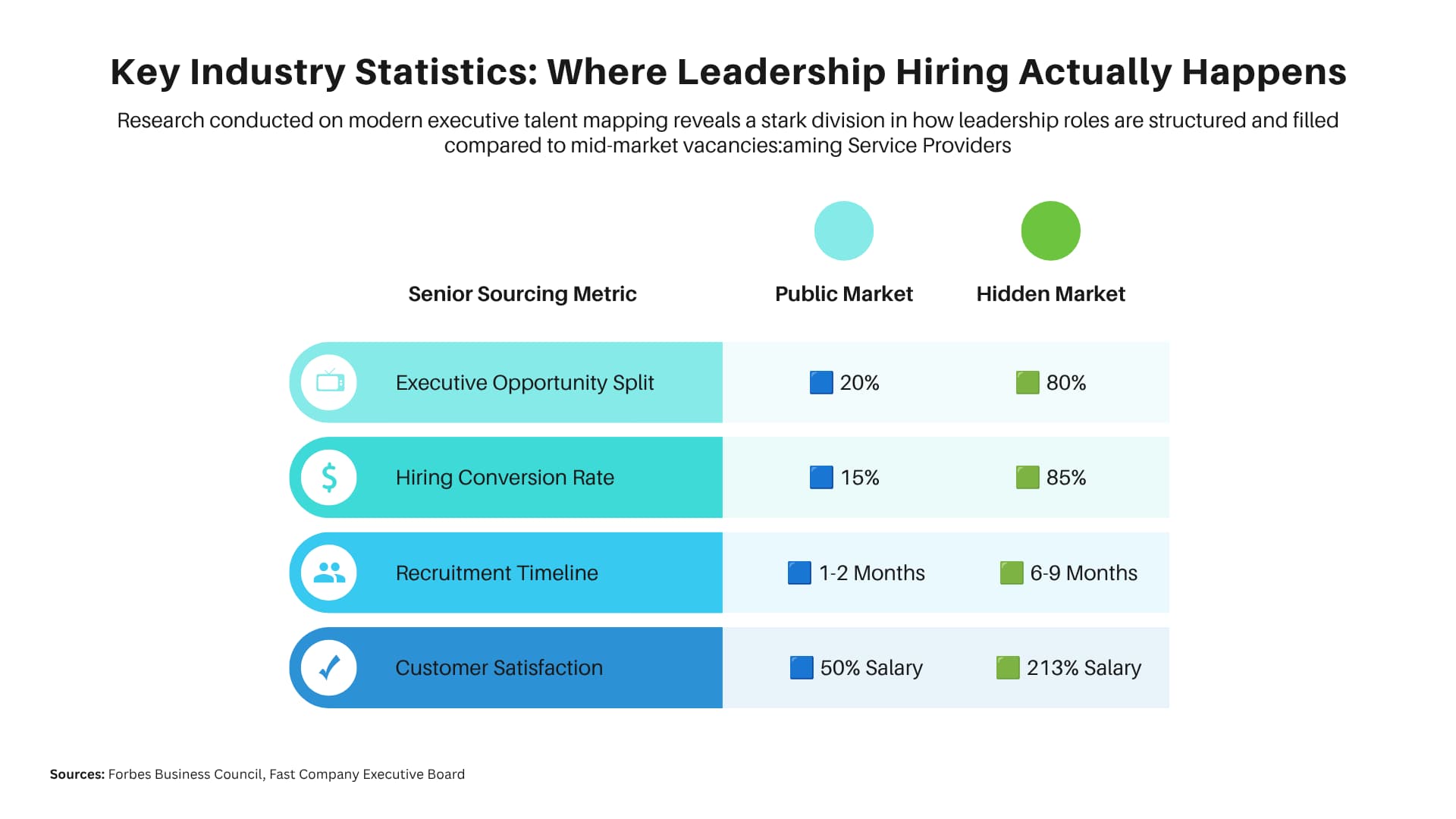
The core takeaway for any senior leader evaluating their next transition is simple: senior opportunities move through people before they move through portals.
Hiring Model | Sourcing Workflow | Ultimate Executive Yield |
Portal-Led Hiring | Apply Online -> ATS Keyword Filtering -> HR Screening Call | Low-yield. Dilutes executive positioning and authority. |
Relationship-Led Sourcing | Referrer/Alumni Introduction -> Retained Search Partner -> Functional C-Suite Head -> Strategic Offer | High-yield. Secures unadvertised mandates and maximizes comp negotiation. |
While learning how to write better outreach messages is important, recruiter outreach alone is rarely sufficient. A successful, high-value executive transition requires multiple systems working together:
An authority-driven personal brand on LinkedIn to attract inbound headhunters.
An off-portal discovery engine to map the hidden job market.
A peer-level interview presence and company-specific win decks to prove your strategic ROI.
A systematic negotiation framework to evaluate and maximize your total compensation package.
Relying on manual, ad-hoc execution across all these channels leads to operational fatigue and missed opportunities. To transition successfully without turning your job search into a stressful, second full-time job, you need an integrated operating system.
This is why NxtJob.ai built Networker.
How NxtJob.ai Helps Senior Professionals Build a Networking System
NxtJob.ai does not leave senior professionals alone to navigate the complexities of a modern transition. We provide an integrated, executive-level operating infrastructure driven by structured workflows and expert, human-led guidance.
Active System Agent | Core Workflow Integration | Strategic Outcome for Transition |
Nova | Slices your target niche and directs your roadmap. | Routes your transition focus with zero manual guesswork. |
Networker | Maps retained partners, automates variables, tracks pipeline. | Manages outreach systematically without bulk-spamming. |
Pitcher | Sours insider corporate research to build strategic presentations. | Proves your immediate business value before the final board round. |
inside your personalized NxtJob.ai career workspace, this system streamlines every phase of your transition:
Sourcing hidden opportunities
The Hunter system scans across off-portal sources, private databases, and hiring indicators to surface high-value, confidential senior roles that never reach public job boards.
Strategic sourcing
Your central career command center, Nova, analyzes each opportunity, maps your target companies, and identifies the exact internal talent heads and retained executive search partners you need to target.
Streamlined outreach
Using Networker, our specialized access system, you can instantly generate highly customized, peer-level outreach drafts that incorporate your specific career metrics, mutual connections, and company-specific business context.
Automated follow-up logistics
Networker tracks every single outreach campaign across your transition pipeline. It systematically alerts you when to follow up, drafts respectful reminder messages, and ensures your pipeline remains consistently warm with minimal daily effort.
Pipeline tracking
Your unified NxtJob.ai dashboard categorizes your entire executive pipeline into four clear, operational stages, giving you total visibility and control over your transition journey:
Pipeline Column | Operational Stage | Strategic Next Step |
Sent | Initial connection sequence or InMail sent. | Monitor for acceptance and prepare the secondary follow-up. |
Accepted | Invites approved; contact is registered in your executive network. | Networker prepares the value-led case pitch automatically. |
Engagement | Active, peer-level message exchange or scheduled introductory call. | Transition relationship to discuss target business problems. |
Converted | Outreach has successfully moved into a formal hiring loop. | Prepare company-specific win decks with the Pitcher agent. |
Rejected | Closed, archived, or paused campaign paths. | Log and save details for future market mapping reference. |
By taking the mechanical friction, database tracking, and template drafting out of your job search, NxtJob.ai lets you focus on what you do best: leading organizations, delivering value, and having high-stakes business conversations.
Conclusion
The best way to reach out to a recruiter on LinkedIn is not simply to write better messages. It is to build a better, more integrated networking system.
For senior professionals with over 20 years of experience, a successful career transition is an exercise in strategic positioning. You do not win high-value mandates by appearing on mass portals or pleading for open vacancies.
You win them by presenting your multi-decade career as an elegant, low-risk solution to an organization’s active business pain.
Through strategic relationships, warm referrals, retained recruiting partners, functional heads, and organized follow-up pipelines, you can reclaim your executive leverage and take complete control over your professional future.
See how NxtJob.ai helps senior professionals build a structured, dignified networking and outreach system through recruiters, referrals, alumni, and decision-makers.
Frequently Asked Questions
1. What is the best way to reach out to an executive recruiter on LinkedIn?
Establish peer status by focusing on business outcomes instead of vacancies. Do not send cold resumes. Instead, introduce yourself with clear operational scale and propose a ten-minute introductory call to exchange high-level industry insights. This positions you as a solutions partner.
2. How do I find recruiters on LinkedIn who specialize in senior-level or VP mandates?
Filter out mid-level contingency recruiters. Use Boolean search strings on LinkedIn to target partners at retained search firms (using terms like "Partner" and "Retained Search"). Alternatively, use NxtJob's automated system to map target organizations and pinpoint matching search partners.
3. How do I message recruiters on LinkedIn without sounding desperate or losing my leverage?
Never ask for a job or career favors. Instead, frame your introduction as a peer-level exchange of market intelligence. Shifting your messaging from seeking work to sharing a proven business case study demonstrates clear domain authority and preserves your executive dignity.
4. Should I send my executive resume in my first message to a LinkedIn recruiter?
No, sending a cold resume is a positioning mistake that lowers your perceived market value. Focus first on establishing professional rapport and securing an introductory conversation. You can share your customized resume once mutual interest is established during your discussion.
5. How do I manage a confidential job search on LinkedIn if I have 20+ years of experience?
Disable LinkedIn profile updates to keep changes quiet, and avoid public badges. Manage your campaign securely inside a private workspace like NxtJob’s Networker. This keeps your transition entirely confidential until you choose to schedule formal board interviews.

As a co-founder and CEO of NxtJob.ai, I help mid and senior level professionals land 3-5 job offers within 3 months with a substantial salary hike. I am an Internationally Certified Career Coach, Resume Writing Expert, Job Interview and LinkedIn Strategist, and a Motivational Speaker.
Richik Sinha Roy
Creative Strategist & Copywriter
Recent articles

Resume
5 min read
ATS Resume Format: How to Create a Resume That Gets Past Applicant Tracking Systems
Learn how to create an ATS-friendly resume that passes through applicant tracking systems and increases your chances of landing an interview.
Resume
5 min read
ATS Resume Format: How to Create a Resume That Gets Past Applicant Tracking Systems
Learn how to create an ATS-friendly resume that passes through applicant tracking systems and increases your chances of landing an interview.
Resume
5 min read
ATS Resume Format: How to Create a Resume That Gets Past Applicant Tracking Systems
Learn how to create an ATS-friendly resume that passes through applicant tracking systems and increases your chances of landing an interview.
Resume
5 min read
ATS Resume Format: How to Create a Resume That Gets Past Applicant Tracking Systems
Learn how to create an ATS-friendly resume that passes through applicant tracking systems and increases your chances of landing an interview.
Resume
5 min read
ATS Resume Format: How to Create a Resume That Gets Past Applicant Tracking Systems
Learn how to create an ATS-friendly resume that passes through applicant tracking systems and increases your chances of landing an interview.
Resume
5 min read
ATS Resume Format: How to Create a Resume That Gets Past Applicant Tracking Systems
Learn how to create an ATS-friendly resume that passes through applicant tracking systems and increases your chances of landing an interview.
Everything you need to know
Here you can find solutions to all your queries.
Job search
15 min read
How to Reach Out to a Recruiter on LinkedIn: A Senior Professional’s Guide
Published Date:
|
Last Modified:
Most executive job seekers believe their career transition hinges on finding a "magic" message template. They spend hours adjusting introductions, hoping the perfect arrangement of words will unlock a hidden opportunity.
But senior professionals with over 20 years of experience know the challenge runs much deeper. At the leadership level (where compensation packages exceed ₹50 LPA to ₹1 Cr), opportunities are rarely won through bulk applications.
Relying on public portals can actually erode your professional authority, as automated screening algorithms strip away your strategic value.
The reality is that elite senior opportunities are secured long before positions are publicly advertised. They are built through quiet, structured, and deliberate conversations with trusted industry partners. Learning how to reach out to a recruiter on LinkedIn is not an isolated tactical task; it is one part of a systematic access strategy designed to protect your professional dignity.
Why Senior Leaders Need an Outreach Operating System
The manual friction of managing an executive transition can quickly exhaust even the most disciplined leader.
When you are balancing a highly demanding current role, attempting to source prospects, customize introductions, follow up on silent threads, and track status across multiple companies leads to execution fatigue.
Traditional networking often looks like a chaotic mess of browser tabs, bookmarked LinkedIn profiles, and outdated spreadsheets. This ad-hoc approach is not only time-consuming but also risky.
When you are managing communications manually, you are highly likely to miss critical follow-up opportunities, allow warm conversations to go cold, or send rushed messages that compromise your seniority.
To maintain your executive authority and transition systematically, you must move away from manual tracking and adopt an outreach operating system.
Inside NxtJob.ai, this infrastructure is managed by Networker, your specialized executive networking agent
Traditional Networking | NxtJob's Networker System |
Searching profiles on LinkedIn ad-hoc | Sourcing highly targeted corporate partners and search partners |
Copy-pasting raw templates and modifying variables manually | Automating peer-level contextual drafting |
Forgetting follow-up windows and timelines | Triggering structured, respectful follow-up sequences |
Sifting through scattered spreadsheets and browser tabs | Tracking active campaigns across a unified workspace pipeline |
The Networker system acts as your structural coordinator. Rather than relying on spam automation, Networker organizes your outreach into a highly visible, five-column pipeline: Sent, Accepted, Engagement, Converted, and Rejected.
This visual system ensures that your pipeline remains consistent without turning your transition into a stressful, second full-time job. It preserves your highly personalized standards while eliminating the administrative friction of follow-up management.
Case Study 1: Srinivasan Shankar (20+ Years - Enterprise-scale Solution Architect)
Background and Executive Context
Srinivasan Shankar is an enterprise-scale Solution Architect with over 20 years of experience designing complex technology infrastructures.
Following a sudden departure from a major technology firm, he felt deeply motivated to prove both to his previous employer and to himself that he possessed the capability to bounce back rapidly without taking months to find his next leadership landing.
The Pain Point: "Nervous Energy" and the ChatGPT Resume Trap
Before joining NxtJob, Srinivasan described his transition process as highly nervous, fragmented, and directionless. He felt as if he was driving a car in "sixth gear," hitting every obstacle on the road with no clear path.
To find a way out, he spent ₹17,000 to ₹18,000 on generic subscriptions (such as Naukri and Founded) and worked with a third-party consulting firm (MyPM) that promised to apply to jobs on his behalf. These services yielded no results.
Srinivasan was manually applying to five jobs a day, using ChatGPT to customize his resume for every single job description. The AI simply stuffed JD keywords into his resume, creating an inflated, artificial profile.
While this automated optimization did get him interviews, he found himself completely unable to meet the expectations of the interviewers because he did not even know what achievements ChatGPT had fabricated on his resume.
He was trapped in a demoralizing cycle, taking multiple interviews but losing out on final offers from premium organizations (including PwC, TCS, Callaway Golf, and Coforge), leading him to describe himself as a "duki atma" (sad soul) in his weekly progress feedback.
The Strategic Pivot: Reverse-Engineering and Systemic LinkedIn Networking
Onboarding with NxtJob required Srinivasan to go through a complete unlearning process. Instead of attempting to force his background to fit every single job description, he implemented NxtJob's core reverse-engineering model (Richic's brainchild), putting only what he had actually accomplished into his resume.
He adopted the 70% match rule, only targeting roles where his natural, multi-decade career history was already a 70% baseline match to the job description, achieving minimum customization effort for maximum conversion probability.
He then transitioned his networking approach on LinkedIn. Rather than using cold, transactional job-seeking messages, he focused his energy on building high-trust professional relationships with enterprise leaders and executive search consultants.
While these connections did not always lead to immediate hires, they created an indirect referral network, where industry leaders actively introduced him to other C-suite decision-makers.
The Quantitative Transition Outcome
By focusing his operational energy, Srinivasan's efforts became concentrated like a magnifying glass burning paper. He ran his transition pipeline like an active call center, taking technical interviews every single morning, afternoon, and evening.
During his final evaluation loop for a senior Solution Architect mandate (Syntax), he navigated a rigorous, continuous 1.5-hour process. In this loop, four different stakeholders (including the regional Managing Director and Senior Vice President) interviewed him back-to-back on a single call, resulting in a direct, high-value offer.
Finally, to secure his target package, Srinivasan used NxtJob's negotiation simulator on "hard mode" to practice his compensation discussions 10 to 15 times, breaking past his previous assumptions and successfully graduating with four premium offers.
Before You Connect: Fix These Four Positioning Pillars First
A well-crafted outreach message cannot compensate for weak or confusing positioning on your profile. Before you begin to use Networker to connect with recruiters on LinkedIn, you must audit your digital presence.
If an executive search consultant clicks on your profile and sees an outdated resume, a generic headline, or a passive tone, they will archive your message. Your profile must match your seniority.
Positioning Pillar | Core Executive Focus | Common Pitfalls to Avoid |
1. Role Focus | Specializing in a clear, high-relevance domain (e.g., Enterprise Cloud Architecture). | Sounding "flexible" or open to general management, which dilutes authority. |
2. Headline Audit | Stating your executive title, domain, and the specific scale of your past impact. | Using passive, looking-for-work phrases such as "Seeking Next Opportunity." |
3. About Narrative | Crafting a strategic business story outlining P&L, team headcount, and turnarounds. | Listing tactical, chronological task lists instead of strategic leadership outcomes. |
4. Quantified Metrics | Proving your multi-decade value through clear revenue, efficiency, and cost metrics. | Making general, qualitative claims like "highly collaborative leader." |
1. Clarify your target role
At the 20+ year level, sounding "flexible" is a positioning risk. If your profile suggests you are open to being a VP of Operations, a Head of Customer Success, or a General Manager of Sales, you appear unfocused.
Executive search consultants look for specialists who possess deep, authoritative solutions to specific problems. Define your target niche clearly (such as SaaS Scale-Up Operations or Enterprise Cloud Architecture) and align your entire profile with that single direction.
2. Optimize your LinkedIn headline
Your headline is your billboard. It is the first thing a recruiter sees when your profile appears in search results or message previews.
What to avoid: Generic, passive phrases like "Experienced Leader Looking for Next Opportunity" or "VP of Operations, Open to New Roles." This signals that you are out of options.
What to use: A clear statement of your title, your specialized domain, and the scale of your past impact.
Example: "VP of Operations | Scaling SaaS Infrastructure from ₹50Cr to ₹200Cr ARR | Restructuring Cross-Functional Teams"
3. Strengthen your About section
Your LinkedIn "About" section should read like a strategic executive summary, not a chronological list of tasks.
The Hook: Start with a strong, definitive statement of your business philosophy or core specialization.
The Scale: Outline the parameters of your leadership: budget size (P&L), team size, geographic footprint, and major business turnarounds.
The Narrative: Connect your multi-decade journey into a coherent story of compounding value, demonstrating why you are a low-risk, high-return hire for your target firms.
4. Demonstrate measurable business impact
At the senior level, qualitative claims like "results-driven leader" or "excellent communication skills" carry very little weight. Your profile must prove your value through quantified metrics.
Wherever possible, illustrate your career achievements with clear numbers:
Before: "Managed regional sales operations and grew market share."
After: "Directed regional sales operations across South Asia, expanding market share by 24% and growing annual revenue from ₹40Cr to ₹110Cr within 36 months."
Note: The way you position yourself on LinkedIn must align with your physical resume. To ensure your offline assets match your digital authority, review our guide on How to Make an ATS-Friendly Resume.
The 6-Stage LinkedIn Access Pipeline (Networker Workflow)
To prevent your transition from feeling like a series of disconnected, stressful activities, NxtJob.ai organizes your linkedin networking strategy into a highly structured, 6-stage operational pipeline.
This workflow integrates our browser utility directly with your LinkedIn profile, turning manual networking into an organized access campaign.
Access Stage | Sourcing Step | Operational Value |
Stage 1 | Download Browser Extension | Creates the essential bridge to manage pipeline data from your active tab. |
Stage 2 | Connect LinkedIn Profile | Securely integrates and syncs LinkedIn communication records into your dashboard. |
Stage 3 | Sourcing Target Roles (Hunter) | Identifies stable, high-growth target companies using off-portal intelligence. |
Stage 4 | Mapping Key Contacts | Filters and isolates high-value hiring managers, alumni, and search partners. |
Stage 5 | Triggering Outreach Sequences | Despatches personalized sequences using targeted variable configurations. |
Stage 6 | Kanban Pipeline Management | Tracks and converts candidate contacts systematically toward formal interviews. |
Stage 1: Download the NxtJob.ai extension
Your journey begins by installing the NxtJob.ai browser utility. This lightweight application serves as your primary bridge, allowing you to extract profiles, save contacts, and manage sequences directly from your active LinkedIn browser tab.
Stage 2: Connect your LinkedIn profile
Once the utility is installed, authenticate and connect your LinkedIn profile to your NxtJob.ai workspace. This secure integration allows the Networker system to sync your connections, visualize your message histories, and prepare customized outreach drafts directly in your dashboard.
Stage 3: Discover target companies via Hunter
Before reaching out to individuals, you must define where you want to work. Use NxtJob.ai’s Hunter system to scan corporate records, funding databases, and hidden growth signals to locate companies that match your career roadmap.
Save these companies and their active, unadvertised roles directly to your workspace.
Stage 4: Map relevant recruiters and hiring managers
With your target companies locked, use the extension on LinkedIn to identify the exact decision-makers inside those firms.
Networker filters for the high-value contacts you need: the senior internal talent partners, the retained search consultants, and the functional managers (such as VPs or CXOs) who would serve as your direct manager.
Stage 5: Trigger your targeted message sequences
Rather than sending isolated, manually typed introductions, select a contact and launch your targeted messaging sequence. You can choose the highly vetted default sequence or customize your own multi-step cadence.
The initial connection invite utilizes NxtJob’s custom variables, automatically auto-filling fields like {firstName}, {jobTitle}, and {companyName} within LinkedIn’s strict 300-character limit, ensuring perfect personalization without manual copy-paste errors.
Sequence Step | Message Type | Automation Scope |
Step 1 | Connection Request (Limit: 300 characters) | Auto-fills {firstName} and {companyName} dynamically based on profile extraction. |
Step 2 | Pitch Message (Wait 1 day if no reply) | Networker pauses for 24 hours, monitors approval status, and drafts follow-up with zero manual copy-paste. |
Stage 6: Manage your pipeline column by column
As your outreach campaigns progress, manage your contacts across your visual Kanban workspace. Move cards from Sent to Accepted as connections are established.
Once a peer-level dialogue begins, transition the card to Engagement. The ultimate operational goal of this systematic pipeline is to move your target contacts into the Converted column, signaling that you have secured an interview call or received a direct confirmation that your leadership interview has been scheduled.
Executive Discovery: How to Find the Right Recruiters on LinkedIn
One of the most common reasons senior professionals experience low response rates is that they target the wrong individuals. When executing a linkedin networking strategy, you must understand the distinct tiers of recruiters and focus your limited energy on those who actually manage high-level mandates.
Recruiter Type | Operational Scope | Strategic Value to Senior Candidates |
Retained Search Firms | Exclusively hired by boards to quietly place VP and CXO talent. | High. Builds long-term relationships and maps hidden market portfolios. |
Internal Talent Teams | Full-time corporate recruiters managing company-wide hiring portfolios. | Medium. Direct access to internal stakeholders but focused on volume metrics. |
Contingency Agencies | Sourcing general mid-to-low level candidates paid upon placement. | Low. Volume-driven matches with very few executive mandates. |
Internal recruiters
These are full-time employees of your target companies, typically carrying titles like Director of Leadership Recruiting or Head of Executive Talent Acquisition.
Why they matter: They have direct, unmediated access to the hiring business heads and understand the confidential strategic changes happening inside the firm.
How to approach: Focus your outreach on their long-term talent-mapping initiatives.
Agency recruiters
These are external, third-party recruiters who work across multiple client portfolios.
The Caveat: Many agency recruiters operate on a contingency basis, meaning they are only paid if their candidate is hired. Because of this, they tend to focus on high-volume, mid-level roles and may not manage senior executive positions.
The Rule: Only invest time in agency recruiters who have a visible, proven track record of placing senior leadership talent in your specific domain.
Executive search recruiters
These are highly specialized partners at global search firms (such as Korn Ferry, Spencer Stuart, or boutique leadership consultancies).
Why they are critical: They are paid retained fees upfront to discreetly map the market for VP, CXO, and Board-level roles. They value relationships over transaction volume.
How to approach: Introduce your profile as a strategic asset for their upcoming, highly confidential briefs.
Recruiters inside target companies
When searching for internal recruiters on LinkedIn, use highly specific search queries to filter out junior coordinators:
Target Search Query: "Director of Executive Search" AND [Your Target Company Name] or "Head of Leadership Hiring" AND [Target Sector].
Signs you're contacting the wrong recruiter
To save your operational energy, learn to recognize when a recruiter is unlikely to be helpful:
Their active LinkedIn posts and shared roles target junior or mid-level competencies.
They work across highly unrelated domains, such as a recruiter handling both retail sales roles and enterprise cybersecurity mandates.
Their profile shows a high volume of transactional, bulk postings without any focus on executive leadership or corporate strategy.
Case Study 2: Runali (Expert in SAP Record-to-Report (R2R) financial systems)
Executive Context and Background
Runali is an experienced operations executive specializing in SAP Record-to-Report (R2R) financial systems. For several years, she worked demanding US corporate shifts, a lifestyle that eventually led to severe health issues and physical burnout.
Following a medical warning where her doctor ordered immediate recovery steps, Runali realized she needed a strategic transition to a premium, day-shift SAP R2R role to protect her health and reclaim her career momentum.
The Pain Point: Shift Burnout and the Failure of Cold Portals
Prior to NxtJob, Runali spent over six months actively searching the market. She spent money across multiple paid portals, including Naukri, Facebook ads, Indeed, and LinkedIn Premium, but received only a single interview call during that entire half-year period. She felt as though she was dumping her professional energy into a black hole.
Her search was unstructured, relying on a single general resume that listed her operational tasks rather than her business impact. Working continuous overnight shifts while managing an unsuccessful, manual job hunt left her physically exhausted and professionally discouraged.
The Systemic Implementation: Customization and Corporate Culture Mapping
Runali decided to treat her career transition as a rigorous professional project, committing at least two hours of focused effort daily to the process. Her strategic pivot included:
Networking over Applications: Runali stopped applying blindly to open portals. She used NxtJob's referral-led networking frameworks to identify senior managers and executive search partners on LinkedIn, bypassing HR gatekeepers.
ATS Optimization with Quantified Metrics: Using the Tailor agent, she audited her resume. Instead of fabricating achievements, she polished her phrasing to focus on how her SAP R2R process optimizations historically reduced corporate overhead and streamlined financial reporting, which elevated her ATS score.
Deconstruction of Corporate Culture: She systematically studied her target organizations, mapping her past achievements to match their visible culture, mission, and strategic goals.
The Quantitative Transition Outcome
Runali practiced her interview loops using NxtJob's AI-powered Interviewer platform to prepare for real-world scenarios. During her technical rounds, she introduced a company-specific WIN Deck (a strategic presentation analyzing her target firm's financial bottleneck challenges), which deeply impressed European stakeholders and immediately accelerated her to the final board rounds.
Finally, using the Negotiation GPT database, Runali mapped standard market rates for senior SAP R2R roles. By keeping her salary discussions open-ended and refusing to disclose her specific expectations too early in the process, she successfully navigated HR salary boundaries to secure a 28% salary hike and transition into a premium, day-shift SAP R2R role.
Peer-Level Message Construction on LinkedIn
Once you have identified your strategic targets, your outreach message must be designed to stand out from the noise in an executive search consultant’s inbox. To message recruiters on LinkedIn successfully, you must match your copy to the specific psychology of senior hiring.
What recruiters actually want to see
Executive recruiters are not looking for generalists; they are looking for specific solutions to clear problems. When they read your message, they want to see three things immediately:
Immediate Context: Why are you reaching out to them specifically?
Quantified Authority: What scale of business operations have you directed?
Low-friction Call to Action: What is the specific, low-commitment next step you are proposing?
What to include in your first message
Your initial message should be highly structured and strictly under 150 words:
The Hook: Reference a mutual connection, a shared sector insight, or a confidential transition occurring at their target client firm.
The Scale Statement: State your primary executive title, your domain specialization, and a quantified metric proving your past outcome-delivery.
The Low-Friction Request: Propose a brief, 10-minute exchange of market insights regarding upcoming trends in your domain.
What to avoid
To preserve your premium positioning, eliminate these common mistakes from your messaging:
Do not ask for a job: Asking "Do you have any open roles for me?" immediately casts you as a transactional supplicant.
Do not attach your resume immediately: Sending a cold resume suggests you are desperate for an immediate opening. Propose a conversation first; share your resume once professional interest is established.
Do not send essays: Long paragraphs detailing your entire 20-year career history are overwhelming. Keep your outreach concise, direct, and outcome-led.
When to follow up
In executive search, silence does not necessarily mean rejection. Executive recruiters are incredibly busy, often balancing multiple active mandates, client alignment meetings, and board briefings.
If they do not respond to your initial message, wait 5 to 7 business days before sending a polite, value-led follow-up.
How often to follow up
Limit your follow-up sequence to two respectful touches after your initial message.
The Rule: If you do not receive a response after three total messages, spaced across 2 to 3 weeks, pause your outreach to that specific contact.
Why: Continuing to message a silent inbox erodes your professional status and can lead to your profile being flagged as spam. Maintain your professional dignity by moving on to other high-value targets in your pipeline.
The Anatomy of NxtJob’s Executive Messaging Blueprints
At the 20+ year level, outreach cannot rely on static text. It must be dynamically personalized to match the recipient's specific business context, utilizing clear parameters like {firstName}, {jobTitle}, and {companyName} within structured, multi-step sequences.
Below is the strategic anatomy of the primary sequences managed by the system:
Recruiters vs Hiring Managers vs Referrers: Who Should You Contact?
Executing a high-yield linkedin networking strategy requires understanding that different stakeholders serve completely different functions in your transition pipeline.
To optimize your operational energy, you must build multiple access pathways into your target companies.
Access Pathway | Target Stakeholder | Core Operational Value |
Recruiter Channel | Executive search partners & internal talent heads | Best for active, confidential mandates or corporate mapping. |
Hiring Manager Channel | Functional business heads (VPs, CXOs, CCOs). | Best for co-creating unadvertised roles based on immediate business pain |
Referrer Channel | Executive board members, alumni, and former colleagues. | Bypasses automated gateways and gatekeepers via peer-to-peer trust. |
When recruiters are the right choice
Recruiters are your primary entry point when a company has an active, publicly visible, or retained executive mandate.
The Strategy: Use recruiters to understand the structural boundaries of the role: reporting lines, salary bands, and the board’s immediate expectations. Treat them as valuable resource partners who can help you prepare your strategic win decks before you present to the hiring committee.
When hiring managers are better
Hiring managers, meaning the functional VPs, CXOs, or Managing Directors who own the business unit, are your best target when no active role is advertised, but the company is experiencing visible transition challenges.
The Strategy: Approach them directly with peer-level solutions. By starting a business conversation regarding their active pain points, you can often inspire the creation of a bespoke role designed specifically for your capabilities, bypassing competitive hiring channels entirely.
When referrals create stronger access
A warm introduction from a trusted referrer, such as an advisory board member, a mutual client, or a former business partner, is the highest-yielding access point in executive search.
The Strategy: A referral bypasses both automated screening algorithms and human resource gatekeepers. When a senior decision-maker receives a recommendation from a peer they trust, your profile is immediately reviewed with high authority.
Why alumni networks matter
Do not overlook your executive alumni directories, whether from past organizations or business schools.
The Strategy: Alumni networks operate on an immediate foundation of shared history and trust. Reaching out to a Managing Director at a target firm with a brief, alumni-centric context (such as "As a fellow [University Name] alumnus...") has an exceptionally high conversion rate, transforming cold outreach into a warm, supportive conversation in seconds.
Building multiple paths into target companies
To maximize your transition success, combine these strategies.
The Ideal Scenario: If you want to transition into a target firm, you should connect with the retained executive search recruiter, initiate a peer-level dialogue with the functional hiring head, and seek out mutual alumni to provide internal support. This multi-layered access plan ensures your authority is felt at every level of the decision-making process.
Case Study 3: Gireesha (International Director)
How an executive with 21 years of single-company tenure overcame the portal "black box" to secure a high-paying international leadership role.
Executive Context and Background
Gireesha is a seasoned senior leader who spent 21 dedicated years building, managing, and scaling operations within a single, prominent organization. When he decided to make a transition, he found himself navigating a recruitment market that had changed dramatically since he was last active.
His goal was to secure a high-paying, international director-level leadership role, but his long-term loyalty to one firm made his transition positioning complex.
The Pain Point: The "Black Box" of Automated Portals
Attempting to use traditional channels, Gireesha found that applying through standard job boards felt like throwing his multi-decade history into a silent, unresponsive "black box." Despite being perfectly qualified for the leadership roles he targeted, he received almost zero feedback.
This algorithmic gating created a massive barrier, demonstrating that traditional, volume-focused applications degrade executive status and fail to convey the value of deep, single-company tenure.
The Systemic Implementation: Structured Foundations and CAR Mapping
Recognizing that he needed a strategic approach, Gireesha abandoned cold applications and focused on NxtJob’s structured foundation framework:
CV Reverse Engineering: He restructured his resume, mapping his multi-decade accomplishments to align with his specific executive niche.
SWOT Self-Introspection: He conducted a detailed SWOT analysis to systematically map his strengths, market opportunities, and potential transition risks.
CAR Documentation: He drafted highly polished CAR (Challenge, Action, Result) statements to document the massive business value he had generated over his 21-year career.
Strategic Relationship Building: Using the Networker system, he shifted his focus from passive applications to active relationship design, initiating direct LinkedIn dialogues with senior Vice Presidents to bypass automated HR gateways.
The Quantitative Transition Outcome
To secure his international mandate, Gireesha implemented a highly disciplined, two-stage WIN Strategy:
The Precursor WIN Document: He drafted an initial value-add proposal based on early corporate research to show he understood the target firm's general operational challenges.
The Refined WIN Proposal: After securing a call and discussing specific pain points directly with the hiring manager, he delivered a second, highly tailored proposal mapping his exact solutions.
This unique, relationship-first methodology proved to be the ultimate differentiator.
By focusing on NxtJob's playbooks and strategic access models rather than simple resume-builder features, Gireesha bypassed traditional corporate barriers and successfully transitioned into a high-paying, international senior director-level role
Common LinkedIn Outreach Mistakes Senior Professionals Make
Even with decades of executive experience, many leadership candidates fall into operational traps that quietly derail their job search networking efforts. By recognizing and correcting these common mistakes, you can instantly improve your outreach conversion rate.
Sending generic messages
Recruiters and business heads receive dozens of generic, automated outreach messages every week. If your message reads like a template that could have been sent to any industry or any company, it will be ignored. Always customize your hook, your proof metrics, and your business context to the specific individual you are targeting.
Asking for jobs immediately
The fastest way to shut down a potential transition conversation is to ask for a job in your very first message. This immediately shifts the dynamic from a peer-level professional exchange of ideas to a transactional negotiation. Always focus your initial outreach on building a relationship, sharing insights, or exploring mutual alignments.
Contacting the wrong recruiter
As detailed previously, targeting agency recruiters who focus on high-volume, mid-level roles is a major waste of executive energy. Always audit a recruiter’s profile, post history, and placement record before reaching out. Ensure they actively operate in your salary and seniority bracket.
Ignoring follow-ups
Many senior professionals send a single, well-crafted message, receive no response, and assume there is no interest. But in executive hiring, timelines are long and corporate calendars are demanding. Failing to execute a polite, value-led follow-up sequence means leaving half of your potential transition pipeline completely untapped.
Treating networking as a one-time activity
If you only initiate job search networking when you are actively looking for a new role, you are operating reactively. This approach can sometimes lead to rushed transitions and compromised positioning. Build and maintain your professional network consistently, cultivating relationships with key executive search consultants even when you are fully satisfied with your current role.
Focusing only on recruiters
While executive search consultants are vital partners, they are only one part of the opportunity network. Over-indexing on recruiters while ignoring direct functional heads, industry referrers, and alumni networks means ignoring your highest-yielding access channels. Build multiple access pathways into every target organization.
Why Recruiter Outreach Alone Is Not Enough
The core takeaway for any senior leader evaluating their next transition is simple: senior opportunities move through people before they move through portals.
Hiring Model | Sourcing Workflow | Ultimate Executive Yield |
Portal-Led Hiring | Apply Online -> ATS Keyword Filtering -> HR Screening Call | Low-yield. Dilutes executive positioning and authority. |
Relationship-Led Sourcing | Referrer/Alumni Introduction -> Retained Search Partner -> Functional C-Suite Head -> Strategic Offer | High-yield. Secures unadvertised mandates and maximizes comp negotiation. |
While learning how to write better outreach messages is important, recruiter outreach alone is rarely sufficient. A successful, high-value executive transition requires multiple systems working together:
An authority-driven personal brand on LinkedIn to attract inbound headhunters.
An off-portal discovery engine to map the hidden job market.
A peer-level interview presence and company-specific win decks to prove your strategic ROI.
A systematic negotiation framework to evaluate and maximize your total compensation package.
Relying on manual, ad-hoc execution across all these channels leads to operational fatigue and missed opportunities. To transition successfully without turning your job search into a stressful, second full-time job, you need an integrated operating system.
This is why NxtJob.ai built Networker.
How NxtJob.ai Helps Senior Professionals Build a Networking System
NxtJob.ai does not leave senior professionals alone to navigate the complexities of a modern transition. We provide an integrated, executive-level operating infrastructure driven by structured workflows and expert, human-led guidance.
Active System Agent | Core Workflow Integration | Strategic Outcome for Transition |
Nova | Slices your target niche and directs your roadmap. | Routes your transition focus with zero manual guesswork. |
Networker | Maps retained partners, automates variables, tracks pipeline. | Manages outreach systematically without bulk-spamming. |
Pitcher | Sours insider corporate research to build strategic presentations. | Proves your immediate business value before the final board round. |
inside your personalized NxtJob.ai career workspace, this system streamlines every phase of your transition:
Sourcing hidden opportunities
The Hunter system scans across off-portal sources, private databases, and hiring indicators to surface high-value, confidential senior roles that never reach public job boards.
Strategic sourcing
Your central career command center, Nova, analyzes each opportunity, maps your target companies, and identifies the exact internal talent heads and retained executive search partners you need to target.
Streamlined outreach
Using Networker, our specialized access system, you can instantly generate highly customized, peer-level outreach drafts that incorporate your specific career metrics, mutual connections, and company-specific business context.
Automated follow-up logistics
Networker tracks every single outreach campaign across your transition pipeline. It systematically alerts you when to follow up, drafts respectful reminder messages, and ensures your pipeline remains consistently warm with minimal daily effort.
Pipeline tracking
Your unified NxtJob.ai dashboard categorizes your entire executive pipeline into four clear, operational stages, giving you total visibility and control over your transition journey:
Pipeline Column | Operational Stage | Strategic Next Step |
Sent | Initial connection sequence or InMail sent. | Monitor for acceptance and prepare the secondary follow-up. |
Accepted | Invites approved; contact is registered in your executive network. | Networker prepares the value-led case pitch automatically. |
Engagement | Active, peer-level message exchange or scheduled introductory call. | Transition relationship to discuss target business problems. |
Converted | Outreach has successfully moved into a formal hiring loop. | Prepare company-specific win decks with the Pitcher agent. |
Rejected | Closed, archived, or paused campaign paths. | Log and save details for future market mapping reference. |
By taking the mechanical friction, database tracking, and template drafting out of your job search, NxtJob.ai lets you focus on what you do best: leading organizations, delivering value, and having high-stakes business conversations.
Conclusion
The best way to reach out to a recruiter on LinkedIn is not simply to write better messages. It is to build a better, more integrated networking system.
For senior professionals with over 20 years of experience, a successful career transition is an exercise in strategic positioning. You do not win high-value mandates by appearing on mass portals or pleading for open vacancies.
You win them by presenting your multi-decade career as an elegant, low-risk solution to an organization’s active business pain.
Through strategic relationships, warm referrals, retained recruiting partners, functional heads, and organized follow-up pipelines, you can reclaim your executive leverage and take complete control over your professional future.
See how NxtJob.ai helps senior professionals build a structured, dignified networking and outreach system through recruiters, referrals, alumni, and decision-makers.
Frequently Asked Questions
1. What is the best way to reach out to an executive recruiter on LinkedIn?
Establish peer status by focusing on business outcomes instead of vacancies. Do not send cold resumes. Instead, introduce yourself with clear operational scale and propose a ten-minute introductory call to exchange high-level industry insights. This positions you as a solutions partner.
2. How do I find recruiters on LinkedIn who specialize in senior-level or VP mandates?
Filter out mid-level contingency recruiters. Use Boolean search strings on LinkedIn to target partners at retained search firms (using terms like "Partner" and "Retained Search"). Alternatively, use NxtJob's automated system to map target organizations and pinpoint matching search partners.
3. How do I message recruiters on LinkedIn without sounding desperate or losing my leverage?
Never ask for a job or career favors. Instead, frame your introduction as a peer-level exchange of market intelligence. Shifting your messaging from seeking work to sharing a proven business case study demonstrates clear domain authority and preserves your executive dignity.
4. Should I send my executive resume in my first message to a LinkedIn recruiter?
No, sending a cold resume is a positioning mistake that lowers your perceived market value. Focus first on establishing professional rapport and securing an introductory conversation. You can share your customized resume once mutual interest is established during your discussion.
5. How do I manage a confidential job search on LinkedIn if I have 20+ years of experience?
Disable LinkedIn profile updates to keep changes quiet, and avoid public badges. Manage your campaign securely inside a private workspace like NxtJob’s Networker. This keeps your transition entirely confidential until you choose to schedule formal board interviews.
Table of content
Interview
Salary Negotiation With HR: How Senior Professionals Should Handle the Conversation
Learn how senior professionals can handle salary negotiation with HR, respond to pushback, protect their value, and avoid underselling themselves.
Resume
How to Make an ATS-Friendly Resume: Format, Tips, and Examples for Experienced Professionals
Learn how to make an ATS-friendly resume with the right format, keywords, structure, and role-specific details for experienced professionals.
As a co-founder and CEO of NxtJob.ai, I help mid and senior level professionals land 3-5 job offers within 3 months with a substantial salary hike. I am an Internationally Certified Career Coach, Resume Writing Expert, Job Interview and LinkedIn Strategist, and a Motivational Speaker.
Richik Sinha Roy
Creative Strategist & Copywriter
Everything you need to know
Here you can find solutions to all your queries.
Job search
15 min read
How to Reach Out to a Recruiter on LinkedIn: A Senior Professional’s Guide
Published Date:
|
Last Modified:
Most executive job seekers believe their career transition hinges on finding a "magic" message template. They spend hours adjusting introductions, hoping the perfect arrangement of words will unlock a hidden opportunity.
But senior professionals with over 20 years of experience know the challenge runs much deeper. At the leadership level (where compensation packages exceed ₹50 LPA to ₹1 Cr), opportunities are rarely won through bulk applications.
Relying on public portals can actually erode your professional authority, as automated screening algorithms strip away your strategic value.
The reality is that elite senior opportunities are secured long before positions are publicly advertised. They are built through quiet, structured, and deliberate conversations with trusted industry partners. Learning how to reach out to a recruiter on LinkedIn is not an isolated tactical task; it is one part of a systematic access strategy designed to protect your professional dignity.
Why Senior Leaders Need an Outreach Operating System
The manual friction of managing an executive transition can quickly exhaust even the most disciplined leader.
When you are balancing a highly demanding current role, attempting to source prospects, customize introductions, follow up on silent threads, and track status across multiple companies leads to execution fatigue.
Traditional networking often looks like a chaotic mess of browser tabs, bookmarked LinkedIn profiles, and outdated spreadsheets. This ad-hoc approach is not only time-consuming but also risky.
When you are managing communications manually, you are highly likely to miss critical follow-up opportunities, allow warm conversations to go cold, or send rushed messages that compromise your seniority.
To maintain your executive authority and transition systematically, you must move away from manual tracking and adopt an outreach operating system.
Inside NxtJob.ai, this infrastructure is managed by Networker, your specialized executive networking agent
Traditional Networking | NxtJob's Networker System |
Searching profiles on LinkedIn ad-hoc | Sourcing highly targeted corporate partners and search partners |
Copy-pasting raw templates and modifying variables manually | Automating peer-level contextual drafting |
Forgetting follow-up windows and timelines | Triggering structured, respectful follow-up sequences |
Sifting through scattered spreadsheets and browser tabs | Tracking active campaigns across a unified workspace pipeline |
The Networker system acts as your structural coordinator. Rather than relying on spam automation, Networker organizes your outreach into a highly visible, five-column pipeline: Sent, Accepted, Engagement, Converted, and Rejected.
This visual system ensures that your pipeline remains consistent without turning your transition into a stressful, second full-time job. It preserves your highly personalized standards while eliminating the administrative friction of follow-up management.
Case Study 1: Srinivasan Shankar (20+ Years - Enterprise-scale Solution Architect)
Background and Executive Context
Srinivasan Shankar is an enterprise-scale Solution Architect with over 20 years of experience designing complex technology infrastructures.
Following a sudden departure from a major technology firm, he felt deeply motivated to prove both to his previous employer and to himself that he possessed the capability to bounce back rapidly without taking months to find his next leadership landing.
The Pain Point: "Nervous Energy" and the ChatGPT Resume Trap
Before joining NxtJob, Srinivasan described his transition process as highly nervous, fragmented, and directionless. He felt as if he was driving a car in "sixth gear," hitting every obstacle on the road with no clear path.
To find a way out, he spent ₹17,000 to ₹18,000 on generic subscriptions (such as Naukri and Founded) and worked with a third-party consulting firm (MyPM) that promised to apply to jobs on his behalf. These services yielded no results.
Srinivasan was manually applying to five jobs a day, using ChatGPT to customize his resume for every single job description. The AI simply stuffed JD keywords into his resume, creating an inflated, artificial profile.
While this automated optimization did get him interviews, he found himself completely unable to meet the expectations of the interviewers because he did not even know what achievements ChatGPT had fabricated on his resume.
He was trapped in a demoralizing cycle, taking multiple interviews but losing out on final offers from premium organizations (including PwC, TCS, Callaway Golf, and Coforge), leading him to describe himself as a "duki atma" (sad soul) in his weekly progress feedback.
The Strategic Pivot: Reverse-Engineering and Systemic LinkedIn Networking
Onboarding with NxtJob required Srinivasan to go through a complete unlearning process. Instead of attempting to force his background to fit every single job description, he implemented NxtJob's core reverse-engineering model (Richic's brainchild), putting only what he had actually accomplished into his resume.
He adopted the 70% match rule, only targeting roles where his natural, multi-decade career history was already a 70% baseline match to the job description, achieving minimum customization effort for maximum conversion probability.
He then transitioned his networking approach on LinkedIn. Rather than using cold, transactional job-seeking messages, he focused his energy on building high-trust professional relationships with enterprise leaders and executive search consultants.
While these connections did not always lead to immediate hires, they created an indirect referral network, where industry leaders actively introduced him to other C-suite decision-makers.
The Quantitative Transition Outcome
By focusing his operational energy, Srinivasan's efforts became concentrated like a magnifying glass burning paper. He ran his transition pipeline like an active call center, taking technical interviews every single morning, afternoon, and evening.
During his final evaluation loop for a senior Solution Architect mandate (Syntax), he navigated a rigorous, continuous 1.5-hour process. In this loop, four different stakeholders (including the regional Managing Director and Senior Vice President) interviewed him back-to-back on a single call, resulting in a direct, high-value offer.
Finally, to secure his target package, Srinivasan used NxtJob's negotiation simulator on "hard mode" to practice his compensation discussions 10 to 15 times, breaking past his previous assumptions and successfully graduating with four premium offers.
Before You Connect: Fix These Four Positioning Pillars First
A well-crafted outreach message cannot compensate for weak or confusing positioning on your profile. Before you begin to use Networker to connect with recruiters on LinkedIn, you must audit your digital presence.
If an executive search consultant clicks on your profile and sees an outdated resume, a generic headline, or a passive tone, they will archive your message. Your profile must match your seniority.
Positioning Pillar | Core Executive Focus | Common Pitfalls to Avoid |
1. Role Focus | Specializing in a clear, high-relevance domain (e.g., Enterprise Cloud Architecture). | Sounding "flexible" or open to general management, which dilutes authority. |
2. Headline Audit | Stating your executive title, domain, and the specific scale of your past impact. | Using passive, looking-for-work phrases such as "Seeking Next Opportunity." |
3. About Narrative | Crafting a strategic business story outlining P&L, team headcount, and turnarounds. | Listing tactical, chronological task lists instead of strategic leadership outcomes. |
4. Quantified Metrics | Proving your multi-decade value through clear revenue, efficiency, and cost metrics. | Making general, qualitative claims like "highly collaborative leader." |
1. Clarify your target role
At the 20+ year level, sounding "flexible" is a positioning risk. If your profile suggests you are open to being a VP of Operations, a Head of Customer Success, or a General Manager of Sales, you appear unfocused.
Executive search consultants look for specialists who possess deep, authoritative solutions to specific problems. Define your target niche clearly (such as SaaS Scale-Up Operations or Enterprise Cloud Architecture) and align your entire profile with that single direction.
2. Optimize your LinkedIn headline
Your headline is your billboard. It is the first thing a recruiter sees when your profile appears in search results or message previews.
What to avoid: Generic, passive phrases like "Experienced Leader Looking for Next Opportunity" or "VP of Operations, Open to New Roles." This signals that you are out of options.
What to use: A clear statement of your title, your specialized domain, and the scale of your past impact.
Example: "VP of Operations | Scaling SaaS Infrastructure from ₹50Cr to ₹200Cr ARR | Restructuring Cross-Functional Teams"
3. Strengthen your About section
Your LinkedIn "About" section should read like a strategic executive summary, not a chronological list of tasks.
The Hook: Start with a strong, definitive statement of your business philosophy or core specialization.
The Scale: Outline the parameters of your leadership: budget size (P&L), team size, geographic footprint, and major business turnarounds.
The Narrative: Connect your multi-decade journey into a coherent story of compounding value, demonstrating why you are a low-risk, high-return hire for your target firms.
4. Demonstrate measurable business impact
At the senior level, qualitative claims like "results-driven leader" or "excellent communication skills" carry very little weight. Your profile must prove your value through quantified metrics.
Wherever possible, illustrate your career achievements with clear numbers:
Before: "Managed regional sales operations and grew market share."
After: "Directed regional sales operations across South Asia, expanding market share by 24% and growing annual revenue from ₹40Cr to ₹110Cr within 36 months."
Note: The way you position yourself on LinkedIn must align with your physical resume. To ensure your offline assets match your digital authority, review our guide on How to Make an ATS-Friendly Resume.
The 6-Stage LinkedIn Access Pipeline (Networker Workflow)
To prevent your transition from feeling like a series of disconnected, stressful activities, NxtJob.ai organizes your linkedin networking strategy into a highly structured, 6-stage operational pipeline.
This workflow integrates our browser utility directly with your LinkedIn profile, turning manual networking into an organized access campaign.
Access Stage | Sourcing Step | Operational Value |
Stage 1 | Download Browser Extension | Creates the essential bridge to manage pipeline data from your active tab. |
Stage 2 | Connect LinkedIn Profile | Securely integrates and syncs LinkedIn communication records into your dashboard. |
Stage 3 | Sourcing Target Roles (Hunter) | Identifies stable, high-growth target companies using off-portal intelligence. |
Stage 4 | Mapping Key Contacts | Filters and isolates high-value hiring managers, alumni, and search partners. |
Stage 5 | Triggering Outreach Sequences | Despatches personalized sequences using targeted variable configurations. |
Stage 6 | Kanban Pipeline Management | Tracks and converts candidate contacts systematically toward formal interviews. |
Stage 1: Download the NxtJob.ai extension
Your journey begins by installing the NxtJob.ai browser utility. This lightweight application serves as your primary bridge, allowing you to extract profiles, save contacts, and manage sequences directly from your active LinkedIn browser tab.
Stage 2: Connect your LinkedIn profile
Once the utility is installed, authenticate and connect your LinkedIn profile to your NxtJob.ai workspace. This secure integration allows the Networker system to sync your connections, visualize your message histories, and prepare customized outreach drafts directly in your dashboard.
Stage 3: Discover target companies via Hunter
Before reaching out to individuals, you must define where you want to work. Use NxtJob.ai’s Hunter system to scan corporate records, funding databases, and hidden growth signals to locate companies that match your career roadmap.
Save these companies and their active, unadvertised roles directly to your workspace.
Stage 4: Map relevant recruiters and hiring managers
With your target companies locked, use the extension on LinkedIn to identify the exact decision-makers inside those firms.
Networker filters for the high-value contacts you need: the senior internal talent partners, the retained search consultants, and the functional managers (such as VPs or CXOs) who would serve as your direct manager.
Stage 5: Trigger your targeted message sequences
Rather than sending isolated, manually typed introductions, select a contact and launch your targeted messaging sequence. You can choose the highly vetted default sequence or customize your own multi-step cadence.
The initial connection invite utilizes NxtJob’s custom variables, automatically auto-filling fields like {firstName}, {jobTitle}, and {companyName} within LinkedIn’s strict 300-character limit, ensuring perfect personalization without manual copy-paste errors.
Sequence Step | Message Type | Automation Scope |
Step 1 | Connection Request (Limit: 300 characters) | Auto-fills {firstName} and {companyName} dynamically based on profile extraction. |
Step 2 | Pitch Message (Wait 1 day if no reply) | Networker pauses for 24 hours, monitors approval status, and drafts follow-up with zero manual copy-paste. |
Stage 6: Manage your pipeline column by column
As your outreach campaigns progress, manage your contacts across your visual Kanban workspace. Move cards from Sent to Accepted as connections are established.
Once a peer-level dialogue begins, transition the card to Engagement. The ultimate operational goal of this systematic pipeline is to move your target contacts into the Converted column, signaling that you have secured an interview call or received a direct confirmation that your leadership interview has been scheduled.
Executive Discovery: How to Find the Right Recruiters on LinkedIn
One of the most common reasons senior professionals experience low response rates is that they target the wrong individuals. When executing a linkedin networking strategy, you must understand the distinct tiers of recruiters and focus your limited energy on those who actually manage high-level mandates.
Recruiter Type | Operational Scope | Strategic Value to Senior Candidates |
Retained Search Firms | Exclusively hired by boards to quietly place VP and CXO talent. | High. Builds long-term relationships and maps hidden market portfolios. |
Internal Talent Teams | Full-time corporate recruiters managing company-wide hiring portfolios. | Medium. Direct access to internal stakeholders but focused on volume metrics. |
Contingency Agencies | Sourcing general mid-to-low level candidates paid upon placement. | Low. Volume-driven matches with very few executive mandates. |
Internal recruiters
These are full-time employees of your target companies, typically carrying titles like Director of Leadership Recruiting or Head of Executive Talent Acquisition.
Why they matter: They have direct, unmediated access to the hiring business heads and understand the confidential strategic changes happening inside the firm.
How to approach: Focus your outreach on their long-term talent-mapping initiatives.
Agency recruiters
These are external, third-party recruiters who work across multiple client portfolios.
The Caveat: Many agency recruiters operate on a contingency basis, meaning they are only paid if their candidate is hired. Because of this, they tend to focus on high-volume, mid-level roles and may not manage senior executive positions.
The Rule: Only invest time in agency recruiters who have a visible, proven track record of placing senior leadership talent in your specific domain.
Executive search recruiters
These are highly specialized partners at global search firms (such as Korn Ferry, Spencer Stuart, or boutique leadership consultancies).
Why they are critical: They are paid retained fees upfront to discreetly map the market for VP, CXO, and Board-level roles. They value relationships over transaction volume.
How to approach: Introduce your profile as a strategic asset for their upcoming, highly confidential briefs.
Recruiters inside target companies
When searching for internal recruiters on LinkedIn, use highly specific search queries to filter out junior coordinators:
Target Search Query: "Director of Executive Search" AND [Your Target Company Name] or "Head of Leadership Hiring" AND [Target Sector].
Signs you're contacting the wrong recruiter
To save your operational energy, learn to recognize when a recruiter is unlikely to be helpful:
Their active LinkedIn posts and shared roles target junior or mid-level competencies.
They work across highly unrelated domains, such as a recruiter handling both retail sales roles and enterprise cybersecurity mandates.
Their profile shows a high volume of transactional, bulk postings without any focus on executive leadership or corporate strategy.
Case Study 2: Runali (Expert in SAP Record-to-Report (R2R) financial systems)
Executive Context and Background
Runali is an experienced operations executive specializing in SAP Record-to-Report (R2R) financial systems. For several years, she worked demanding US corporate shifts, a lifestyle that eventually led to severe health issues and physical burnout.
Following a medical warning where her doctor ordered immediate recovery steps, Runali realized she needed a strategic transition to a premium, day-shift SAP R2R role to protect her health and reclaim her career momentum.
The Pain Point: Shift Burnout and the Failure of Cold Portals
Prior to NxtJob, Runali spent over six months actively searching the market. She spent money across multiple paid portals, including Naukri, Facebook ads, Indeed, and LinkedIn Premium, but received only a single interview call during that entire half-year period. She felt as though she was dumping her professional energy into a black hole.
Her search was unstructured, relying on a single general resume that listed her operational tasks rather than her business impact. Working continuous overnight shifts while managing an unsuccessful, manual job hunt left her physically exhausted and professionally discouraged.
The Systemic Implementation: Customization and Corporate Culture Mapping
Runali decided to treat her career transition as a rigorous professional project, committing at least two hours of focused effort daily to the process. Her strategic pivot included:
Networking over Applications: Runali stopped applying blindly to open portals. She used NxtJob's referral-led networking frameworks to identify senior managers and executive search partners on LinkedIn, bypassing HR gatekeepers.
ATS Optimization with Quantified Metrics: Using the Tailor agent, she audited her resume. Instead of fabricating achievements, she polished her phrasing to focus on how her SAP R2R process optimizations historically reduced corporate overhead and streamlined financial reporting, which elevated her ATS score.
Deconstruction of Corporate Culture: She systematically studied her target organizations, mapping her past achievements to match their visible culture, mission, and strategic goals.
The Quantitative Transition Outcome
Runali practiced her interview loops using NxtJob's AI-powered Interviewer platform to prepare for real-world scenarios. During her technical rounds, she introduced a company-specific WIN Deck (a strategic presentation analyzing her target firm's financial bottleneck challenges), which deeply impressed European stakeholders and immediately accelerated her to the final board rounds.
Finally, using the Negotiation GPT database, Runali mapped standard market rates for senior SAP R2R roles. By keeping her salary discussions open-ended and refusing to disclose her specific expectations too early in the process, she successfully navigated HR salary boundaries to secure a 28% salary hike and transition into a premium, day-shift SAP R2R role.
Peer-Level Message Construction on LinkedIn
Once you have identified your strategic targets, your outreach message must be designed to stand out from the noise in an executive search consultant’s inbox. To message recruiters on LinkedIn successfully, you must match your copy to the specific psychology of senior hiring.
What recruiters actually want to see
Executive recruiters are not looking for generalists; they are looking for specific solutions to clear problems. When they read your message, they want to see three things immediately:
Immediate Context: Why are you reaching out to them specifically?
Quantified Authority: What scale of business operations have you directed?
Low-friction Call to Action: What is the specific, low-commitment next step you are proposing?
What to include in your first message
Your initial message should be highly structured and strictly under 150 words:
The Hook: Reference a mutual connection, a shared sector insight, or a confidential transition occurring at their target client firm.
The Scale Statement: State your primary executive title, your domain specialization, and a quantified metric proving your past outcome-delivery.
The Low-Friction Request: Propose a brief, 10-minute exchange of market insights regarding upcoming trends in your domain.
What to avoid
To preserve your premium positioning, eliminate these common mistakes from your messaging:
Do not ask for a job: Asking "Do you have any open roles for me?" immediately casts you as a transactional supplicant.
Do not attach your resume immediately: Sending a cold resume suggests you are desperate for an immediate opening. Propose a conversation first; share your resume once professional interest is established.
Do not send essays: Long paragraphs detailing your entire 20-year career history are overwhelming. Keep your outreach concise, direct, and outcome-led.
When to follow up
In executive search, silence does not necessarily mean rejection. Executive recruiters are incredibly busy, often balancing multiple active mandates, client alignment meetings, and board briefings.
If they do not respond to your initial message, wait 5 to 7 business days before sending a polite, value-led follow-up.
How often to follow up
Limit your follow-up sequence to two respectful touches after your initial message.
The Rule: If you do not receive a response after three total messages, spaced across 2 to 3 weeks, pause your outreach to that specific contact.
Why: Continuing to message a silent inbox erodes your professional status and can lead to your profile being flagged as spam. Maintain your professional dignity by moving on to other high-value targets in your pipeline.
The Anatomy of NxtJob’s Executive Messaging Blueprints
At the 20+ year level, outreach cannot rely on static text. It must be dynamically personalized to match the recipient's specific business context, utilizing clear parameters like {firstName}, {jobTitle}, and {companyName} within structured, multi-step sequences.
Below is the strategic anatomy of the primary sequences managed by the system:
Recruiters vs Hiring Managers vs Referrers: Who Should You Contact?
Executing a high-yield linkedin networking strategy requires understanding that different stakeholders serve completely different functions in your transition pipeline.
To optimize your operational energy, you must build multiple access pathways into your target companies.
Access Pathway | Target Stakeholder | Core Operational Value |
Recruiter Channel | Executive search partners & internal talent heads | Best for active, confidential mandates or corporate mapping. |
Hiring Manager Channel | Functional business heads (VPs, CXOs, CCOs). | Best for co-creating unadvertised roles based on immediate business pain |
Referrer Channel | Executive board members, alumni, and former colleagues. | Bypasses automated gateways and gatekeepers via peer-to-peer trust. |
When recruiters are the right choice
Recruiters are your primary entry point when a company has an active, publicly visible, or retained executive mandate.
The Strategy: Use recruiters to understand the structural boundaries of the role: reporting lines, salary bands, and the board’s immediate expectations. Treat them as valuable resource partners who can help you prepare your strategic win decks before you present to the hiring committee.
When hiring managers are better
Hiring managers, meaning the functional VPs, CXOs, or Managing Directors who own the business unit, are your best target when no active role is advertised, but the company is experiencing visible transition challenges.
The Strategy: Approach them directly with peer-level solutions. By starting a business conversation regarding their active pain points, you can often inspire the creation of a bespoke role designed specifically for your capabilities, bypassing competitive hiring channels entirely.
When referrals create stronger access
A warm introduction from a trusted referrer, such as an advisory board member, a mutual client, or a former business partner, is the highest-yielding access point in executive search.
The Strategy: A referral bypasses both automated screening algorithms and human resource gatekeepers. When a senior decision-maker receives a recommendation from a peer they trust, your profile is immediately reviewed with high authority.
Why alumni networks matter
Do not overlook your executive alumni directories, whether from past organizations or business schools.
The Strategy: Alumni networks operate on an immediate foundation of shared history and trust. Reaching out to a Managing Director at a target firm with a brief, alumni-centric context (such as "As a fellow [University Name] alumnus...") has an exceptionally high conversion rate, transforming cold outreach into a warm, supportive conversation in seconds.
Building multiple paths into target companies
To maximize your transition success, combine these strategies.
The Ideal Scenario: If you want to transition into a target firm, you should connect with the retained executive search recruiter, initiate a peer-level dialogue with the functional hiring head, and seek out mutual alumni to provide internal support. This multi-layered access plan ensures your authority is felt at every level of the decision-making process.
Case Study 3: Gireesha (International Director)
How an executive with 21 years of single-company tenure overcame the portal "black box" to secure a high-paying international leadership role.
Executive Context and Background
Gireesha is a seasoned senior leader who spent 21 dedicated years building, managing, and scaling operations within a single, prominent organization. When he decided to make a transition, he found himself navigating a recruitment market that had changed dramatically since he was last active.
His goal was to secure a high-paying, international director-level leadership role, but his long-term loyalty to one firm made his transition positioning complex.
The Pain Point: The "Black Box" of Automated Portals
Attempting to use traditional channels, Gireesha found that applying through standard job boards felt like throwing his multi-decade history into a silent, unresponsive "black box." Despite being perfectly qualified for the leadership roles he targeted, he received almost zero feedback.
This algorithmic gating created a massive barrier, demonstrating that traditional, volume-focused applications degrade executive status and fail to convey the value of deep, single-company tenure.
The Systemic Implementation: Structured Foundations and CAR Mapping
Recognizing that he needed a strategic approach, Gireesha abandoned cold applications and focused on NxtJob’s structured foundation framework:
CV Reverse Engineering: He restructured his resume, mapping his multi-decade accomplishments to align with his specific executive niche.
SWOT Self-Introspection: He conducted a detailed SWOT analysis to systematically map his strengths, market opportunities, and potential transition risks.
CAR Documentation: He drafted highly polished CAR (Challenge, Action, Result) statements to document the massive business value he had generated over his 21-year career.
Strategic Relationship Building: Using the Networker system, he shifted his focus from passive applications to active relationship design, initiating direct LinkedIn dialogues with senior Vice Presidents to bypass automated HR gateways.
The Quantitative Transition Outcome
To secure his international mandate, Gireesha implemented a highly disciplined, two-stage WIN Strategy:
The Precursor WIN Document: He drafted an initial value-add proposal based on early corporate research to show he understood the target firm's general operational challenges.
The Refined WIN Proposal: After securing a call and discussing specific pain points directly with the hiring manager, he delivered a second, highly tailored proposal mapping his exact solutions.
This unique, relationship-first methodology proved to be the ultimate differentiator.
By focusing on NxtJob's playbooks and strategic access models rather than simple resume-builder features, Gireesha bypassed traditional corporate barriers and successfully transitioned into a high-paying, international senior director-level role
Common LinkedIn Outreach Mistakes Senior Professionals Make
Even with decades of executive experience, many leadership candidates fall into operational traps that quietly derail their job search networking efforts. By recognizing and correcting these common mistakes, you can instantly improve your outreach conversion rate.
Sending generic messages
Recruiters and business heads receive dozens of generic, automated outreach messages every week. If your message reads like a template that could have been sent to any industry or any company, it will be ignored. Always customize your hook, your proof metrics, and your business context to the specific individual you are targeting.
Asking for jobs immediately
The fastest way to shut down a potential transition conversation is to ask for a job in your very first message. This immediately shifts the dynamic from a peer-level professional exchange of ideas to a transactional negotiation. Always focus your initial outreach on building a relationship, sharing insights, or exploring mutual alignments.
Contacting the wrong recruiter
As detailed previously, targeting agency recruiters who focus on high-volume, mid-level roles is a major waste of executive energy. Always audit a recruiter’s profile, post history, and placement record before reaching out. Ensure they actively operate in your salary and seniority bracket.
Ignoring follow-ups
Many senior professionals send a single, well-crafted message, receive no response, and assume there is no interest. But in executive hiring, timelines are long and corporate calendars are demanding. Failing to execute a polite, value-led follow-up sequence means leaving half of your potential transition pipeline completely untapped.
Treating networking as a one-time activity
If you only initiate job search networking when you are actively looking for a new role, you are operating reactively. This approach can sometimes lead to rushed transitions and compromised positioning. Build and maintain your professional network consistently, cultivating relationships with key executive search consultants even when you are fully satisfied with your current role.
Focusing only on recruiters
While executive search consultants are vital partners, they are only one part of the opportunity network. Over-indexing on recruiters while ignoring direct functional heads, industry referrers, and alumni networks means ignoring your highest-yielding access channels. Build multiple access pathways into every target organization.
Why Recruiter Outreach Alone Is Not Enough
The core takeaway for any senior leader evaluating their next transition is simple: senior opportunities move through people before they move through portals.
Hiring Model | Sourcing Workflow | Ultimate Executive Yield |
Portal-Led Hiring | Apply Online -> ATS Keyword Filtering -> HR Screening Call | Low-yield. Dilutes executive positioning and authority. |
Relationship-Led Sourcing | Referrer/Alumni Introduction -> Retained Search Partner -> Functional C-Suite Head -> Strategic Offer | High-yield. Secures unadvertised mandates and maximizes comp negotiation. |
While learning how to write better outreach messages is important, recruiter outreach alone is rarely sufficient. A successful, high-value executive transition requires multiple systems working together:
An authority-driven personal brand on LinkedIn to attract inbound headhunters.
An off-portal discovery engine to map the hidden job market.
A peer-level interview presence and company-specific win decks to prove your strategic ROI.
A systematic negotiation framework to evaluate and maximize your total compensation package.
Relying on manual, ad-hoc execution across all these channels leads to operational fatigue and missed opportunities. To transition successfully without turning your job search into a stressful, second full-time job, you need an integrated operating system.
This is why NxtJob.ai built Networker.
How NxtJob.ai Helps Senior Professionals Build a Networking System
NxtJob.ai does not leave senior professionals alone to navigate the complexities of a modern transition. We provide an integrated, executive-level operating infrastructure driven by structured workflows and expert, human-led guidance.
Active System Agent | Core Workflow Integration | Strategic Outcome for Transition |
Nova | Slices your target niche and directs your roadmap. | Routes your transition focus with zero manual guesswork. |
Networker | Maps retained partners, automates variables, tracks pipeline. | Manages outreach systematically without bulk-spamming. |
Pitcher | Sours insider corporate research to build strategic presentations. | Proves your immediate business value before the final board round. |
inside your personalized NxtJob.ai career workspace, this system streamlines every phase of your transition:
Sourcing hidden opportunities
The Hunter system scans across off-portal sources, private databases, and hiring indicators to surface high-value, confidential senior roles that never reach public job boards.
Strategic sourcing
Your central career command center, Nova, analyzes each opportunity, maps your target companies, and identifies the exact internal talent heads and retained executive search partners you need to target.
Streamlined outreach
Using Networker, our specialized access system, you can instantly generate highly customized, peer-level outreach drafts that incorporate your specific career metrics, mutual connections, and company-specific business context.
Automated follow-up logistics
Networker tracks every single outreach campaign across your transition pipeline. It systematically alerts you when to follow up, drafts respectful reminder messages, and ensures your pipeline remains consistently warm with minimal daily effort.
Pipeline tracking
Your unified NxtJob.ai dashboard categorizes your entire executive pipeline into four clear, operational stages, giving you total visibility and control over your transition journey:
Pipeline Column | Operational Stage | Strategic Next Step |
Sent | Initial connection sequence or InMail sent. | Monitor for acceptance and prepare the secondary follow-up. |
Accepted | Invites approved; contact is registered in your executive network. | Networker prepares the value-led case pitch automatically. |
Engagement | Active, peer-level message exchange or scheduled introductory call. | Transition relationship to discuss target business problems. |
Converted | Outreach has successfully moved into a formal hiring loop. | Prepare company-specific win decks with the Pitcher agent. |
Rejected | Closed, archived, or paused campaign paths. | Log and save details for future market mapping reference. |
By taking the mechanical friction, database tracking, and template drafting out of your job search, NxtJob.ai lets you focus on what you do best: leading organizations, delivering value, and having high-stakes business conversations.
Conclusion
The best way to reach out to a recruiter on LinkedIn is not simply to write better messages. It is to build a better, more integrated networking system.
For senior professionals with over 20 years of experience, a successful career transition is an exercise in strategic positioning. You do not win high-value mandates by appearing on mass portals or pleading for open vacancies.
You win them by presenting your multi-decade career as an elegant, low-risk solution to an organization’s active business pain.
Through strategic relationships, warm referrals, retained recruiting partners, functional heads, and organized follow-up pipelines, you can reclaim your executive leverage and take complete control over your professional future.
See how NxtJob.ai helps senior professionals build a structured, dignified networking and outreach system through recruiters, referrals, alumni, and decision-makers.
Frequently Asked Questions
1. What is the best way to reach out to an executive recruiter on LinkedIn?
Establish peer status by focusing on business outcomes instead of vacancies. Do not send cold resumes. Instead, introduce yourself with clear operational scale and propose a ten-minute introductory call to exchange high-level industry insights. This positions you as a solutions partner.
2. How do I find recruiters on LinkedIn who specialize in senior-level or VP mandates?
Filter out mid-level contingency recruiters. Use Boolean search strings on LinkedIn to target partners at retained search firms (using terms like "Partner" and "Retained Search"). Alternatively, use NxtJob's automated system to map target organizations and pinpoint matching search partners.
3. How do I message recruiters on LinkedIn without sounding desperate or losing my leverage?
Never ask for a job or career favors. Instead, frame your introduction as a peer-level exchange of market intelligence. Shifting your messaging from seeking work to sharing a proven business case study demonstrates clear domain authority and preserves your executive dignity.
4. Should I send my executive resume in my first message to a LinkedIn recruiter?
No, sending a cold resume is a positioning mistake that lowers your perceived market value. Focus first on establishing professional rapport and securing an introductory conversation. You can share your customized resume once mutual interest is established during your discussion.
5. How do I manage a confidential job search on LinkedIn if I have 20+ years of experience?
Disable LinkedIn profile updates to keep changes quiet, and avoid public badges. Manage your campaign securely inside a private workspace like NxtJob’s Networker. This keeps your transition entirely confidential until you choose to schedule formal board interviews.
Table of content
Interview
Salary Negotiation With HR: How Senior Professionals Should Handle the Conversation
Learn how senior professionals can handle salary negotiation with HR, respond to pushback, protect their value, and avoid underselling themselves.
Resume
How to Make an ATS-Friendly Resume: Format, Tips, and Examples for Experienced Professionals
Learn how to make an ATS-friendly resume with the right format, keywords, structure, and role-specific details for experienced professionals.
As a co-founder and CEO of NxtJob.ai, I help mid and senior level professionals land 3-5 job offers within 3 months with a substantial salary hike. I am an Internationally Certified Career Coach, Resume Writing Expert, Job Interview and LinkedIn Strategist, and a Motivational Speaker.
Richik Sinha Roy
Creative Strategist & Copywriter
Recent articles
Resume
5 min read
How to Make an ATS-Friendly Resume: Format, Tips, and Examples for Experienced Professionals
Learn how to make an ATS-friendly resume with the right format, keywords, structure, and role-specific details for experienced professionals.
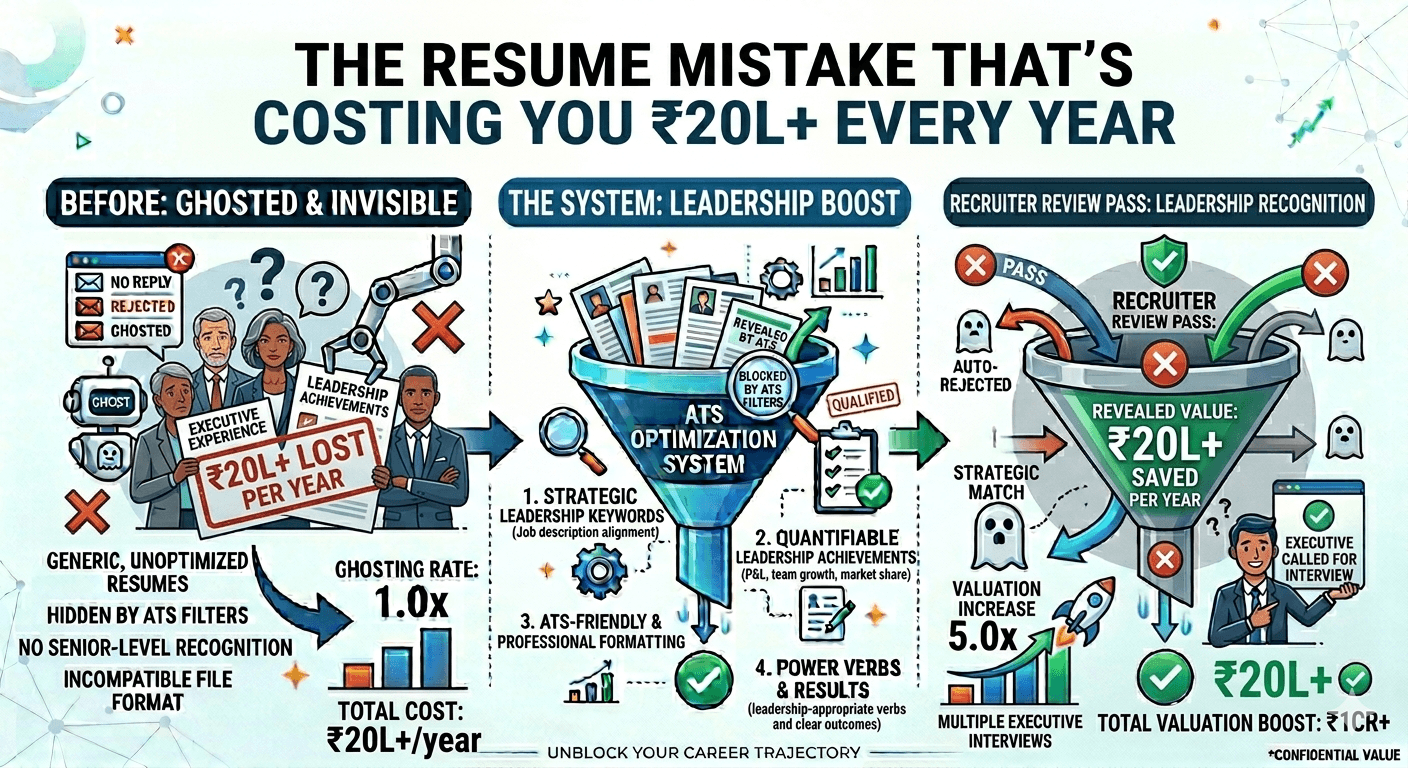
Resume
5 min read
The Resume Mistake That’s Costing You ₹20L+ Every Year
The Resume Mistake That’s Costing You ₹20L+ Every Year
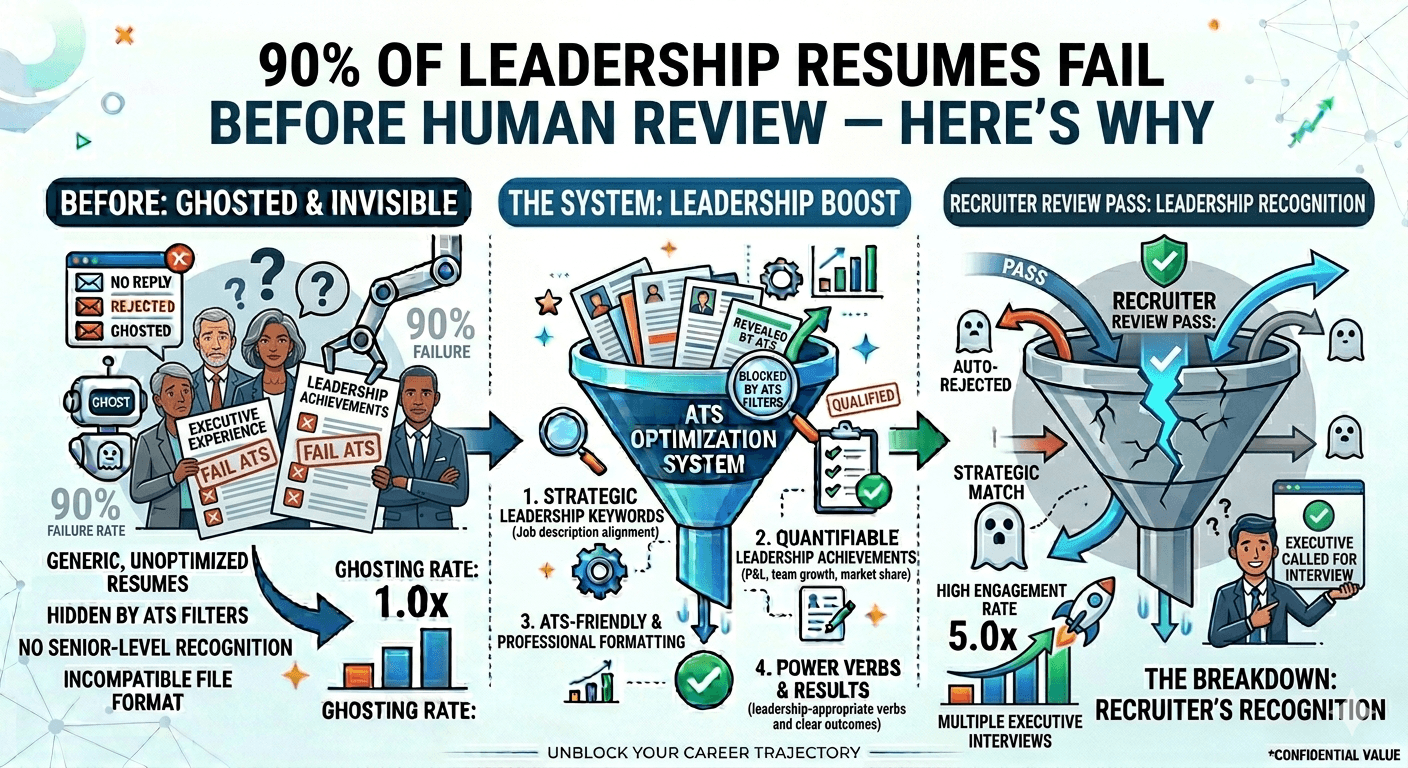
Resume
5 min read
90% of Leadership Resumes Fail Before Human Review - Here’s Why
90% of Leadership Resumes Fail Before Human Review - Here’s Why
Resume
5 min read
How to Make an ATS-Friendly Resume: Format, Tips, and Examples for Experienced Professionals
Learn how to make an ATS-friendly resume with the right format, keywords, structure, and role-specific details for experienced professionals.
Resume
5 min read
The Resume Mistake That’s Costing You ₹20L+ Every Year
The Resume Mistake That’s Costing You ₹20L+ Every Year
Everything you need to know
Here you can find solutions to all your queries.
Join the Revolution
Your AI career copilot to land you top jobs in under 90 days.
A Pinnacle Shift Company
by Richik Sinha Roy
Join the Revolution
Your AI career copilot to land you top jobs in under 90 days.
Join the Revolution
Your AI career copilot to land you top jobs in under 90 days.