
Job search
5 min read
Signs of No Career Growth: How to Recognize Career Stagnation
Published Date:
|
Last Modified:

Let’s be honest—most of us in our late 20s, 30s, or even 40s didn’t step into our careers dreaming of “just surviving.” We worked hard in college, landed decent jobs, pushed through deadlines, and hoped for steady growth. But somewhere along the way, many mid-senior professionals in India hit a strange wall. Promotions slow down, learning plateaus, and every Monday morning starts feeling like déjà vu.
This isn’t always because of lack of talent or effort. Sometimes, it’s because we miss the warning signs of career stagnation. And if you don’t catch these early, years can slip away while your peers leap ahead—or worse, you risk becoming irrelevant in an industry that’s moving fast.
Let’s break down these signs in detail, not from a textbook perspective, but from lived experience—what I’ve seen, what I’ve learned, and what you can look out for.
1. Promotions and Salary Hikes Have Stalled
In India, career growth often gets measured by two things: promotions and salary hikes. If you’ve been in the same role for 3–4 years with only standard appraisals (5–8%) and no meaningful title change, it’s a sign you might be stuck.
If your juniors are catching up in designation.
If you’re doing more work but the role title hasn’t evolved.
If salary increments are not keeping pace with the market.
This is usually the first red flag. It doesn’t always mean your company doesn’t value you—it could also mean you haven’t positioned yourself for growth, or the role itself has limited upward mobility.
2. Your Learning Curve Has Flattened
Remember the excitement of your first 3–5 years? Every project felt like a challenge. You learned new tools, worked with fresh problems, and felt yourself leveling up.
But now, maybe you can do your job with your eyes closed. You’re no longer learning new skills, no longer exposed to newer technologies or business models, and no longer stretching yourself.
For a mid-senior professional, learning stagnation is more dangerous than salary stagnation. Because in India’s job market, outdated skills get punished harshly. Think of how IT professionals who didn’t upgrade from legacy systems to cloud, AI, or modern stacks suddenly found themselves unemployable.
Ask yourself:
When was the last time you learned a skill that could make you more valuable in the market?
Are you still relying on the same knowledge you had 5 years ago?
If yes, you’re at risk.
3. Your Manager Doesn’t See You as a Successor
One of the biggest indicators of career growth is visibility and succession planning. If your boss or leadership doesn’t see you as someone who could take on their role tomorrow, that’s a problem.
Signs of this include:
You’re left out of strategic discussions.
You’re not trusted with high-stakes projects.
Your input is rarely asked in decision-making.
In India’s corporate culture, succession planning is subtle. Sometimes you’re being groomed, other times you’re being sidelined—and if you don’t notice, you’ll wake up years later realizing you were never considered for leadership.
4. You’re Not Expanding Your Network or Visibility
A lot of mid-senior professionals focus only on “doing their job.” But growth isn’t just about execution—it’s about visibility. If your network isn’t growing—both inside and outside the organization—you’re setting yourself up for isolation.
Indicators:
You aren’t being invited to cross-functional projects.
You’re not speaking at internal or external forums.
Your LinkedIn looks like a dead profile from 2015.
In India especially, who knows you often matters as much as what you know. If you’re invisible, opportunities pass you by.
5. You’re Experiencing Chronic Work Dissatisfaction
Here’s the emotional side. If every day feels like a drag, if you don’t feel proud of what you’re building, and if you constantly wonder whether “this is all there is,” you’re in a zone of dissatisfaction.
Do you often compare your career to peers from college?
Do you feel like you’re just executing instructions without owning outcomes?
Do you secretly resent colleagues who seem to be growing faster?
That gnawing feeling isn’t just stress—it’s your mind telling you that you’ve outgrown your current role.
6. You’re Not Being Challenged Anymore
Comfort can be dangerous. If your work feels too easy, you stop stretching. And while comfort feels safe in the short run, in the long run it robs you of growth.
In high-growth careers, discomfort is a constant companion. If you can go weeks without breaking a sweat, making tough calls, or solving new problems, you’re coasting. And coasting leads to stagnation.
7. You’ve Stopped Thinking Long-Term
When growth stalls, people fall into survival mode—waiting for the next paycheck, the next appraisal cycle, or the next long weekend.
But if you’re not thinking in terms of 5-year goals, if you don’t have a vision for where your career is headed, you’ve already lost momentum. Mid-senior professionals in India often get so caught up in daily grind (deadlines, client calls, approvals) that they forget to pause and ask: Am I building towards something bigger?
8. You’re Not Market-Ready
One of the most brutal truths in India’s job market is this: the market moves faster than companies. You may be valuable in your company, but irrelevant outside it.
Try this test:
Search for 3–5 roles you’d ideally like to apply for today.
Compare the JD with your CV.
If there’s a gap in more than 40% of the skills required, you’re not market-ready.
This gap widens silently if you ignore it. The longer you wait, the harder it gets to switch.
What to Do if You See These Signs
Identifying stagnation is step one. Acting on it is step two. Here’s what you can do:
Upskill with intent: Pick 1–2 high-value skills relevant to your industry. For tech, it could be AI or cloud; for marketing, it could be performance analytics or brand strategy; for operations, it could be automation tools.
Seek visibility projects: Volunteer for projects that cross departments, bring visibility to leadership, and show your ability to lead.
Rebuild your personal brand: Update your LinkedIn, write about your work, mentor juniors, and expand your professional network.
Have tough conversations: Speak with your manager about growth paths. If there isn’t one, plan your exit strategically.
Test the market: Even if you’re not desperate to leave, apply for roles and talk to recruiters. It will show you where you stand.
Final Word: Don’t Wait for a Wake-Up Call
Career stagnation is like quicksand it feels manageable until you realize you’re sinking too deep to move. Many mid-senior professionals in India wake up to this reality only when layoffs hit, juniors overtake them, or financial needs force a change.
But you don’t need to wait for a crisis. By recognizing the signs of no career growth early, you can take control of your path. Remember, your career is not your company’s responsibility—it’s yours.
So if you see yourself in any of these signs, don’t panic. Take a deep breath, acknowledge where you are, and make your next move deliberately. Growth may not always be linear, but with awareness and action, you can break free from stagnation and step into the next level of your career.

As a co-founder and CEO of NxtJob.ai, I help mid and senior level professionals land 3-5 job offers within 3 months with a substantial salary hike. I am an Internationally Certified Career Coach, Resume Writing Expert, Job Interview and LinkedIn Strategist, and a Motivational Speaker.
Richik Sinha Roy
CEO, NxtJob
Recent articles

Resume
5 min read
ATS Resume Format: How to Create a Resume That Gets Past Applicant Tracking Systems
Learn how to create an ATS-friendly resume that passes through applicant tracking systems and increases your chances of landing an interview.
Resume
5 min read
ATS Resume Format: How to Create a Resume That Gets Past Applicant Tracking Systems
Learn how to create an ATS-friendly resume that passes through applicant tracking systems and increases your chances of landing an interview.
Resume
5 min read
ATS Resume Format: How to Create a Resume That Gets Past Applicant Tracking Systems
Learn how to create an ATS-friendly resume that passes through applicant tracking systems and increases your chances of landing an interview.
Resume
5 min read
ATS Resume Format: How to Create a Resume That Gets Past Applicant Tracking Systems
Learn how to create an ATS-friendly resume that passes through applicant tracking systems and increases your chances of landing an interview.
Resume
5 min read
ATS Resume Format: How to Create a Resume That Gets Past Applicant Tracking Systems
Learn how to create an ATS-friendly resume that passes through applicant tracking systems and increases your chances of landing an interview.
Resume
5 min read
ATS Resume Format: How to Create a Resume That Gets Past Applicant Tracking Systems
Learn how to create an ATS-friendly resume that passes through applicant tracking systems and increases your chances of landing an interview.
Everything you need to know
Here you can find solutions to all your queries.
How do I know if I’m facing career stagnation?
Is staying too long in the same role harmful in India’s job market?
What should I do if my company has limited growth opportunities?
How can mid-senior professionals stay relevant in a fast-changing market?
Can career stagnation be reversed without switching jobs?
Job search
5 min read
Signs of No Career Growth: How to Recognize Career Stagnation
Published Date:
|
Last Modified:
Let’s be honest—most of us in our late 20s, 30s, or even 40s didn’t step into our careers dreaming of “just surviving.” We worked hard in college, landed decent jobs, pushed through deadlines, and hoped for steady growth. But somewhere along the way, many mid-senior professionals in India hit a strange wall. Promotions slow down, learning plateaus, and every Monday morning starts feeling like déjà vu.
This isn’t always because of lack of talent or effort. Sometimes, it’s because we miss the warning signs of career stagnation. And if you don’t catch these early, years can slip away while your peers leap ahead—or worse, you risk becoming irrelevant in an industry that’s moving fast.
Let’s break down these signs in detail, not from a textbook perspective, but from lived experience—what I’ve seen, what I’ve learned, and what you can look out for.
1. Promotions and Salary Hikes Have Stalled
In India, career growth often gets measured by two things: promotions and salary hikes. If you’ve been in the same role for 3–4 years with only standard appraisals (5–8%) and no meaningful title change, it’s a sign you might be stuck.
If your juniors are catching up in designation.
If you’re doing more work but the role title hasn’t evolved.
If salary increments are not keeping pace with the market.
This is usually the first red flag. It doesn’t always mean your company doesn’t value you—it could also mean you haven’t positioned yourself for growth, or the role itself has limited upward mobility.
2. Your Learning Curve Has Flattened
Remember the excitement of your first 3–5 years? Every project felt like a challenge. You learned new tools, worked with fresh problems, and felt yourself leveling up.
But now, maybe you can do your job with your eyes closed. You’re no longer learning new skills, no longer exposed to newer technologies or business models, and no longer stretching yourself.
For a mid-senior professional, learning stagnation is more dangerous than salary stagnation. Because in India’s job market, outdated skills get punished harshly. Think of how IT professionals who didn’t upgrade from legacy systems to cloud, AI, or modern stacks suddenly found themselves unemployable.
Ask yourself:
When was the last time you learned a skill that could make you more valuable in the market?
Are you still relying on the same knowledge you had 5 years ago?
If yes, you’re at risk.
3. Your Manager Doesn’t See You as a Successor
One of the biggest indicators of career growth is visibility and succession planning. If your boss or leadership doesn’t see you as someone who could take on their role tomorrow, that’s a problem.
Signs of this include:
You’re left out of strategic discussions.
You’re not trusted with high-stakes projects.
Your input is rarely asked in decision-making.
In India’s corporate culture, succession planning is subtle. Sometimes you’re being groomed, other times you’re being sidelined—and if you don’t notice, you’ll wake up years later realizing you were never considered for leadership.
4. You’re Not Expanding Your Network or Visibility
A lot of mid-senior professionals focus only on “doing their job.” But growth isn’t just about execution—it’s about visibility. If your network isn’t growing—both inside and outside the organization—you’re setting yourself up for isolation.
Indicators:
You aren’t being invited to cross-functional projects.
You’re not speaking at internal or external forums.
Your LinkedIn looks like a dead profile from 2015.
In India especially, who knows you often matters as much as what you know. If you’re invisible, opportunities pass you by.
5. You’re Experiencing Chronic Work Dissatisfaction
Here’s the emotional side. If every day feels like a drag, if you don’t feel proud of what you’re building, and if you constantly wonder whether “this is all there is,” you’re in a zone of dissatisfaction.
Do you often compare your career to peers from college?
Do you feel like you’re just executing instructions without owning outcomes?
Do you secretly resent colleagues who seem to be growing faster?
That gnawing feeling isn’t just stress—it’s your mind telling you that you’ve outgrown your current role.
6. You’re Not Being Challenged Anymore
Comfort can be dangerous. If your work feels too easy, you stop stretching. And while comfort feels safe in the short run, in the long run it robs you of growth.
In high-growth careers, discomfort is a constant companion. If you can go weeks without breaking a sweat, making tough calls, or solving new problems, you’re coasting. And coasting leads to stagnation.
7. You’ve Stopped Thinking Long-Term
When growth stalls, people fall into survival mode—waiting for the next paycheck, the next appraisal cycle, or the next long weekend.
But if you’re not thinking in terms of 5-year goals, if you don’t have a vision for where your career is headed, you’ve already lost momentum. Mid-senior professionals in India often get so caught up in daily grind (deadlines, client calls, approvals) that they forget to pause and ask: Am I building towards something bigger?
8. You’re Not Market-Ready
One of the most brutal truths in India’s job market is this: the market moves faster than companies. You may be valuable in your company, but irrelevant outside it.
Try this test:
Search for 3–5 roles you’d ideally like to apply for today.
Compare the JD with your CV.
If there’s a gap in more than 40% of the skills required, you’re not market-ready.
This gap widens silently if you ignore it. The longer you wait, the harder it gets to switch.
What to Do if You See These Signs
Identifying stagnation is step one. Acting on it is step two. Here’s what you can do:
Upskill with intent: Pick 1–2 high-value skills relevant to your industry. For tech, it could be AI or cloud; for marketing, it could be performance analytics or brand strategy; for operations, it could be automation tools.
Seek visibility projects: Volunteer for projects that cross departments, bring visibility to leadership, and show your ability to lead.
Rebuild your personal brand: Update your LinkedIn, write about your work, mentor juniors, and expand your professional network.
Have tough conversations: Speak with your manager about growth paths. If there isn’t one, plan your exit strategically.
Test the market: Even if you’re not desperate to leave, apply for roles and talk to recruiters. It will show you where you stand.
Final Word: Don’t Wait for a Wake-Up Call
Career stagnation is like quicksand it feels manageable until you realize you’re sinking too deep to move. Many mid-senior professionals in India wake up to this reality only when layoffs hit, juniors overtake them, or financial needs force a change.
But you don’t need to wait for a crisis. By recognizing the signs of no career growth early, you can take control of your path. Remember, your career is not your company’s responsibility—it’s yours.
So if you see yourself in any of these signs, don’t panic. Take a deep breath, acknowledge where you are, and make your next move deliberately. Growth may not always be linear, but with awareness and action, you can break free from stagnation and step into the next level of your career.
Table of content
Interview
Salary Negotiation With HR: How Senior Professionals Should Handle the Conversation
Learn how senior professionals can handle salary negotiation with HR, respond to pushback, protect their value, and avoid underselling themselves.
Resume
How to Make an ATS-Friendly Resume: Format, Tips, and Examples for Experienced Professionals
Learn how to make an ATS-friendly resume with the right format, keywords, structure, and role-specific details for experienced professionals.
As a co-founder and CEO of NxtJob.ai, I help mid and senior level professionals land 3-5 job offers within 3 months with a substantial salary hike. I am an Internationally Certified Career Coach, Resume Writing Expert, Job Interview and LinkedIn Strategist, and a Motivational Speaker.
Richik Sinha Roy
CEO, NxtJob
How do I know if I’m facing career stagnation?
Is staying too long in the same role harmful in India’s job market?
What should I do if my company has limited growth opportunities?
How can mid-senior professionals stay relevant in a fast-changing market?
Can career stagnation be reversed without switching jobs?
Everything you need to know
Here you can find solutions to all your queries.
Job search
5 min read
Signs of No Career Growth: How to Recognize Career Stagnation
Published Date:
|
Last Modified:
Let’s be honest—most of us in our late 20s, 30s, or even 40s didn’t step into our careers dreaming of “just surviving.” We worked hard in college, landed decent jobs, pushed through deadlines, and hoped for steady growth. But somewhere along the way, many mid-senior professionals in India hit a strange wall. Promotions slow down, learning plateaus, and every Monday morning starts feeling like déjà vu.
This isn’t always because of lack of talent or effort. Sometimes, it’s because we miss the warning signs of career stagnation. And if you don’t catch these early, years can slip away while your peers leap ahead—or worse, you risk becoming irrelevant in an industry that’s moving fast.
Let’s break down these signs in detail, not from a textbook perspective, but from lived experience—what I’ve seen, what I’ve learned, and what you can look out for.
1. Promotions and Salary Hikes Have Stalled
In India, career growth often gets measured by two things: promotions and salary hikes. If you’ve been in the same role for 3–4 years with only standard appraisals (5–8%) and no meaningful title change, it’s a sign you might be stuck.
If your juniors are catching up in designation.
If you’re doing more work but the role title hasn’t evolved.
If salary increments are not keeping pace with the market.
This is usually the first red flag. It doesn’t always mean your company doesn’t value you—it could also mean you haven’t positioned yourself for growth, or the role itself has limited upward mobility.
2. Your Learning Curve Has Flattened
Remember the excitement of your first 3–5 years? Every project felt like a challenge. You learned new tools, worked with fresh problems, and felt yourself leveling up.
But now, maybe you can do your job with your eyes closed. You’re no longer learning new skills, no longer exposed to newer technologies or business models, and no longer stretching yourself.
For a mid-senior professional, learning stagnation is more dangerous than salary stagnation. Because in India’s job market, outdated skills get punished harshly. Think of how IT professionals who didn’t upgrade from legacy systems to cloud, AI, or modern stacks suddenly found themselves unemployable.
Ask yourself:
When was the last time you learned a skill that could make you more valuable in the market?
Are you still relying on the same knowledge you had 5 years ago?
If yes, you’re at risk.
3. Your Manager Doesn’t See You as a Successor
One of the biggest indicators of career growth is visibility and succession planning. If your boss or leadership doesn’t see you as someone who could take on their role tomorrow, that’s a problem.
Signs of this include:
You’re left out of strategic discussions.
You’re not trusted with high-stakes projects.
Your input is rarely asked in decision-making.
In India’s corporate culture, succession planning is subtle. Sometimes you’re being groomed, other times you’re being sidelined—and if you don’t notice, you’ll wake up years later realizing you were never considered for leadership.
4. You’re Not Expanding Your Network or Visibility
A lot of mid-senior professionals focus only on “doing their job.” But growth isn’t just about execution—it’s about visibility. If your network isn’t growing—both inside and outside the organization—you’re setting yourself up for isolation.
Indicators:
You aren’t being invited to cross-functional projects.
You’re not speaking at internal or external forums.
Your LinkedIn looks like a dead profile from 2015.
In India especially, who knows you often matters as much as what you know. If you’re invisible, opportunities pass you by.
5. You’re Experiencing Chronic Work Dissatisfaction
Here’s the emotional side. If every day feels like a drag, if you don’t feel proud of what you’re building, and if you constantly wonder whether “this is all there is,” you’re in a zone of dissatisfaction.
Do you often compare your career to peers from college?
Do you feel like you’re just executing instructions without owning outcomes?
Do you secretly resent colleagues who seem to be growing faster?
That gnawing feeling isn’t just stress—it’s your mind telling you that you’ve outgrown your current role.
6. You’re Not Being Challenged Anymore
Comfort can be dangerous. If your work feels too easy, you stop stretching. And while comfort feels safe in the short run, in the long run it robs you of growth.
In high-growth careers, discomfort is a constant companion. If you can go weeks without breaking a sweat, making tough calls, or solving new problems, you’re coasting. And coasting leads to stagnation.
7. You’ve Stopped Thinking Long-Term
When growth stalls, people fall into survival mode—waiting for the next paycheck, the next appraisal cycle, or the next long weekend.
But if you’re not thinking in terms of 5-year goals, if you don’t have a vision for where your career is headed, you’ve already lost momentum. Mid-senior professionals in India often get so caught up in daily grind (deadlines, client calls, approvals) that they forget to pause and ask: Am I building towards something bigger?
8. You’re Not Market-Ready
One of the most brutal truths in India’s job market is this: the market moves faster than companies. You may be valuable in your company, but irrelevant outside it.
Try this test:
Search for 3–5 roles you’d ideally like to apply for today.
Compare the JD with your CV.
If there’s a gap in more than 40% of the skills required, you’re not market-ready.
This gap widens silently if you ignore it. The longer you wait, the harder it gets to switch.
What to Do if You See These Signs
Identifying stagnation is step one. Acting on it is step two. Here’s what you can do:
Upskill with intent: Pick 1–2 high-value skills relevant to your industry. For tech, it could be AI or cloud; for marketing, it could be performance analytics or brand strategy; for operations, it could be automation tools.
Seek visibility projects: Volunteer for projects that cross departments, bring visibility to leadership, and show your ability to lead.
Rebuild your personal brand: Update your LinkedIn, write about your work, mentor juniors, and expand your professional network.
Have tough conversations: Speak with your manager about growth paths. If there isn’t one, plan your exit strategically.
Test the market: Even if you’re not desperate to leave, apply for roles and talk to recruiters. It will show you where you stand.
Final Word: Don’t Wait for a Wake-Up Call
Career stagnation is like quicksand it feels manageable until you realize you’re sinking too deep to move. Many mid-senior professionals in India wake up to this reality only when layoffs hit, juniors overtake them, or financial needs force a change.
But you don’t need to wait for a crisis. By recognizing the signs of no career growth early, you can take control of your path. Remember, your career is not your company’s responsibility—it’s yours.
So if you see yourself in any of these signs, don’t panic. Take a deep breath, acknowledge where you are, and make your next move deliberately. Growth may not always be linear, but with awareness and action, you can break free from stagnation and step into the next level of your career.
Table of content
Interview
Salary Negotiation With HR: How Senior Professionals Should Handle the Conversation
Learn how senior professionals can handle salary negotiation with HR, respond to pushback, protect their value, and avoid underselling themselves.
Resume
How to Make an ATS-Friendly Resume: Format, Tips, and Examples for Experienced Professionals
Learn how to make an ATS-friendly resume with the right format, keywords, structure, and role-specific details for experienced professionals.
As a co-founder and CEO of NxtJob.ai, I help mid and senior level professionals land 3-5 job offers within 3 months with a substantial salary hike. I am an Internationally Certified Career Coach, Resume Writing Expert, Job Interview and LinkedIn Strategist, and a Motivational Speaker.
Richik Sinha Roy
CEO, NxtJob
Recent articles
Resume
5 min read
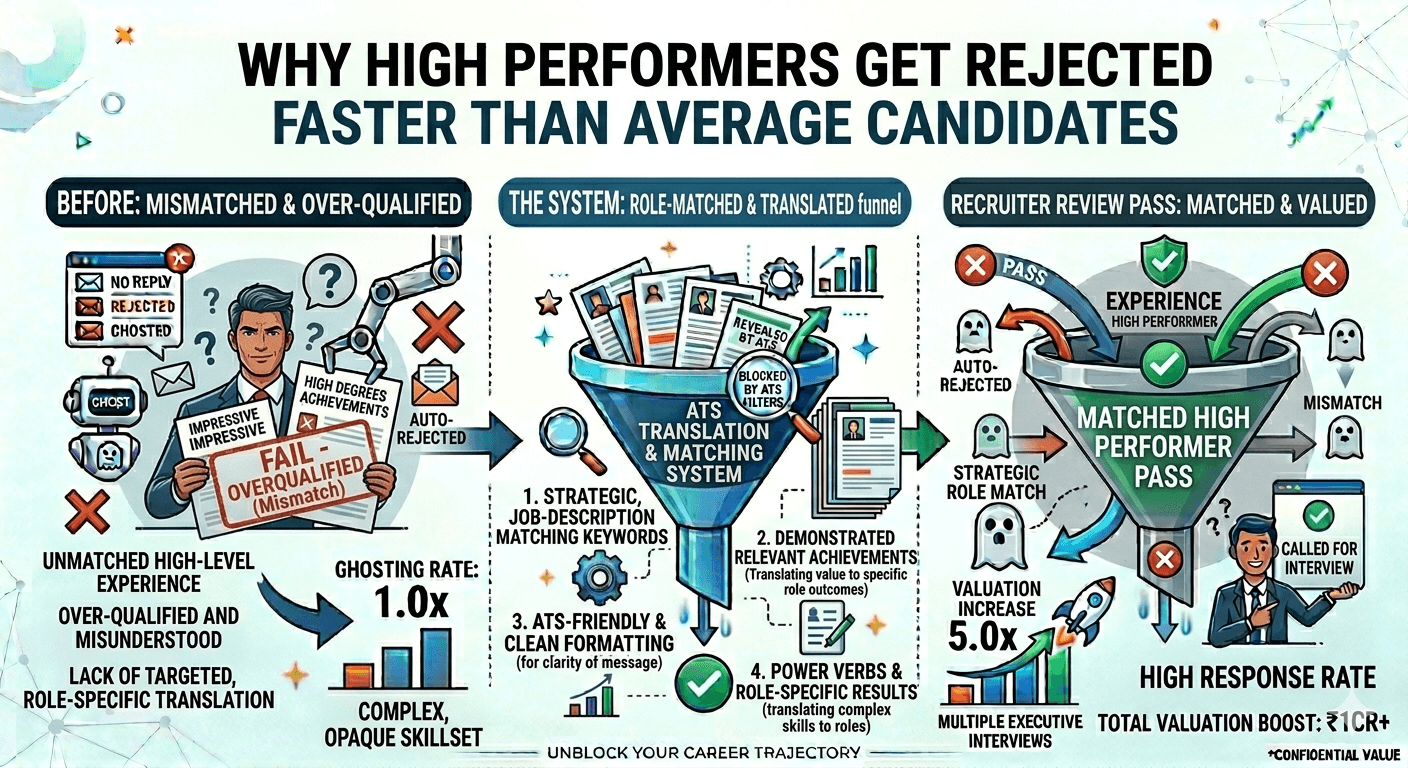
Why High Performers Get Rejected Faster Than Average Candidates
Why High Performers Get Rejected Faster Than Average Candidates
Resume
5 min read
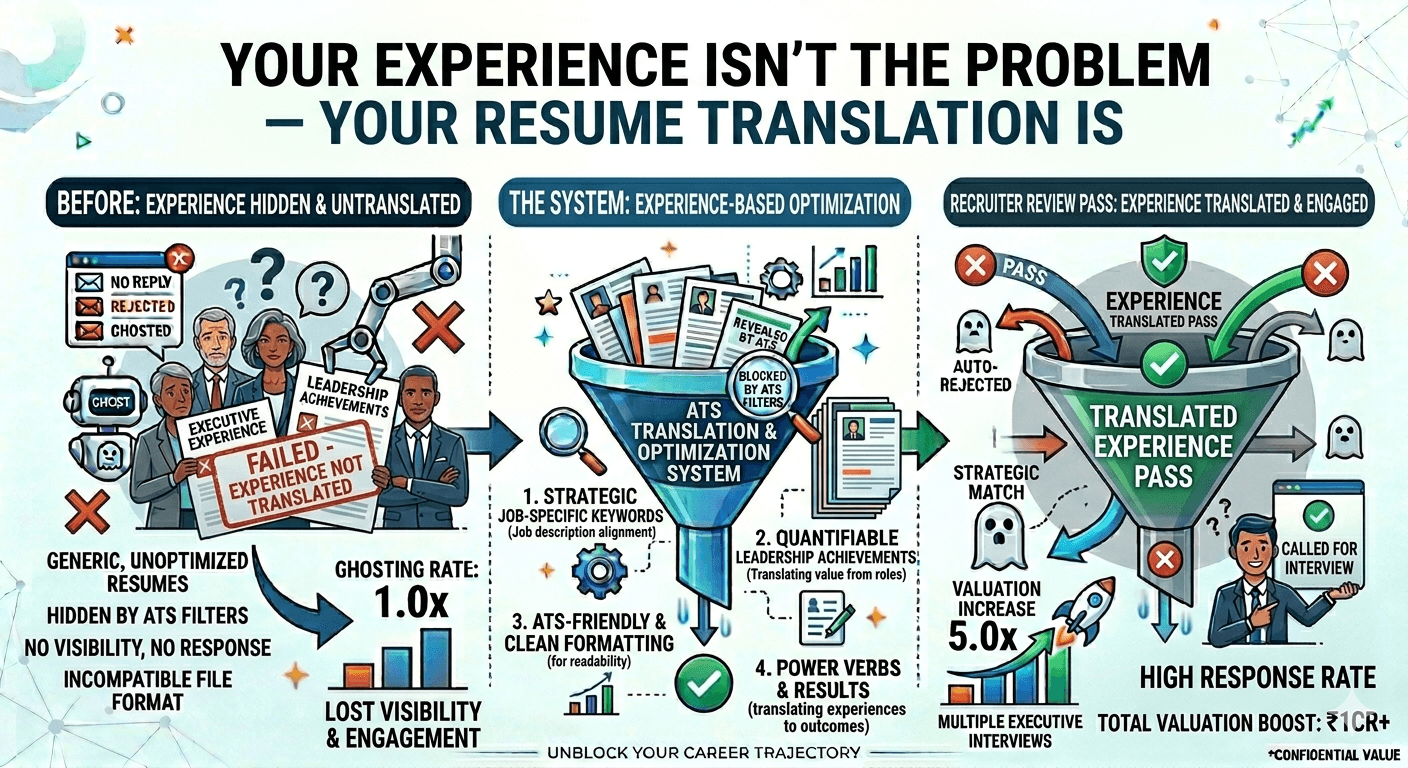
Your Experience Isn’t the Problem, Your Resume Translation Is
Struggling to get interviews despite strong experience? Discover how an ATS Resume Checker reveals hidden resume gaps and helps you translate your experience into results that recruiters actually notice.
Resume
5 min read
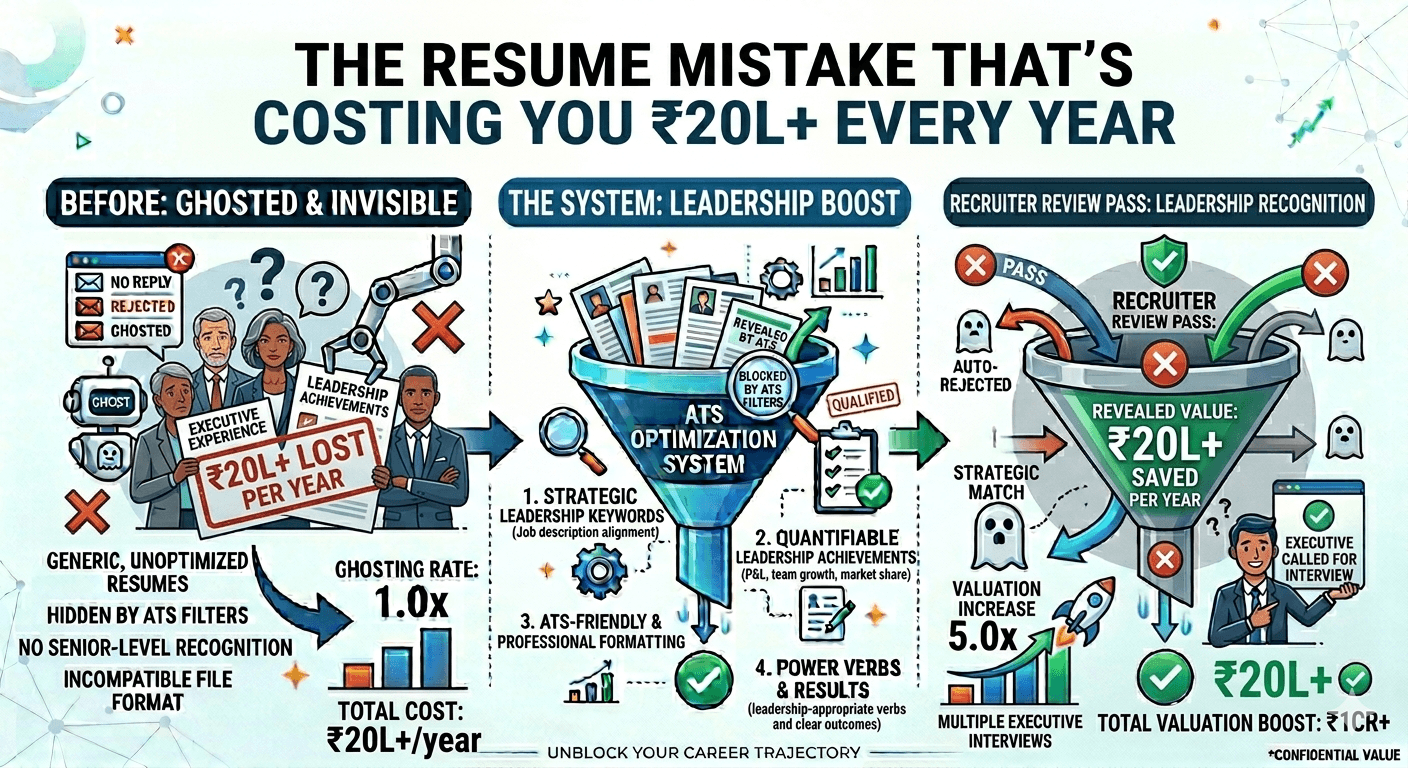
The Resume Mistake That’s Costing You ₹20L+ Every Year
The Resume Mistake That’s Costing You ₹20L+ Every Year
Resume
5 min read
Why High Performers Get Rejected Faster Than Average Candidates
Why High Performers Get Rejected Faster Than Average Candidates
Resume
5 min read
Your Experience Isn’t the Problem, Your Resume Translation Is
Struggling to get interviews despite strong experience? Discover how an ATS Resume Checker reveals hidden resume gaps and helps you translate your experience into results that recruiters actually notice.
Everything you need to know
Here you can find solutions to all your queries.
How do I know if I’m facing career stagnation?
Is staying too long in the same role harmful in India’s job market?
What should I do if my company has limited growth opportunities?
How can mid-senior professionals stay relevant in a fast-changing market?
Can career stagnation be reversed without switching jobs?
Join the Revolution
Your AI career copilot to land you top jobs in under 90 days.
Join the Revolution
Your AI career copilot to land you top jobs in under 90 days.
Join the Revolution
Your AI career copilot to land you top jobs in under 90 days.